Sustainable Retail: Common Questions
Sustainable retail is a loop decision, not a label. Read how circular-economy principles map to product design choices, with claim status explicit.
Retailers often call any recycling initiative sustainable, which hides the choice that actually matters. The circular economy entry describes keeping products and materials in use, and the fast fashion entry describes a model built on short lifecycles and high volume. The real problem is that a product's route through the economy is decided at design time, long before any recycling bin is offered.
Direct answer: A circular economy aims to keep products and materials in use and regenerate natural systems, in contrast to a take-make-dispose model. Fast fashion is a production model built on rapid, high-volume, low-cost clothing with shortened use. The bounded claim: sustainability depends on which loop a product follows, not on the presence of a recycling program.
Delta: This article adds a design-to-loop mapping beyond the sources: it maps each product design choice to a circular loop, with claim status explicit.
The mechanism
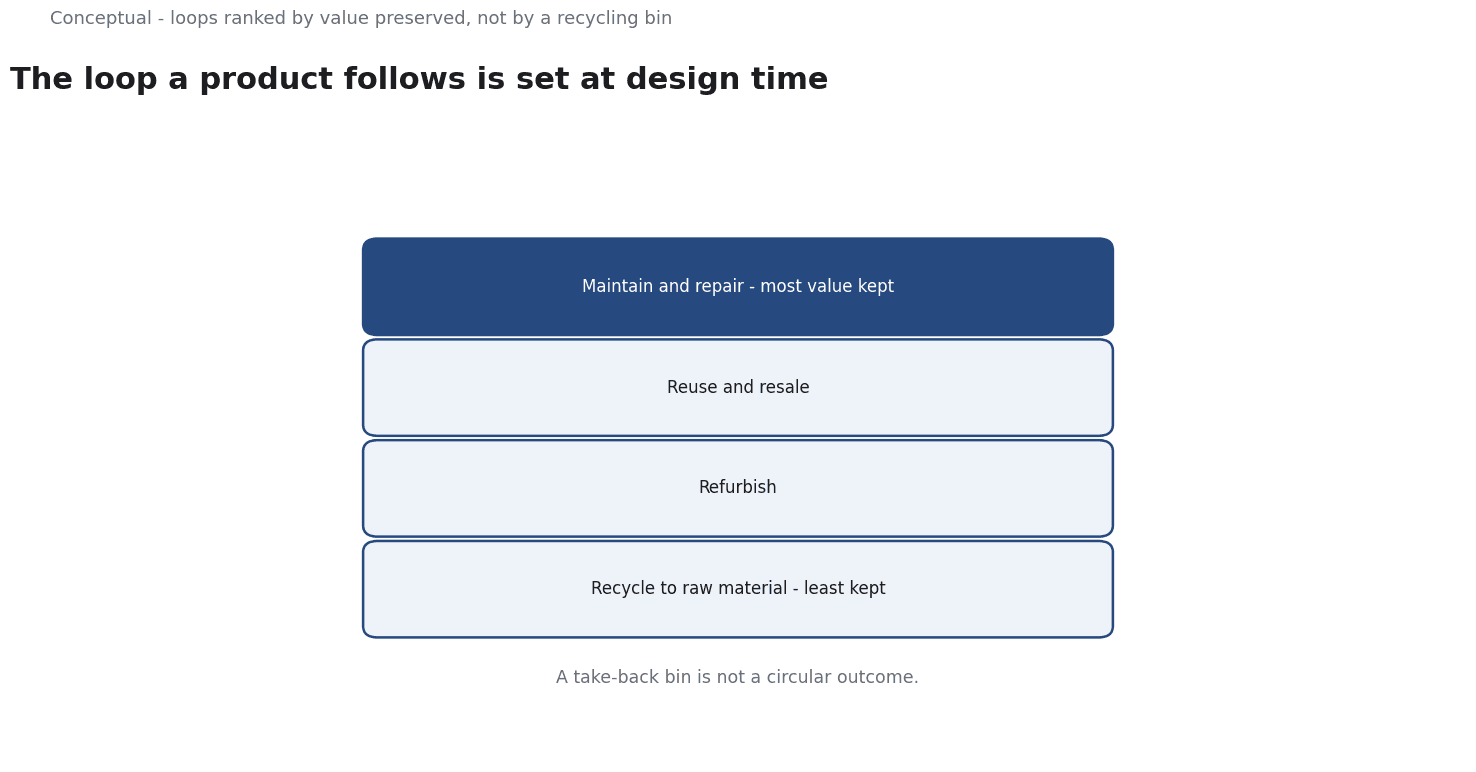
The circular economy entry defines a model of production and consumption built on sharing, leasing, reusing, repairing, refurbishing, and recycling so that materials stay in use as long as possible. It is framed against a linear take-make-dispose model and is commonly summarised by three aims: design out waste and pollution, keep products and materials in use, and regenerate natural systems. The practical consequence is that the loops are ranked by how much value they preserve. Maintaining or repairing a product keeps more of its embedded value than recycling it into raw material.
The fast fashion entry describes a model that compresses production cycles, produces large volumes of trend-driven clothing at low cost, and shortens the time a garment is kept. The entry associates the model with textile waste, water and chemical use, carbon emissions, and labour concerns. The practical consequence is that volume and lifespan are design variables, not afterthoughts. A garment intended for a few wears creates a disposal problem that no downstream recycling scheme can fully undo.
The two sources connect at the design decision. Circular economy supplies a hierarchy of loops; fast fashion shows what happens when the shortest loop is designed out. A company cannot recycle its way out of a product built for a single season.
The loop a product follows is set by durability, repairability, and resale options that are decided before sale.
Which loop is appropriate for a given product is a local judgement, so it must be marked as inferred.
The useful output is a mapping from each product line to its intended loop and the design features that support it. That mapping, rather than a recycling claim, is the decision instrument: it shows where a product is designed for maintenance and resale and where it is designed for disposal. It makes the rationale reviewable, because the loop and the design choice are recorded together. A team that writes the loop down can later explain why a material was chosen or why a repair path exists.
A worked example
The following is hypothetical and illustrative. A retailer considers adding a take-back bin to a low-cost clothing line. Three checks decide whether the move is substantive. First, what loop is the product designed for, and is durability or repairability built in? Second, does a take-back route actually return the garment to reuse or repair, or only to downcycled material? Third, would extending the product's intended lifetime reduce volume more than the bin recovers? The review finds a short-lived garment with no repair path. The team redesigns for durability and adds resale. The outcome is a loop decision, not a label. The details are hypothetical; the method is the contribution.
Evidence status
| Claim | Status | Source | Verified | Recheck when |
|---|---|---|---|---|
| Circular economy aims to keep materials in use | source-reported | Wikipedia, Circular economy | 2026-11-18 | Entry revised |
| Fast fashion shortens product lifecycles and raises volume | source-reported | Wikipedia, Fast fashion | 2026-11-18 | Entry revised |
| The product loop is set by design choices | inferred | Derived from the sources | 2026-11-18 | Product design changes |
The first two rows report the two source descriptions. The third is an inference about where the loop is decided, because neither entry assigns a loop to a specific product. Recheck the source rows when the entries are revised and the inferred row when a product's design changes.
What it cannot do
A circular-economy frame does not prove that a product is sustainable. It establishes a hierarchy of loops and a design relationship, but the environmental outcome depends on scale, consumer behaviour, and the energy used in each loop. Recycling a product with a heavy process can be worse than a lighter linear option. Treating a loop label as proof of lower impact confuses a design intention with a measured result. A team that needs impact assurance must look to lifecycle measurement, not to the label.
The hidden cost is that keeping products in use is slower and more complex than selling new ones. Repair, resale, and take-back require reverse logistics, spare parts, and customer cooperation, all of which a linear model avoids. The bin is the cheap, visible gesture; the loop is the expensive, operational one. That asymmetry is why recycling is over-promoted. The cost is paid in systems that return a product to use rather than to a landfill, and in design choices that reduce volume.
A take-back bin measures that items were gathered, not that they re-entered use. If the collected garments are downcycled or exported as waste, the loop has not closed. Without a recorded destination, the scheme cannot be reviewed. The relevant question is where the product goes after collection and how much value is preserved. A defensible claim states the destination alongside the collection number.
There is a boundary around this method. It covers loop hierarchy and design intent, not verified impact data, cost modelling, or consumer behaviour forecasts. It does not measure carbon, water, or labour outcomes, and it cannot certify a product as sustainable. It also does not replace a lifecycle assessment, which measures impacts the loop label only implies. The method can show which loop a product is designed for; it cannot show that the loop is better in a specific context. That is a narrower contribution than the word sustainable suggests.
Because entries and products evolve, the mapping needs a refresh. Each product line should carry its intended loop and its recheck condition, and the loop choice should be treated as a local decision rather than a value the sources supply. Without that record, a future reviewer cannot tell which loops were deliberate and which were assumed. The products will keep selling; the rationale for their route through the economy is what makes the review possible.
The counterargument that recycling bins are fair as a first step is incomplete when the product is designed for a single season.
A decision test
- Name the product line and its intended use period.
- Identify which circular loop it is designed for.
- Check that durability and repairability support that loop.
- Trace where a returned product actually goes.
- Compare volume reduction against end-of-pipe recovery.
- Record the loop and its recheck condition.
- Verify the claim against measured outcomes where available.
A sustainable-retail practice is useful only when the loop and the design choice are both recorded. The test turns a marketing label into a sequence of decisions with a visible rationale, so a reviewer can see which loop a product follows and when it must be revisited. For further reading, see Decision Memos That Survive Review.
References & Further Reading
- Wikipedia contributors, 2026. Circular economy - Wikipedia — Systems that keep materials in use.
- Wikipedia contributors, 2026. Fast fashion - Wikipedia — The fashion retail model of rapid, low-cost production.