Synthetic Data for Beginners
Synthetic data is generated, not observed. Read where it helps, a worked example, and why it cannot reveal what was never in the original.
Synthetic data is often described as a way to get more data without privacy risk, which overstates it. The synthetic-data entry describes data generated by a model rather than collected, as the data-modeling entry treats structure, as the model-collapse article warns about training on generated data, as Data Quality in Practice treats upstream inputs, as the privacy article makes obligations jurisdiction-specific, as the publication standard forbids guaranteed outcomes.
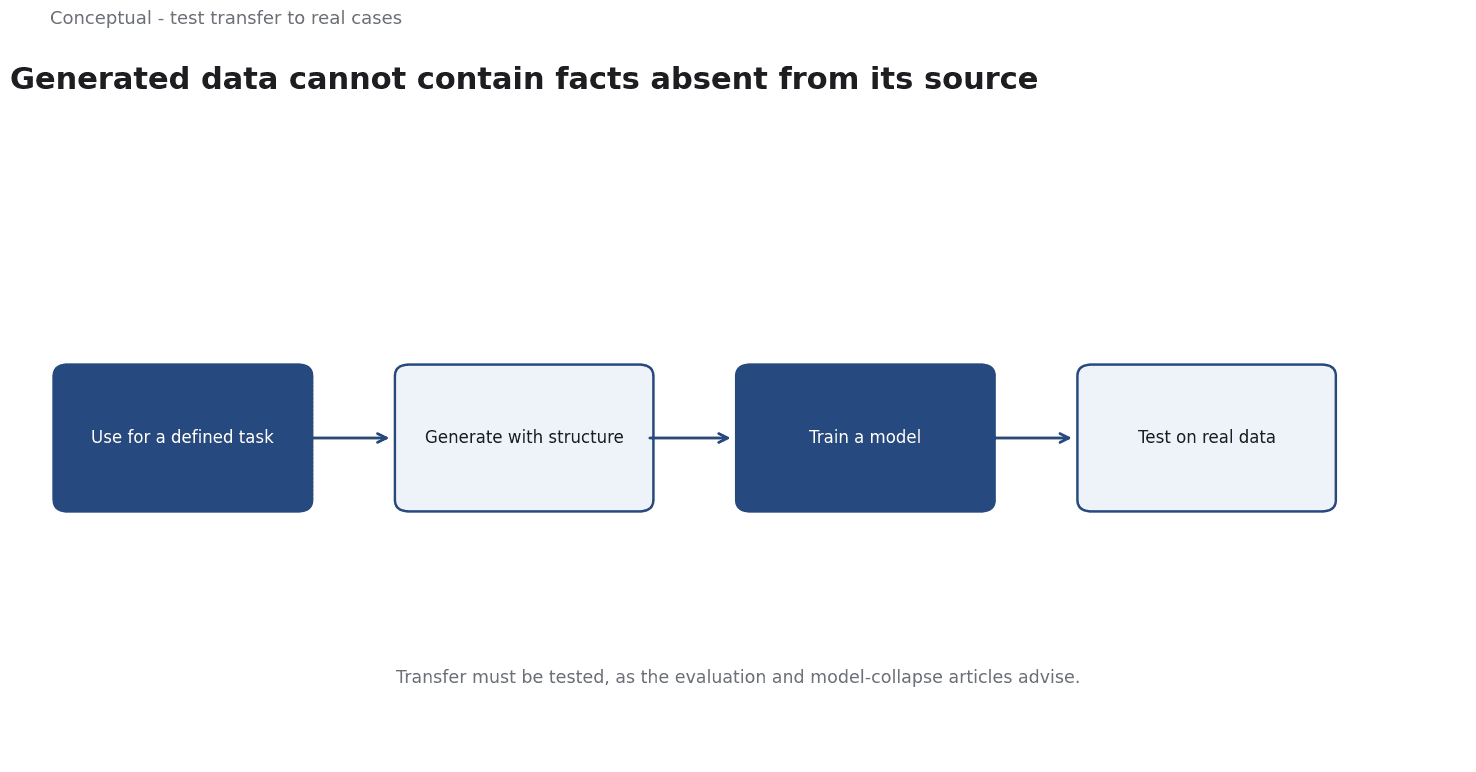
Direct answer: Use synthetic data for a defined task where the real data cannot be shared, then test whether a model trained on it transfers to real cases. Wikipedia's synthetic-data entry provides the definition, and data modeling covers the structure. The boundary: generated data cannot contain facts absent from its source, which the model-collapse article warns, as Synthetic Data for Model Training: Value and Collapse Risk requires residual risk, as the publication standard forbids guaranteed outcomes.
Where it helps
Sharing and testing. When real records cannot be shared, generated records can support development and testing, which the synthetic-data entry describes, as the privacy article makes obligations jurisdiction-specific, as the data-governance article requires provenance, as the decision-memo article requires for a record, as Synthetic Data for Model Training: Value and Collapse Risk requires residual risk.
Rare cases. When real examples are scarce, generated cases can fill a defined gap, which the synthetic-data entry treats, as the data-curation article advises on quality, as the benchmarks article warns about easy cases, as the evaluation-rubric article requires concrete criteria, as the data-governance article requires dated figures, as Synthetic Data for Model Training: Value and Collapse Risk requires residual risk.
Structure and labels. A model can be taught a schema or a format with generated examples, which the data-modeling entry describes, as the structured-output article treats schemas, as the rubric article requires criteria, as the evaluation article requires a test, as the monitoring article advises for review.
Limits of transfer.
Three consequences follow. The task should be defined first, as the rubric article requires, as the decision-memo article requires a question, as the synthetic-data entry describes uses, as the data-governance article requires provenance, as the privacy article requires a dated check, as the data-curation article advises quality, as the benchmarks article warns, as the evaluation article requires a test, as the monitoring article advises for review, as the model-collapse article warns about generated training, as Data Quality in Practice treats upstream inputs, as Synthetic Data for Model Training: Value and Collapse Risk requires residual risk.
A worked example
The following is hypothetical and illustrative. A team wants to share a dataset for development but cannot expose real customer records.
Three checks decide. First, what task requires the data, as the rubric and decision-memo articles require, with a clear question, as the synthetic-data entry describes? Second, does a model trained on generated records work on a held-out real sample, as the evaluation and benchmarks articles advise, with a criterion, as the rubric article requires? Third, is the sharing permitted, as the privacy article requires, with a dated check, as the legal article advises, as the data-governance article requires provenance, as Synthetic Data for Model Training: Value and Collapse Risk requires residual risk?
Three conclusions follow. Generated data supports development, which the checks show.
Transfer must be tested, as the evaluation and model-collapse articles advise.
And the decision should be recorded with residual risk, as the decision-memo and risk articles require.
What synthetic data cannot do
It cannot reveal facts absent from its source, which the model-collapse article warns, as Data Quality in Practice treats upstream inputs, as the publication standard forbids guaranteed outcomes, as Synthetic Data for Model Training: Value and Collapse Risk requires residual risk. It does not remove privacy obligations, which the privacy article makes jurisdiction-specific, as the legal article requires a dated check, as the data-governance article requires provenance, as the governance checklist requires an owner. And it cannot guarantee model performance, which the benchmarks article warns about, as the evaluation-rubric article requires criteria, as the monitoring article advises for review, as the decision-memo article requires a record.
The counterargument that generated data removes all risk is fair for some sharing scenarios and incomplete when the data is used for training, which the worked example shows, as the model-collapse and evaluation articles advise, as Synthetic Data for Model Training: Value and Collapse Risk requires residual risk.
A decision test
- Define the task, as the rubric article requires.
- Check provenance, as data governance requires.
- Test transfer on real cases, as the evaluation article advises.
- Check privacy obligations, as the privacy article requires.
- Avoid uncontrolled generated training, as the model-collapse article warns.
- Use dated figures, as data governance requires.
- Record the decision and residual risk, as the decision-memo and risk articles require.
For the risk, see Synthetic Data for Model Training; for the inputs, see Data Quality.
References & Further Reading
- Wikipedia contributors, 2026. Synthetic data - Wikipedia — Artificially generated data and its limits.
- Wikipedia contributors, 2026. Data modeling - Wikipedia — The structure and purpose of data models.