Sustainable Retail Trade-Offs
Sustainable retail is a set of trade-offs, not a label. Learn how circular-economy and fast-fashion ideas map to design decisions, with a worked comparison and limits.
Retailers often present sustainability as a single attribute that a product either has or lacks. The circular economy entry describes systems that keep materials in use, while the fast fashion entry describes a model built on rapid turnover and low cost. The real problem is that these are competing operating logics, and a claim of sustainability hides which trade-off was actually chosen.
Direct answer: Sustainable retail trade-offs are decisions between keeping products and materials in use and the speed and cost that quick turnover provides. Circular economy describes the first logic; fast fashion describes the second. Neither source ranks them, so the decision depends on which costs the business is willing to internalise.
Delta: This article adds a logic-to-decision map beyond the sources: it maps each operating logic to the inventory and design decision it implies, with claim status explicit.
The mechanism
The circular economy entry describes an economic system aimed at eliminating waste and keeping products and materials in use. Its principles include designing out waste and pollution, retaining the value of products and materials, and regenerating natural systems. Practices associated with it include reuse, repair, remanufacturing, and recycling. The practical consequence is that design decisions move upstream: a product built for repair or for a second life creates obligations that a disposable product avoids. Logistics also change, because keeping materials in circulation requires channels to collect and return them.
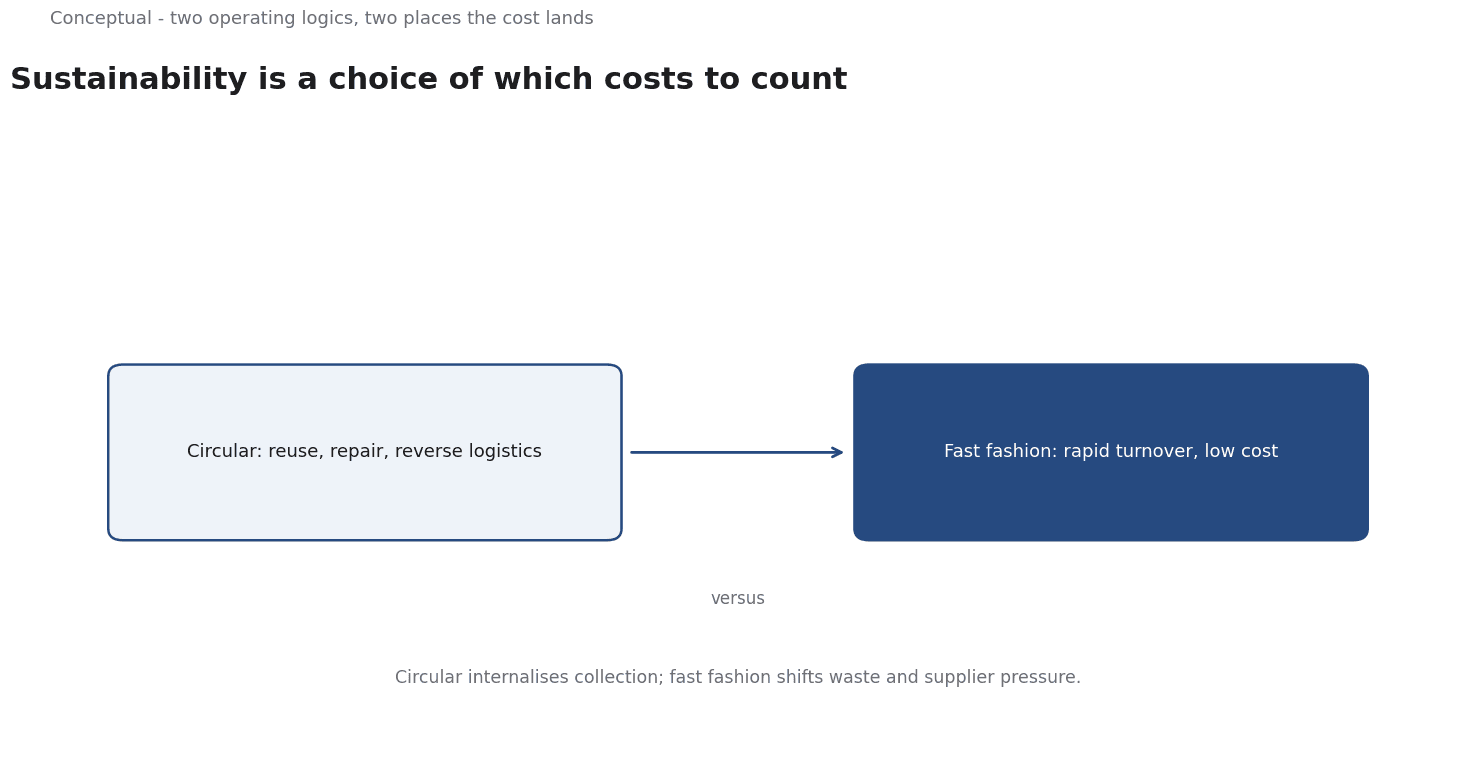
The fast fashion entry describes a business model of replicating current trends, mass-producing them at low cost, and moving through short product life cycles. The entry also records criticism of the model, including environmental impact, waste, and pressure on labour. The practical consequence is that speed and price drive the operating decisions: assortment changes quickly, volumes are large, and the supply chain is tuned for cost. Those choices are coherent within the model even when they conflict with the circular principles above.
The two sources describe models rather than outcomes, and neither supplies a ranking. The connection they make possible is a trade-off map: each logic implies a set of design and inventory decisions, and those decisions shift costs to different places. Circular design tends to internalise the cost of collecting and processing materials; the fast model tends to leave waste and supplier pressure outside the visible price. The choice between them is a local decision about which costs to count, not a fact the sources deliver.
The output is a mapping from each design choice to the logic it serves and the cost it shifts. That mapping is the decision instrument: it lets a reviewer see whether a sustainability claim refers to an actual operating decision or only to a label attached to a product.
A worked example
The following is hypothetical and illustrative. A retailer compares a take-back programme for jackets with a cheaper disposable line. Three checks decide the comparison. First, does each option keep materials in use beyond a single sale? Second, where does each option place its cost: in the purchase price or in reverse logistics the retailer must fund? Third, what happens to the material at the end of its life under each option? The review finds that take-back raises unit cost but keeps garments in use, while the cheaper line lowers price and shifts waste downstream. The outcome is a documented choice to fund collection, with the added cost stated rather than hidden. The numbers are hypothetical; the verification method is the contribution.
Evidence status
| Claim | Status | Source | Verified | Recheck when |
|---|---|---|---|---|
| Circular economy aims to keep materials in use and eliminate waste | source-reported | Wikipedia, Circular economy | 2026-11-18 | Entry revised |
| Fast fashion emphasises rapid turnover and low cost | source-reported | Wikipedia, Fast fashion | 2026-11-18 | Entry revised |
| Rank the two logics only against an explicit local cost boundary | inferred | Derived from the sources | 2026-11-18 | Cost structure changes |
The first two rows restate the two source descriptions: a circular system that keeps materials in use and a fast-fashion model built on speed. The third is inferred because neither source ranks the logics or sets a cost boundary. Recheck the first two rows when the entries are revised and the inferred row when the retailer's cost structure changes.
What it cannot do
A trade-off map does not certify that a product is sustainable. It compares two operating logics against stated costs; it does not measure environmental impact or verify a supply chain. The circular economy entry describes principles and the fast fashion entry describes a business model, but neither provides an accounting method. A retailer cannot conclude from this comparison that one line is green and the other is not. The map identifies which costs were shifted, not whether the outcome is good in absolute terms. An absolute claim needs measurement the sources do not supply.
The hidden cost of the circular logic is reverse logistics. Taking products back, repairing them, and returning materials to use require collection, sorting, and processing that a linear or fast-turnover model avoids. These costs are real and recurring, and they often appear in a different budget from the savings they generate. The fast logic, by contrast, hides its cost in waste and in pressure on suppliers, which may not appear in the purchase price. A comparison that counts only visible costs will favour whichever option hides more of its burden, which is a reason to state the boundary explicitly.
A product described as circular may still be over-produced, and a low price may still depend on conditions the retailer never inspects. Because the sources describe models rather than outcomes, the map cannot detect greenwashing. The defence is to attach each claim to a specific operation: what is reused, what is repaired, and where the waste goes. Without that attachment, a sustainability claim is a story rather than a decision that can be audited later.
The scope is limited to the two logics in the sources. It does not cover labour standards, specific regulations, carbon accounting, or consumer behaviour, all of which affect a retail decision but sit outside these entries. It does not rank the logics, because the sources do not. It is a structuring device for a local choice, not a sustainability standard. Any claim beyond mapping costs to operations needs a different source and a different method, including specialist review where the stakes warrant it.
Both entries evolve as the underlying fields change, so each mapped decision needs a recheck condition. A change in material costs or in how waste is handled can reverse a comparison that once favoured one logic. A review should record which logic was chosen, which costs were counted, and which were excluded. Without that record, a future reviewer cannot tell whether a trade-off was deliberate or simply the cheapest option at the time.
The counterargument that fast turnover is fair for affordability is incomplete when the cost of waste and supplier pressure falls outside the price.
A decision test
- Name the product decision to be made.
- Identify which operating logic each option follows.
- List the costs each option makes visible.
- List the costs each option shifts elsewhere.
- State the boundary of costs the business will count.
- Choose the option consistent with that boundary.
- Record the choice and a recheck condition.
A sustainability trade-off is defensible when the costs counted and the costs shifted are both on the record.
The test turns a marketing label into a comparison between two logics with explicit boundaries, so a reviewer can see what the choice saves and what it exports. For further reading, see Marketing Dashboards.
References & Further Reading
- Wikipedia contributors, 2026. Circular economy - Wikipedia — Systems that keep materials in use.
- Wikipedia contributors, 2026. Fast fashion - Wikipedia — The fashion retail model of rapid, low-cost production.