Systemic Risk at Scale
How interconnected failures become system-wide crises, with a worked containment example, an evidence table, and the limits of crisis planning.
Risk registers usually list failures one at a time. Systemic risk is different: the danger comes from connections between parts, so a local failure can propagate into a system-wide event. The Wikipedia entries on systemic risk and crisis management describe the failure mechanism and the response process, but neither tells a manager which containment decision to make when a shock actually arrives.
Direct answer: Systemic risk is the possibility that a failure in one part of an interconnected system triggers cascading losses across the whole. Crisis management is the organised response to such disruptive events, spanning preparation, response, and recovery. The decision-relevant question is where a shock sits in that sequence, because the right action differs by phase.
Delta: This article adds a decision-facing map beyond the sources: it maps a cascading failure to a crisis-management phase, with claim status explicit.
The mechanism
The systemic risk entry describes a risk that is system-wide rather than local. The concern is not that one institution fails, but that its failure transmits to others through linkages. Interconnection is the mechanism. When institutions share exposures, funding sources, or settlement paths, a shock to one node can propagate to its counterparties, which then propagate it further. The result is a cascade that no single failure would produce on its own.
The practical consequence is that assessing a single position in isolation misses the risk that matters, because the danger lives in the links rather than the nodes.
A portfolio of individually sound positions can still be fragile if they all depend on the same hidden pathway.
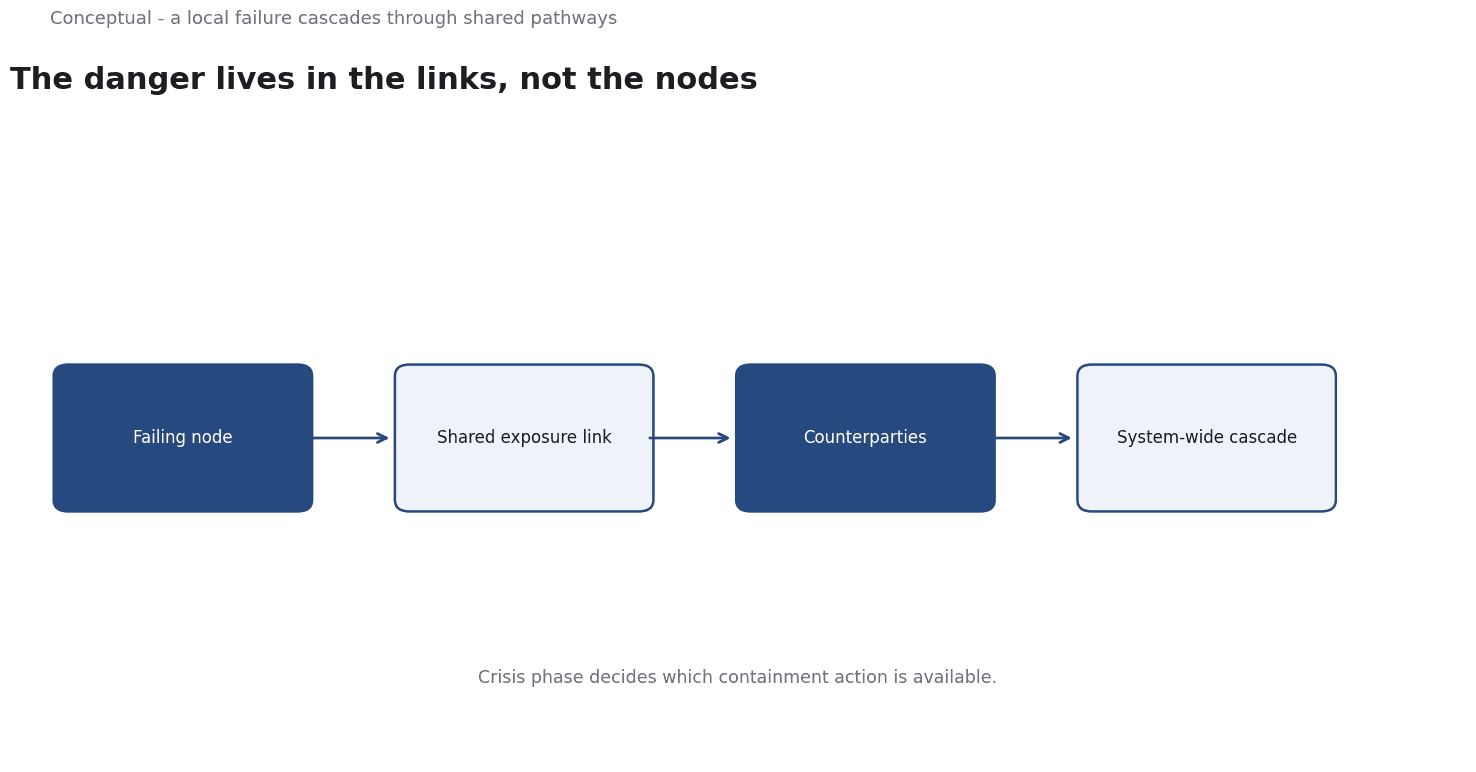
The crisis management entry describes what an organisation does when a disruptive event occurs. It frames the work as a sequence: preparation before an event, response during it, and recovery afterwards. Preparation includes planning and building capacity; response is the immediate effort to contain harm; recovery restores operations and learns from the event. The practical consequence is timing. The same shock calls for different actions depending on which phase the organisation is in, so recognising the phase is a prerequisite for choosing a response. A team still in preparation can invest in redundancy; a team already in response must contain harm with the capacity it has.
Putting the two together gives a way to read an unfolding event. The systemic risk description explains how a local failure becomes a system problem; the crisis management description explains how an organisation moves from preparation through response to recovery. The synthesis is to ask two questions at once: how far has the failure propagated through the links, and which phase of response is active. Mapping a failure to a phase is a judgement about how to use the two descriptions, not something either source states directly, and it is marked inferred below. Keeping that mark visible is what stops a practical reading method from being reported as a finding of either entry.
A worked example
The following is hypothetical and illustrative. A payments provider learns that one clearing partner has suspended settlement. The first check is propagation: does the failure touch other partners through shared settlement paths, or is it isolated to a single route? The second check is phase: is the organisation still preparing, already responding, or moving into recovery? The third check is containment: which action available in the current phase limits further transmission, such as rerouting volume, pausing exposed flows, or drawing on pre-arranged liquidity? The outcome is a decision to shift volume to a second partner while monitoring for spread, with the incident logged for the recovery phase so the dependency can be redesigned. The scenario is invented; the cascade idea and the phase sequence come from the sources.
Evidence status
| Claim | Status | Source | Verified | Recheck when |
|---|---|---|---|---|
| Systemic risk arises when failure in one part cascades through interconnected parts | source-reported | Systemic risk (Wikipedia) | 2026-11-18 | Updated definitions or new systemic events |
| Crisis management covers preparation, response, and recovery phases | source-reported | Crisis management (Wikipedia) | 2026-11-18 | Revised crisis frameworks published |
| Mapping a specific failure to a crisis phase informs the containment decision | inferred | Derived from the sources | 2026-11-18 | Dependencies or network structure change |
The first two rows are claims the sources make. The third is a practical reading method, not a finding of either entry, so it is marked inferred. Its usefulness depends on the actual dependency map of the organisation, and it should be rechecked when those links change even if the sources stay the same. The table exists to keep that dependence visible between reviews.
What it cannot do
A conceptual description of systemic risk cannot quantify the probability or timing of a cascade. The entry explains that interconnection transmits failure, but it does not supply thresholds, correlations, or a model that says when a given shock will spread. A manager who expects a number to act on will not find one here. The concept tells you what to look for, not how large the exposure is or how fast it will move. That gap matters because containment decisions are time-sensitive, and a qualitative warning does not tell you when the window for action closes.
A crisis plan can create an illusion of readiness. Having a documented sequence for preparation, response, and recovery is useful, but the plan does not supply the real-time information needed to execute it during a fast-moving cascade. Plans also go stale: the contacts, authorities, and redundancies they assume may no longer exist when an event occurs. The hidden cost is that the existence of a plan can suppress the question of whether the organisation can actually perform the response, turning a document into a comfort rather than a capability.
A plan is a starting point for practice, not evidence that practice happened.
A common failure mode is misreading the phase.
Preparing only for the last crisis is another version of the same error: the plan fits the previous shock, not the one unfolding. Because the systemic risk entry emphasises novel cascades through changing links, a plan built around a familiar scenario may be precisely the wrong tool for the next event.
The boundary is between general mechanism and local dependency. The sources describe how cascades and crisis phases work in general; they say nothing about a specific institution's counterparties, settlement paths, or concentrations. Mapping a failure to a phase therefore requires local knowledge the sources cannot provide. Without an accurate picture of the actual links, the two descriptions remain abstract and the containment decision stays uninformed. The synthesis is only as good as the dependency map fed into it.
That map needs a date and an owner. Interconnections shift as partners are added, contracts change, and systems are integrated, so a dependency picture that was accurate last quarter may be misleading today. The sources provide the mechanism and the sequence, but not a schedule for review. Setting one locally is what keeps a systemic-risk view tied to the organisation it is meant to protect rather than to a structure that no longer exists.
Counterargument: "The counterargument that systemic-risk language is too abstract to guide action is fair for ordinary, local failures with clear owners and incomplete where failures propagate through links no single team can see on its own."
A decision test
- Identify the failing node and list the links that could carry the shock outward.
- Determine how far propagation has already reached through those links.
- Name the current crisis phase: preparation, response, or recovery.
- Match the available containment actions to that phase.
- Choose the action that limits further transmission first.
- Record the incident for the recovery phase and dependency redesign.
- Assign an owner and a review date to the dependency map.
The test turns two general descriptions into a usable reading of an unfolding event. Each step asks for a specific observation rather than a judgement in the abstract, and the final steps make sure the map stays current. A cascade mapped this way is not thereby controlled; it is at least being seen in terms of the links and the phase that determine which actions are available.
For further reading, see Cash Flow Forecasting: A 13-Week Operating Model.
References & Further Reading
- Wikipedia contributors, 2026. Systemic risk - Wikipedia — Risk of collapse of an entire system or market.
- Wikipedia contributors, 2026. Crisis management - Wikipedia — The phases of preparation, response and recovery in crisis management.