Tax-Efficient Investing Basics
Tax treatment changes the return you keep. Read the mechanisms, a worked example, and why the rules must be checked locally.
An investment return before tax is not the return available to spend. Two portfolios with identical gross returns can produce different outcomes because of when and how they are taxed. Tax efficiency is the practice of reducing that drag without changing the underlying investment risk.
Direct answer:
Tax efficiency works through account structure, holding period, and the timing of realised gains.
Investor.gov's education states that returns are not guaranteed and that risk applies to all investments; the specific rules are jurisdiction-dependent and must be checked currently. The boundary: this is general education, not tax advice — thresholds, allowances, and account types vary by country and change with policy.
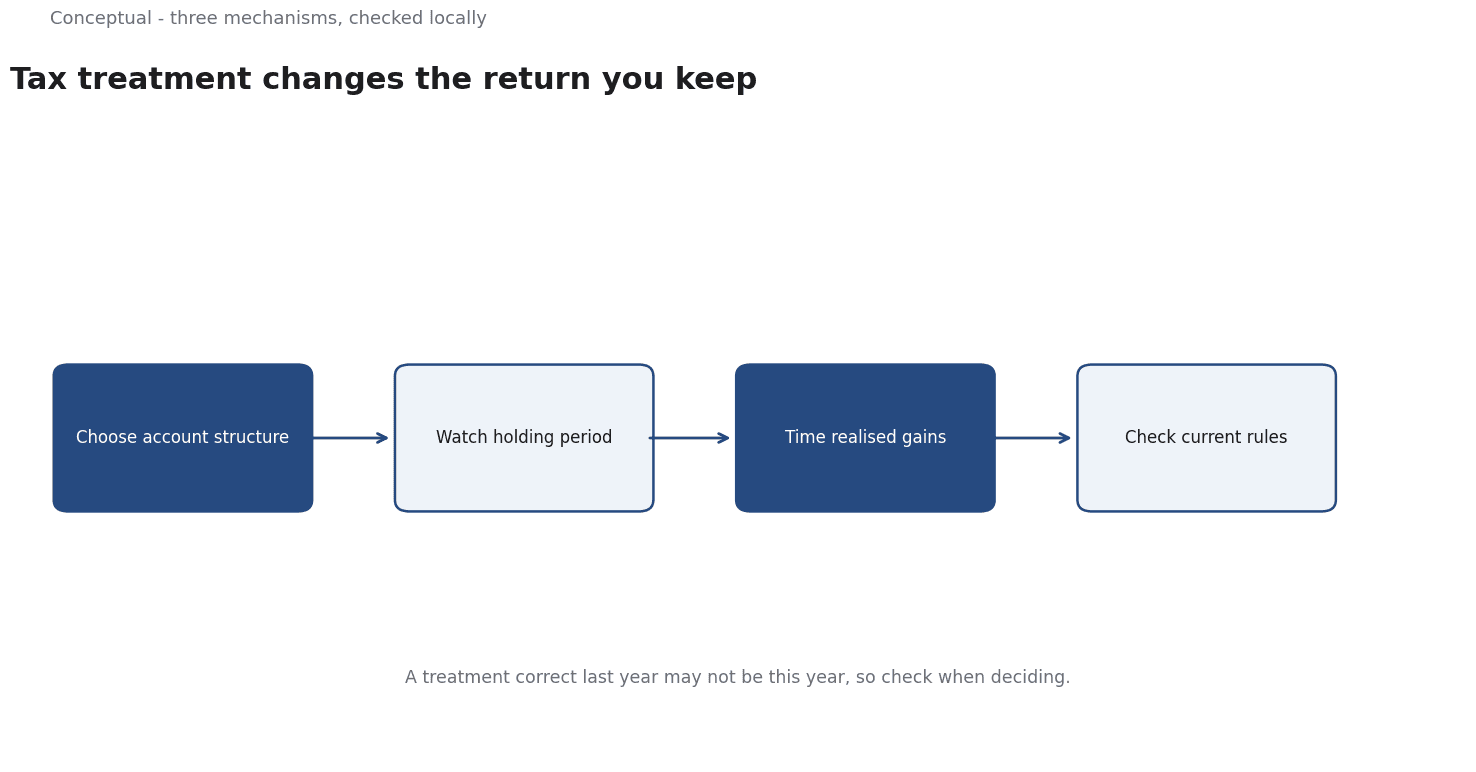
Three mechanisms
Account structure. Some accounts defer or exempt tax on Dividends, interest, or capital gains. The names and rules differ by country, so the first step is to identify which structures are available where you live.
Holding period. In many systems, the tax treatment of a capital gain depends on how long the asset was held. A short-term gain may be taxed as income while a long-term gain receives a lower rate. Check the current rule rather than relying on a remembered threshold.
Realisation timing. Tax is often due when a gain is realised, not when it accrues. An investor who sells frequently may create tax liabilities that a buy-and-hold investor avoids, even with identical gross returns.
A fourth consideration is asset location: holding tax-inefficient assets, such as interest-bearing instruments, in a tax-advantaged account where possible, and more tax-efficient holdings elsewhere. The details depend on the jurisdiction's rules.
A worked example of the drag
The following numbers are hypothetical and illustrative.
A portfolio earns a 7% gross return a year for 20 years on an initial 50,000.
- No tax drag: 50,000 × 1.07^20 ≈ 193,000.
- 1% annual drag from tax on distributions and turnover: 50,000 × 1.06^20 ≈ 160,000.
A one-point annual difference reduces the ending value by about 33,000 — roughly 17%. Three readings follow:
- The drag compounds. It is not 1% of the final value; it is a lower growth rate applied to every year.
- The mechanism matters. The 1% could arise from tax on dividends, from realised gains caused by frequent trading, or from fees. Identifying the source decides whether the fix is an account change, a holding-period change, or a cost reduction.
- The example is nominal. Inflation and the tax treatment of the ending balance are separate adjustments. The real-interest-rates article covers the first.
What to check in your jurisdiction
Four questions cover most of the ground:
- Which accounts offer tax deferral or exemption, and what are the contribution limits?
- How are dividends and interest treated compared with capital gains?
- Does the holding period change the rate?
- Are there rules on losses, carry-forwards, or transfers between accounts?
The answers are not portable. A structure that is tax-efficient in one country may be neutral or disadvantageous in another, and thresholds change with policy. FRED and official tax authorities provide current data and rules; an article written in a different jurisdiction should not be treated as a plan.
Records and review
Tax efficiency depends on details that are easy to lose — purchase dates, cost bases, and the treatment of distributions. Three habits keep the position defensible:
Keep a transaction record. A date and a cost basis for each lot make it possible to choose which shares to sell and to support the treatment if it is questioned. Reconstructing that history years later is difficult and often inaccurate.
Review the structure after a change. A new job, a move, a change in income, or a policy change can alter which accounts and treatments are best. A structure chosen once and never reviewed becomes a habit rather than a decision.
Check the rule at the time of action. Thresholds and allowances change.
An official tax authority's current guidance is the source for the rule. General articles, including this one, explain the mechanism and cannot substitute for the current text.
What tax efficiency cannot do
It cannot make a bad investment good. Reducing tax on a poor return still leaves a poor return.
Reducing tax on a poor return still leaves a poor return.
Investment selection and diversification come first.
It cannot remove all tax. It changes timing and treatment, not the existence of the obligation.
It cannot be static. A change in income, jurisdiction, or policy changes the optimal structure. Review on change, and keep records that make the treatment auditable.
The counterargument — that chasing tax efficiency adds complexity — is fair when the amounts are small. The response is proportionality: start with the strongest available account structure and the simplest holding approach, then add complexity only when the measured drag justifies it.
A decision test
- Identify the accounts available in your jurisdiction and their current rules.
- Check the treatment of dividends, interest, and realised gains.
- Estimate the annual drag from tax and fees on your actual return.
- Consider holding period before selling.
- Place tax-inefficient assets in tax-advantaged accounts where allowed.
- Keep records sufficient to support the treatment.
- Review on change in income, jurisdiction, or policy.
For the account context, see Personal Finance for Professionals; for the compounding effect of costs, see Compound Interest Examples.
References & Further Reading
- U.S. Securities and Exchange Commission (Investor.gov), 2026. Introduction to Investing — Primary regulator guidance on market mechanics and investor protection.
- Federal Reserve Bank of St. Louis, 2026. FRED economic data — The primary time-series database used for macro indicators.