The Anatomy of a Successful Digital Business
A digital business is a system for creating, delivering, and capturing value. Read the mechanism, a unit-economics worked example, and why success stories mislead.
Digital businesses are often described by their surface features — an app, a subscription, a marketplace. Those features do not explain why one succeeds and another fails. The useful description is structural: what value is created, how it reaches customers, and how a share of it is captured sustainably.
Direct answer: Michael Porter's What Is Strategy? warns that "operational effectiveness is not strategy" and that a company must choose a distinctive position supported by a fit of activities. For a digital business, this means the acquisition channel, product, delivery mechanism, and monetisation must reinforce one another. The boundary: a coherent structure is necessary but not sufficient, and a single successful company is a case study, not proof that the structure generalises.
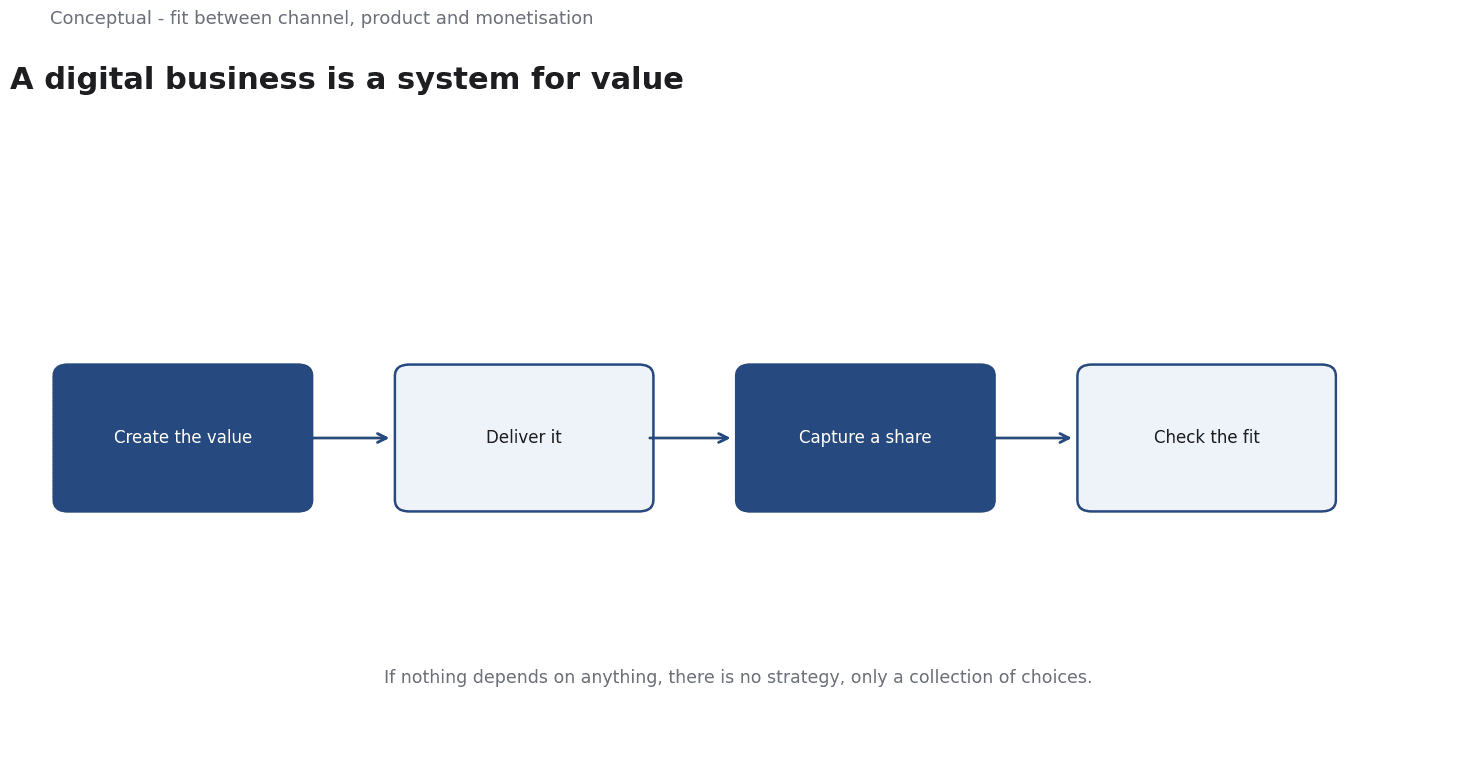
The three questions
What value is created? This is not a feature list. It is the problem solved for a specific customer, and the reason they would switch from their current alternative. A product that is merely better on a specification may not be better in the customer's workflow.
How is it delivered? Digital delivery has distinctive economics: near-zero marginal cost for software, but real costs for support, infrastructure, trust, and compliance. A business that ignores the second set will overstate its margins.
How is value captured? Subscription, transaction fee, advertising, and licensing are different mechanisms with different incentive structures. An advertising-funded product optimises for attention; a subscription product optimises for retention. Those are not the same business wearing different logos.
Porter's point about fit matters here. A company that chooses a premium positioning but acquires customers through discount comparisons has activities that work against each other.
The test of fit is whether a change in one part of the system would require changes in the others — if nothing depends on anything, there is no strategy, only a collection of choices.
A worked example of unit economics
The following numbers are hypothetical and illustrative.
Suppose a digital service charges 100 per year. Its variable costs are 20 per customer per year for infrastructure and support. Customer acquisition cost (CAC) is 300, and average customer lifetime is three years.
- Contribution per customer per year: 100 − 20 = 80.
- Lifetime contribution: 3 × 80 = 240.
- Lifetime contribution minus CAC: 240 − 300 = −60.
The business loses money on each customer, however fast it grows. Three levers change this:
- Reduce CAC to 200. Lifetime contribution of 240 now yields +40 per customer. The business needs a channel with better targeting or stronger word of mouth.
- Extend lifetime to four years. 4 × 80 = 320, giving +20 over CAC. Retention work can be as valuable as acquisition work.
- Raise price to 130. Contribution becomes 110 per year, 330 over three years, giving +30 — if customers accept the price and it does not reduce retention.
The sensitivity is the lesson. A 33% cut in acquisition cost and a 33% increase in lifetime have different effects, and neither is as powerful as the one that attacks the actual constraint.
Two cautions:
- CAC must include the full cost of sales and marketing, not just the ad bill, and it must use the same period as the revenue.
- Lifetime is an estimate, sensitive to churn assumptions and to changes in the product. Treat it as a range.
What digital distribution does and does not change
Digital delivery changes four things:
Marginal cost falls. Serving one more software customer is cheap, which makes scale valuable. It also makes a bad decision cheap to replicate, so growth can amplify a flawed model quickly.
Distribution is measurable. Funnels can be instrumented, which enables the decomposition described earlier. Measurement is not the same as causal understanding, and platform-reported attribution should not be treated as lift.
Network effects are possible. A product can become more valuable as more people use it. This is powerful and rare; assuming it exists without evidence is a common planning error.
Switching costs are low. In many digital products, a customer can leave with a click. That makes retention a product problem rather than a contracting problem.
The counterargument to elaborate unit economics — that some businesses deliberately lose money per customer to build a network — is legitimate. It requires evidence that the network effect is real, that the losses are bounded, and that a path to capture exists. Without those, "we are investing in growth" is a description of the loss, not a strategy.
Cash timing is part of the structure
A profitable unit can still bankrupt a company, because accounting profit and cash timing are different. The unit-economics example earlier showed a +40 contribution per customer after reducing CAC — but that contribution arrives over three years while the 200 CAC is paid at the start.
Suppose the business acquires 1,000 customers in a month. It spends 200,000 in acquisition immediately and receives 16 per customer per month in contribution — 16,000 a month. The cash recovered in the first month is 8% of the spend. Even with a healthy lifetime contribution, the company must finance the gap for roughly two years.
Three structural choices determine whether it can:
- Upfront payment. An annual plan collected in advance converts a three-year stream into immediate cash. It changes the financing problem without changing the product.
- Retention. Faster churn lengthens the payback period, which increases the working capital required. Retention is a cash-flow lever as much as a growth lever.
- Channel mix. A cheaper channel shortens payback; a slower one may improve it even at the same cost because revenue begins sooner.
This is why the anatomy of a digital business is not complete without a cash-flow view. A structure that looks sound in lifetime economics can be impossible to finance, and a structure with modest unit economics can work if customers pay early.
Why success stories mislead
Three biases distort the lessons drawn from prominent digital businesses.
Survivorship. The cases that are written up are the winners. The companies with the same structure that failed are absent, so the structure looks more predictive than it is.
Hindsight. Once a company is large, its early choices are narrated as a coherent plan. At the time they were often experiments, and some succeeded for reasons the narrative omits.
Context. A tactic that worked during a period of cheap capital and low competition may fail under different conditions. Amazon's company news, for example, is primary material for what Amazon says about itself; it is not a transferable recipe for a startup in 2026.
Porter's framework is useful precisely because it asks about fit rather than copying a visible practice.
A company's pricing page is easy to copy; the system of activities that makes that pricing viable is not.
A decision test
- Name the customer and the alternative they would otherwise use.
- State how value is captured and what behaviour that mechanism rewards.
- Check the fit between positioning, acquisition, product, and delivery.
- Compute unit economics with full CAC and a realistic lifetime range.
- Rank the levers by sensitivity before choosing where to work.
- Demand evidence for claimed network effects.
- Treat a success story as a hypothesis to test in your context, not a template.
For the strategic foundation, see Business Model Canvas; for the distinction from product work, see The Difference Between Building a Product and Building a Business.
References & Further Reading
- Colin Bryar and Bill Carr, 2019. Amazon Company News — Primary company material on how the working-backwards method is applied.
- Michael E. Porter, 1996. What Is Strategy? — The differentiation-versus-cost argument behind competitive-advantage analysis.