The Difference Between Building a Product and Building a Business
A good product can fail as a business. Read the distinction, a worked LTV/CAC example, and why product excellence is necessary but not sufficient.
Teams often treat product quality and business viability as the same goal viewed from different angles. They are not. A product can be delightful, technically excellent, and used regularly while the organisation around it runs out of money. The reason is that the two activities answer different questions: whether something is worth using, and whether the company can survive providing it.
Direct answer: Building a product asks whether a solution works for a user and solves a real problem. Building a business asks whether value can be created, delivered, and captured repeatedly at a sustainable cost. Porter's What Is Strategy? is the right frame for the second: "operational effectiveness is not strategy", and a distinctive position must be supported by a fit of activities. The boundary: product work remains necessary — a business with no product has nothing to sell — but it does not answer the business question.
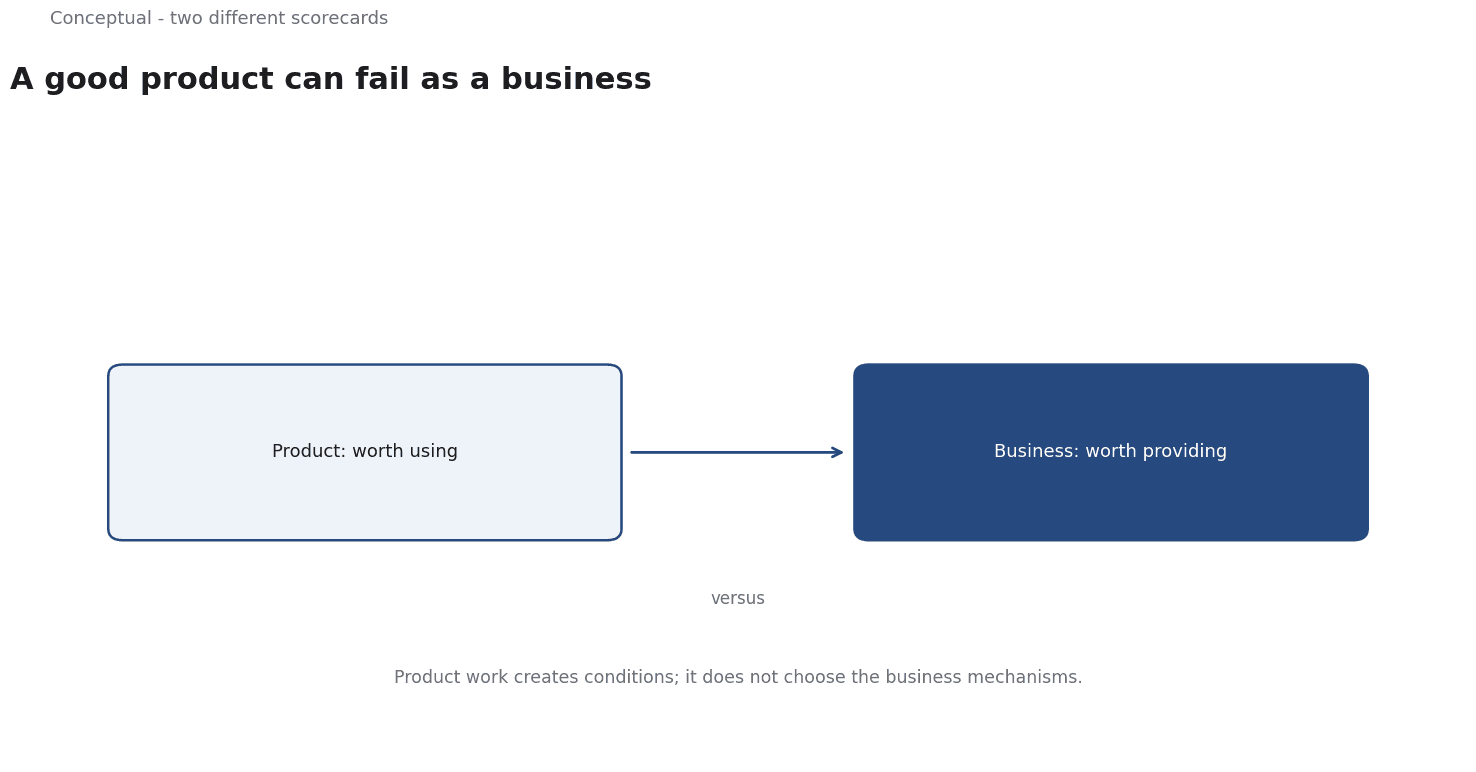
Two different scorecards
A product scorecard includes usability, reliability, retention of use, and whether users accomplish the task. A business scorecard includes acquisition cost, conversion, revenue, gross margin, retention of paying customers, and cash runway.
The metrics overlap in places but diverge in important ones:
- A user is not a customer. Free usage can be evidence of value and still be far from revenue.
- Retention of use is not retention of payment. A user who opens a tool daily may churn the moment a charge begins.
- Quality is not willingness to pay. A product can be better than alternatives and still serve a market too small or too price-sensitive to sustain a company.
This is why a team can report strong engagement and a worsening financial position without anyone lying. Both measurements are correct; they describe different systems.
A worked example of the gap
The following numbers are hypothetical and illustrative.
A software product has 10,000 active users, 40% weekly retention, and a net promoter score that the team is pleased with. Only 500 are paying customers at 20 per month. Monthly gross revenue is 10,000.
- Monthly acquisition spend: 30,000, yielding 1,000 new signups, of which 5% convert to paid — 50 new customers.
- CAC per paying customer: 30,000 / 50 = 600.
- Gross margin after infrastructure and support: 80%, so contribution per paying customer is 16 per month.
- Payback period: 600 / 16 = 37.5 months.
A payback period of more than three years is a business problem irrespective of product quality. Three changes affect it:
- Improve conversion from signup to paid from 5% to 10%. CAC halves to 300, payback to 18.75 months — the same product, the same spend, a different business.
- Raise price from 20 to 30. If conversion holds, contribution becomes 26 per month and payback falls to about 23 months.
- Reduce acquisition spend by shifting to a channel with lower cost but fewer signups. This may improve payback while slowing growth — a different trade-off, not a free win.
Notice that none of these is a product feature. The team could ship a better product and leave the payback problem untouched.
Conversely, improving conversion without improving the product may boost a metric while making the offering less useful — which is why the two scorecards must be read together.
Two cautions: gross margin here excludes fixed costs, and a 37.5-month payback may be acceptable in some enterprise models with contractual commitments. The number is a signal to investigate, not a universal verdict.
Where product thinking helps the business
The distinction is not a reason to ignore product quality. Three ways product work directly improves business metrics:
Activation. A user who reaches the product's core value in the first session is more likely to become paying. This is a product-design problem with a revenue consequence.
Retention. Paying customers leave when the product stops solving the problem. Retention is the product's report card in the business scorecard.
Reduced support cost. A clearer interface lowers the cost to serve, which improves gross margin. Product quality is a cost structure decision as well as a user-experience one.
The productive framing is that product work creates the conditions in which business mechanisms can work — but it does not choose the mechanisms.
Three ways of capturing value
The mechanism a business chooses shapes nearly every other decision, and the product alone does not determine it.
Subscription charges for continued access. It rewards retention and makes lifetime value the central metric. It also creates a continuous obligation to deliver value, and it exposes the company to churn at every renewal.
Transaction fees charge when a deal occurs. They align the company's revenue with the customer's success, which is attractive in marketplaces, but they require enough volume and a reliable way to observe the transaction.
Advertising charges a third party for attention. It can make a product free for users, but it rewards engagement rather than user outcomes, and the incentives can diverge sharply from the product's stated purpose.
A fourth category — one-time licensing — front-loads revenue and shifts the challenge to repeat purchases.
The product can be identical under two mechanisms, while the business is entirely different. A tool sold by subscription and the same tool funded by advertising will make different choices about notifications, data use, and which user behaviours to encourage. Porter's fit argument applies: the capture mechanism must fit the positioning, not merely be attached to it.
Where the business question is ignored
Three patterns signal that a team is building a product without a business:
Growth is described without unit economics. "Users are growing 20% a month" is a fact about a number, not evidence of a viable model.
The price was set once and never revisited. Pricing is a hypothesis about value and a mechanism for capture. It should be tested as deliberately as a feature.
The acquisition channel is an assumption.
Porter's point about fit is the corrective. The channel, the price, and the product must be designed together: a self-serve product needs a channel that brings users to a self-serve moment, and a high-touch enterprise product needs a sales motion that can support its price.
What success stories leave out
Survivorship and hindsight apply with force here. The companies celebrated for "just building a great product" are those for whom the business model worked. The many excellent products that failed to find a viable model are not written up. Amazon's company news is useful primary material for what that company says about its own choices; it is not evidence that the same choices would work elsewhere.
The counterargument that a remarkable product will find its business model is sometimes true and unfalsifiable in advance. A more useful stance is to treat the business model as a set of testable assumptions alongside the product assumptions, and to track both scorecards from the beginning.
A decision test
- Keep two scorecards — product value and business viability — and review them together.
- Distinguish users from paying customers in every metric.
- Compute CAC and payback with full costs and the same time period as revenue.
- Test pricing as a hypothesis, not a one-time decision.
- Check the fit between product, channel, and monetisation.
- Treat acquisition as a measured system, not an assumption.
- Read success stories as hypotheses, with the failed cases remembered.
For the strategic frame, see The Anatomy of a Successful Digital Business; for the commercial mechanics, see Founder-Led Sales.
References & Further Reading
- Colin Bryar and Bill Carr, 2019. Amazon Company News — Primary company material on how the working-backwards method is applied.
- Michael E. Porter, 1996. What Is Strategy? — The differentiation-versus-cost argument behind competitive-advantage analysis.
- Aswath Damodaran, 2026. Damodaran Online: Home Page for Aswath Damodaran — Publicly maintained datasets for industry averages, WACC, and valuation.