The Future of Autonomous Businesses
Autonomous business processes are possible, but reliability compounds across steps. Read the agent mechanism, an error-propagation worked example, and the accountability limit.
An autonomous business sounds like a company that runs itself. The realistic version is narrower and more useful: specific business processes in which software observes a state, decides an action, and executes it with limited human involvement. The difficulty is not making a single step autonomous — it is making a chain of steps reliable enough that the whole process can be trusted.
Direct answer: Autonomous processes are built from agents that interleave reasoning and tool use. Yao et al.'s ReAct work describes a "reason–act–observe" pattern in which a model reasons about a task, calls a tool, and uses the observation to continue. The boundary is mathematical: if each step has a 95% success rate, a ten-step chain succeeds roughly 60% of the time.
Autonomy is therefore a reliability budget, not a switch.
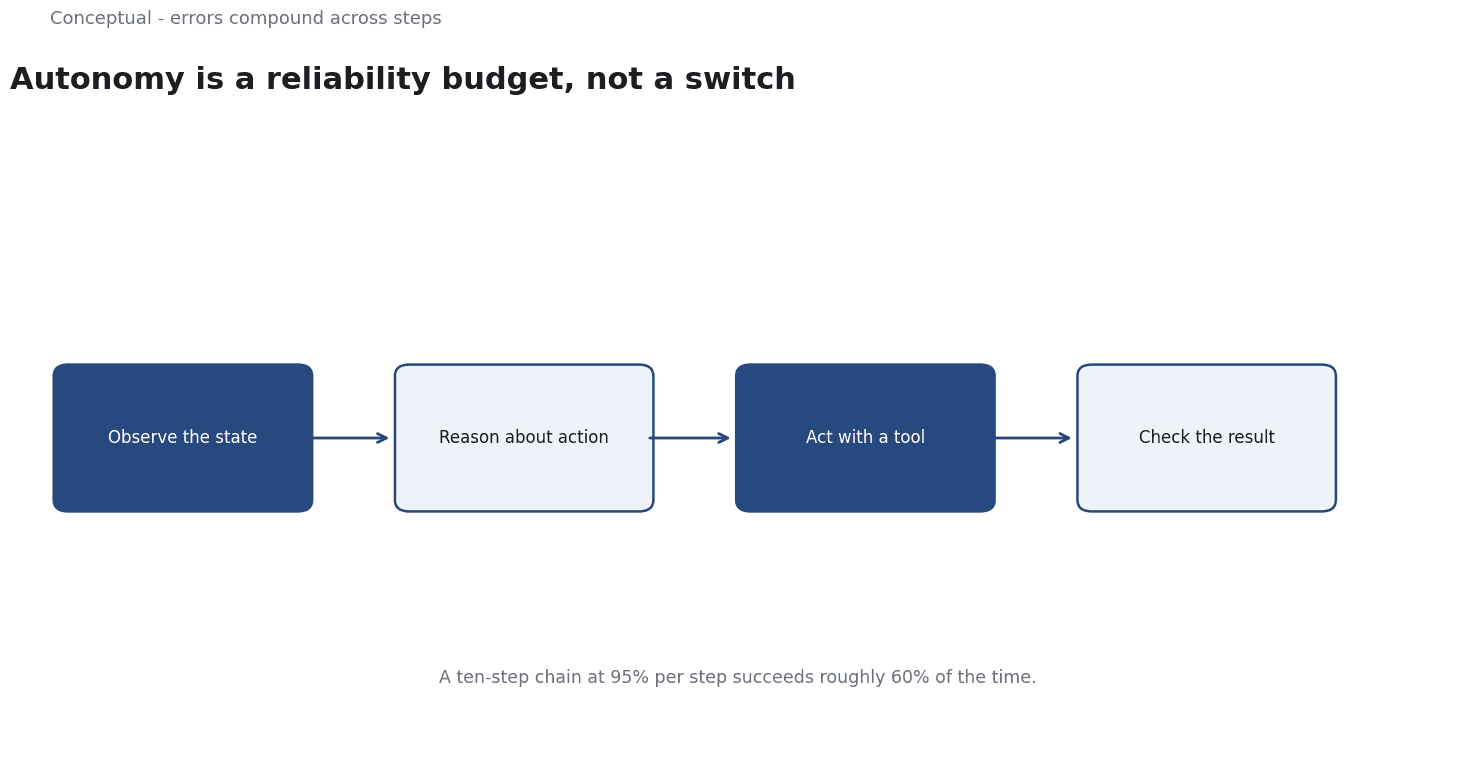
How an agent loop works
Three components form the loop:
Reason. The model interprets the goal and the current state, and decides what to do next. This is where ambiguity is resolved — or misinterpreted.
Act. The model calls a tool: a database query, an API request, a calculator, a file write. The tool is the model's only way to affect the world.
Observe. The result is fed back into the context, and the loop repeats until the goal is met or a stop condition fires.
ReAct's significance is that it makes the loop explicit and grounded in observations rather than pure generation. Later agent frameworks add state, branching, checkpoints, and human approval gates, but the basic structure remains.
For a business process, the loop maps onto a workflow: read the customer request, check the system of record, decide an action, execute it, verify the result. The interesting questions are what happens when a step fails and who is accountable for the outcome.
A worked example of error propagation
The following numbers are hypothetical and illustrative.
Suppose an autonomous invoicing process has five steps: extract the invoice data, match it to a purchase order, check the budget, create the payment record, and notify the vendor. Each step is 95% reliable when considered independently.
- Probability the whole chain succeeds: 0.95^5 ≈ 77%.
- With ten steps: 0.95^10 ≈ 60%.
- To reach 95% end-to-end over ten steps, each step needs about 99.5% reliability: 0.995^10 ≈ 95%.
Three design responses follow:
- Shorten the chain. Combine steps that do not need separate decisions, or remove confirmations that add a failure point without adding information.
- Add verification. A step that checks the output of the previous step can convert a silent error into a detected one. Detection is not correction, but it enables a safe fallback.
- Introduce human gates at irreversible points. Sending a payment is irreversible; drafting a message is not. Put approval before the irreversible action, not before every step.
The arithmetic also explains why demonstrations are misleading.
The relevant measurement is the end-to-end success rate and the distribution of failure modes, not the capability shown in a single trace.
What adoption data tells us — and does not
Bick, Blandin, and Deming's NBER paper reports that 23% of employed respondents had used generative AI for work at least once in the previous week as of late 2024, and 9% used it every workday. That is evidence of diffusion into work, not evidence of autonomous business processes.
Three distinctions matter:
Assistance is not autonomy. A person using a tool to draft an email is assisted. A process that sends the email without review is autonomous. The adoption figures largely describe the former.
Capability is not deployment. A model that can perform a task in a controlled demonstration may not do so reliably in a messy business environment with incomplete data and changing rules.
Efficiency is not the whole case. A process can be autonomous and still be a bad idea if errors are expensive and accountability is unclear.
The OECD AI policy work exists because these questions are not purely technical: trustworthy deployment involves standards, governance, and human oversight. Forecasts about autonomous businesses should be labelled as scenarios with stated assumptions, not treated as predictions of a timeline.
Where autonomy is reasonable
Three conditions make a process a good candidate:
The action is reversible. Sending a reminder can be undone; sending a payment cannot. Start with reversible processes.
The cost of an error is bounded and measurable. If a mistake costs a known, small amount, the reliability arithmetic can be turned into a business decision.
The system can detect its own failure. A process that cannot tell whether it succeeded needs human monitoring, which defeats the purpose.
The counterargument — that humans make errors too — is fair and often used too loosely. Human operators also have an advantage: they can notice a novel situation and escalate. An autonomous process must be designed with that capability explicitly, or it will fail confidently in situations its training did not cover.
The economics of an autonomous step
Autonomy has a cost that is easy to overlook: the infrastructure, monitoring, and exception handling around the model. A worked comparison makes it visible.
Suppose a human costs 40 per hour and processes 20 invoices per hour — 2 per invoice. An autonomous system costs 5,000 to build, 300 a month to run, and handles 90% of invoices without intervention. The remaining 10% still require a human at 2 each. At 5,000 invoices a month:
- Human-only cost: 5,000 × 2 = 10,000 per month.
- Autonomous cost: 300 + (500 × 2) = 1,300 per month, plus the 5,000 build cost.
- Payback: roughly 0.6 months of the 8,700 monthly saving.
The result looks overwhelming, and that is exactly why the arithmetic needs stress-testing:
- Error cost is missing. If 2% of automated invoices contain an error that costs 50 to repair, that is 5,000 × 0.02 × 50 = 5,000 a month — erasing more than half the gain.
- Monitoring is not free. Someone must review the exception queue and the failure statistics. If that takes 20 hours a month, add 800.
- Volume changes the answer. At 500 invoices a month, human cost is 1,000 and the autonomous system costs 300 + 100 + monitoring — the fixed costs dominate and the case weakens.
The point is that autonomy is a capital investment with ongoing operating costs, not a deletion of labour cost.
The reliability arithmetic and the cost arithmetic must be done together.
What the future framing cannot support
Three limits on any claim about autonomous businesses:
Reliability does not compose. The worked example showed that high per-step reliability still produces a mediocre end-to-end result. There is no shortcut around this.
Accountability cannot be automated. A decision that harms a customer still needs an accountable party. "The system did it" is not an answer that satisfies regulators or affected people.
The environment changes. A process that works today may face new inputs, new rules, or an adversary studying it. Autonomy requires monitoring and a defined stop condition, which is ongoing work rather than a one-time implementation.
A decision test
- Map the process as a chain of steps and count them.
- Compute end-to-end reliability from per-step rates, as in the worked example.
- Place human gates at irreversible actions, not arbitrarily.
- Require failure detection at each step that can fail silently.
- Start with reversible, bounded-error processes.
- Measure the full chain in production, not single traces in a demo.
- Name the accountable owner and the stop condition before deployment.
For the agent mechanics, see From LangChain to LangGraph; for the governance frame, see AI Governance.
References & Further Reading
- Shunyu Yao et al., 2022. ReAct: Synergizing Reasoning and Acting in Language Models — Interleaved reasoning and tool use, the pattern most agent frameworks implement.
- Erik Brynjolfsson, Danielle Li, and Lindsey R. Raymond, 2024. The Rapid Adoption of Generative AI — Workforce-level adoption data and the productivity-gap evidence.
- OECD, 2026. The AI Wonk - oecd.ai — Cross-country measurement and policy data for AI adoption.