The Evolution of Web Browsers and the Future of the Internet
Browsers became application platforms by implementing standards, not a plan. Read the mechanism, a feature-adoption example, and why support tables are not guarantees.
The browser is the most widely distributed application runtime ever built, and most of what it can do arrived through a slow process of standardisation and implementation. Understanding that process is more useful than predicting the next feature, because the same mechanism — specification, implementation, measurement, adoption — governs what the web can become.
Direct answer: The web platform evolves through specifications such as the HTML Living Standard, implemented by browser engines and tracked in support tables like Can I Use. RFC 9114 adds HTTP/3, mapping HTTP semantics over QUIC for lower-latency transport. The boundary: a standard is not a deployment, a support table is not a guarantee of behaviour in your users' browsers, and no feature guarantees an outcome such as ranking, traffic, or conversion.
The mechanism of web change
Three layers interact:
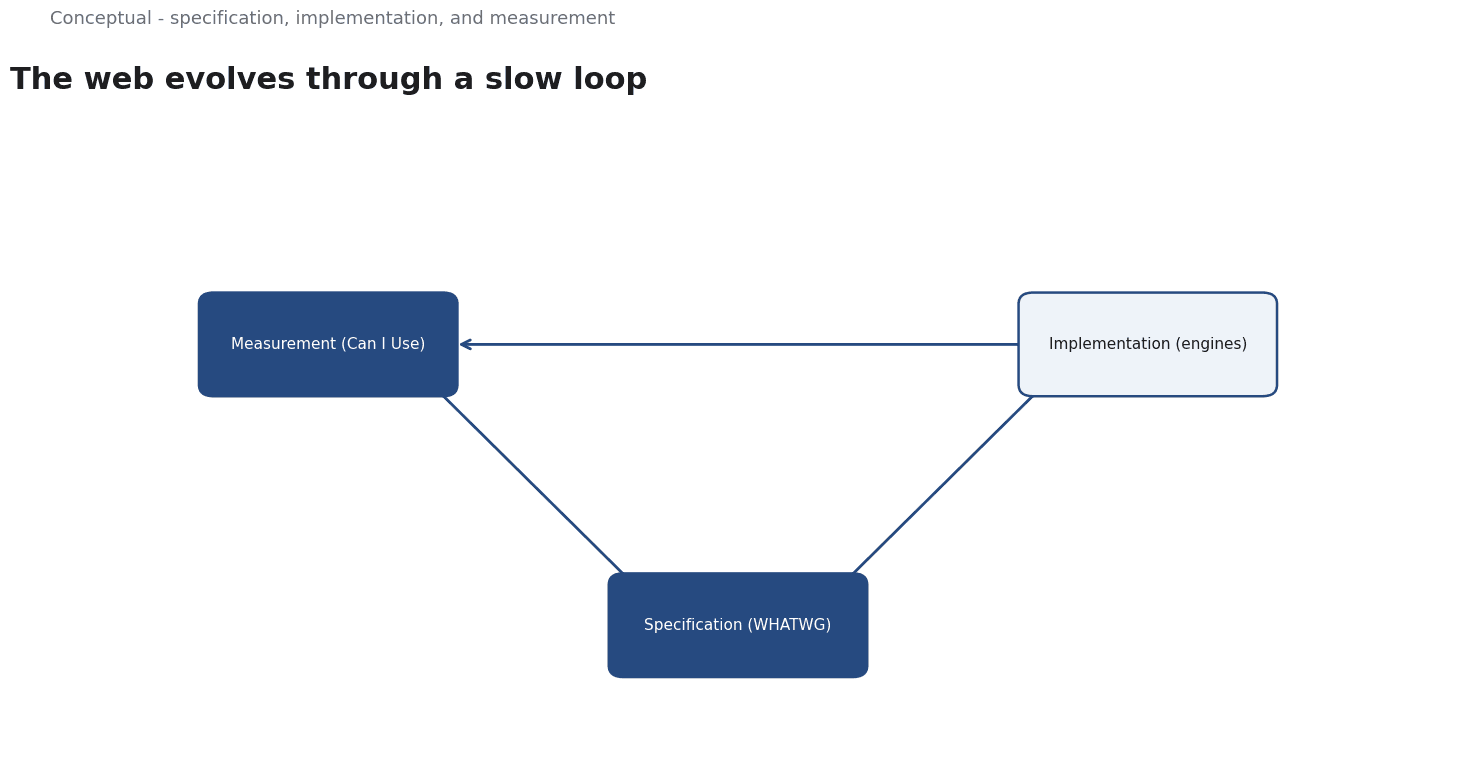
Specification. The WHATWG HTML Living Standard is continuously updated — its current version was last updated 16 November 2026 — and covers structure, elements, user interaction, loading pages, web application APIs, rendering, and more. A "Living Standard" has no final version number; it changes as the platform changes.
Implementation. A specification describes behaviour, but a feature exists for users only when browser engines implement it. Implementations can differ, and a feature may ship behind flags or with partial support.
Measurement. Can I Use tracks support across browser versions. It is a practical tool for asking "can I rely on this?", but it is a snapshot of reported support, not a promise about a specific user's configuration.
The same pattern appears in transport. RFC 9114 specifies HTTP/3 and notes that "HTTP/3 supports the same semantics over a new transport protocol: QUIC". Changing the transport does not change what a web request means, which is why the platform can evolve underneath applications without breaking them.
A worked example of feature adoption
The following is an illustrative decision process, not a measured case.
A team wants to use a modern CSS layout feature instead of a legacy workaround. Before adopting it, four questions:
- What does the support table say? Check the feature in Can I Use across the browsers and versions that matter to the audience. A feature at 95% global support still leaves 5% of users — which may be concentrated in a segment the business cares about.
- What happens in unsupported browsers? If the fallback is a usable layout, adoption is low-risk. If the fallback is a broken page, the feature needs a polyfill or a different approach.
- Is the data about your users? Global support percentages are not your analytics. A product used mainly on one platform may have much better or worse effective support.
- What is the gain? If the feature saves 20 lines of CSS and a workaround that is hard to maintain, the benefit is real. If it is marginally more elegant, the migration cost may exceed it.
The decision rule is to adopt when the fallback is safe and the maintenance saving is real, and to defer when support gaps affect a valuable segment and the benefit is cosmetic.
This is also where the standard's status matters. A feature in the Living Standard has a defined specification, which makes behaviour more predictable across engines — but it is the implementation data that tells you whether you can use it today.
The browser as an application platform
The most consequential change in the browser's history is not any single feature but its emergence as a runtime for applications. A page can now store data locally, run worker threads, render graphics through a GPU, and communicate over persistent connections. Those capabilities are defined in specifications such as the HTML Living Standard, which includes sections on web application APIs, web workers, and web storage.
Three consequences follow:
Distribution without installation. A web application reaches a user through a URL, which removes a major friction in software adoption. It also means the runtime is controlled by the browser vendor, not the application author.
A capability depends on the weakest supported browser. An application that relies on a new API must either restrict its audience or provide a fallback. This is why support tables matter to product decisions, not only to engineers.
The platform is governed by standards bodies, not one company. A specification is developed in public and implemented by multiple engines. That makes behaviour more predictable over time, but it also makes change slow — a feature that exists in a laboratory can take years to become dependable.
This is the real answer to "what is the future of the internet": more capability will arrive through the same slow loop of specification, implementation, and measurement.
The useful question for a builder is not which feature is coming, but which currently standardized feature can be used safely with a fallback today.
What the future framing gets wrong
Three limits apply to any prediction about the web.
Support tables are not causal evidence.
Those claims require measurement of the thing you care about, and search engines have repeatedly stated that individual technical features are not direct ranking guarantees.
Standards do not determine adoption. A specification can be complete and a feature unused because implementations differ, tooling lags, or developers see no benefit. The history of the web contains many well-specified features that never became common.
The platform is not one thing. "The internet" includes browsers, native apps, APIs, and network infrastructure, each evolving on its own schedule. A change in one layer does not imply a change in the others.
The counterargument to this caution — that the web's trajectory is obviously toward richer applications — is probably right in broad direction and useless for a specific decision.
The actionable question is always which feature, in which browsers, for which users, with what fallback.
A practical sequence
- Start from the user need and the browsers your analytics actually show.
- Check the specification status to understand what the feature is supposed to do.
- Check current implementation support with Can I Use and verify in your own test matrix.
- Define the fallback before enabling the feature.
- Measure the outcome — page performance, task completion, maintenance cost — not the adoption itself.
- Re-check periodically, since support changes over time.
- Avoid promising ranking or traffic gains from a technical feature.
For the protocol underneath, see HTTP/3 and QUIC; for the performance consequences, see Web Performance.
References & Further Reading
- WHATWG, 2026. HTML Living Standard — The normative HTML and DOM specification browsers implement.
- Can I Use, 2026. Can I use... Support tables for HTML5, CSS3, etc — The most-cited compatibility reference for browser feature support.
- M. Bishop, 2022. HTTP/3 (RFC 9114) — HTTP semantics mapped onto QUIC.