The Future of Work: Skills That Will Matter in the Next Decade
AI adoption is already widespread, but adoption is not the same as productivity. Read the task-level framework for what changes — and what remains durable.
Predictions about the future of work tend to swing between replacement and irrelevance. A more reliable approach is to look at what is already happening and at the level where change actually occurs: tasks, not job titles. The data shows rapid adoption of generative AI; it does not show that whole occupations disappear on a schedule.
Direct answer: The useful unit of analysis is the task. Generative AI is being adopted quickly — Bick, Blandin, and Deming's NBER working paper reports that "as of late 2024, nearly 40 percent of the U.S. population age 18-64 uses generative AI", with "23 percent of employed respondents" having used it for work "at least once in the previous week" and 9% on every work day.
The boundary is that adoption is a measure of use, not of productivity or of displacement, and the durable skills are those that help a person direct, verify, and work around these tools.
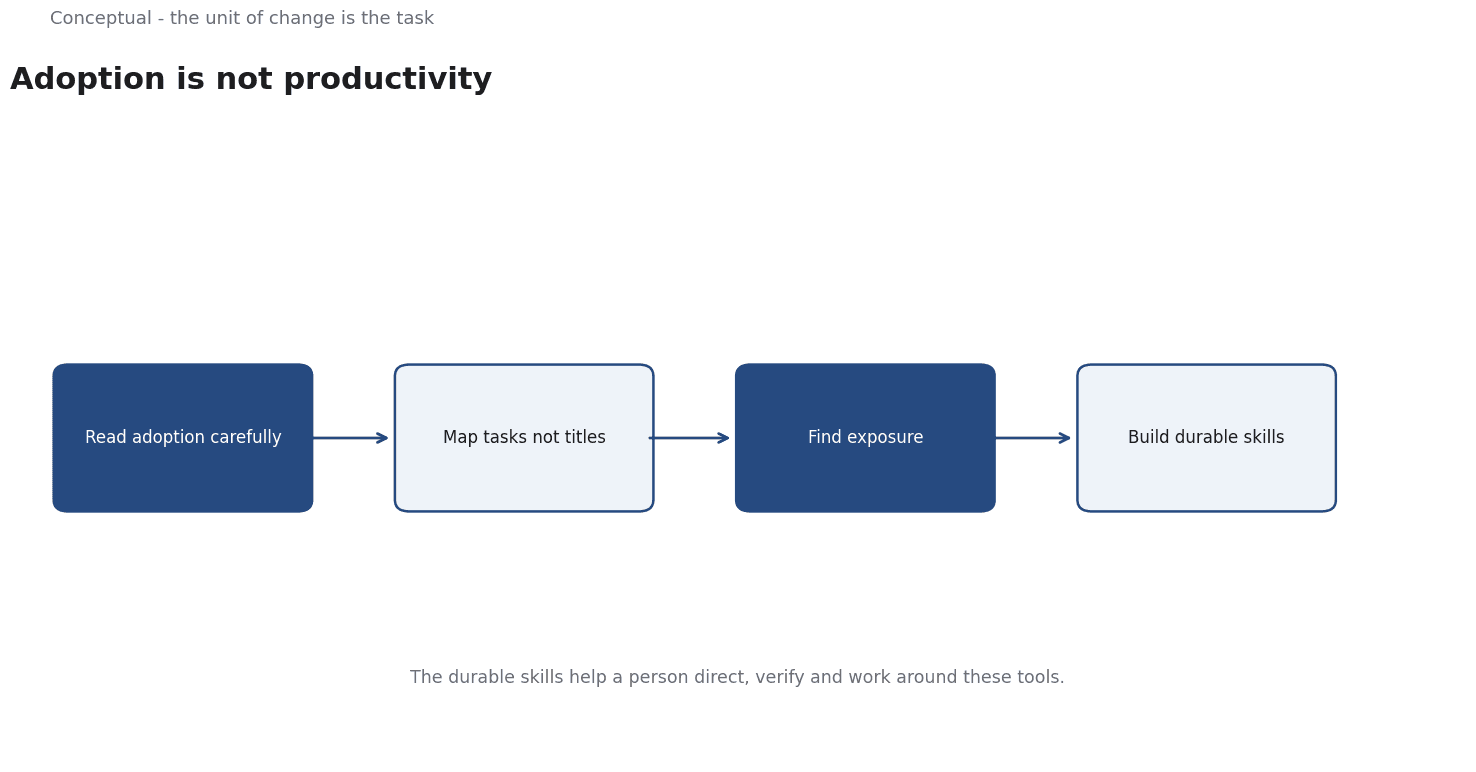
Read the adoption numbers carefully
The NBER paper — The Rapid Adoption of Generative AI, issued September 2024 and revised February 2025 — is valuable because it gives denominators and a date. Nearly 40% of the working-age US population had used generative AI; 23% of employed respondents had used it at work in the previous week; 9% used it every workday.
Three distinctions matter:
- Use is not intensity. Trying a tool once and using it daily are different behaviours with different implications, and the paper reports them separately.
- Adoption is not productivity. A METR randomized controlled trial of early-2025 AI tools with experienced open-source developers found that "when developers use AI tools, they take 19% longer than without—AI makes them slower". METR later noted that "these historical results no longer reflect the current impact of AI models", with newer data published in February 2026. Both findings are informative: the first shows that tool use can carry a cost, the second that the cost can change.
- A survey is not a forecast. These numbers describe reported behaviour at a point in time. They do not tell you what the labour market will look like in a decade.
The honest reading is that adoption is real and fast, while its economic consequences are still being measured.
The task-level framework
A job is a bundle of tasks, and a task can change in several ways:
Automate — the tool performs the task without a person. Transcription and first-draft generation are common examples.
Augment — a person performs the task faster or better with the tool. A developer using an assistant to explore an unfamiliar codebase is augmented, provided they verify the result.
Recompose — the task survives but changes shape. A researcher who no longer spends hours gathering summaries may spend more time designing the question and checking evidence.
Anchor — the task remains human because it depends on accountability, physical presence, or trust. Managing a team, negotiating, and taking responsibility for a decision are anchors.
This framework is more useful than "will AI take my job?" because it produces a specific question: which of my tasks fall into each category, and how large a share of my time do they occupy?
O*NET's occupation descriptions — "detailed descriptions of the world of work" across 900+ occupations, with tasks, skills, and requirements — are a structured way to begin that inventory. Its "Bright Outlook" labels flag occupations expected to grow rapidly or with large numbers of openings, but those labels are labour-market signals, not predictions about an individual.
A worked example of task exposure
The following is a hypothetical decomposition, not a measured job.
Suppose a marketing analyst spends a 40-hour week as follows:
| Task | Hours | Category |
|---|---|---|
| Pulling and cleaning campaign data | 10 | Automate |
| Drafting first-pass performance summaries | 8 | Automate / augment |
| Choosing the metric that answers the business question | 6 | Anchor |
| Interviewing campaign owners about context | 6 | Anchor |
| Checking whether a surprising result is real | 5 | Augment |
| Presenting findings and recommending action | 5 | Anchor |
Roughly 18 hours are in the automate-or-augment column and 17 hours are anchored.
Automating the data pulls does not remove 10 hours of work; it changes the job into one where the analyst is expected to answer more questions with the time saved. The anchored tasks become more important, not less, because they are now the visible part of the role.
This is the pattern the framework is meant to reveal: exposure to automation often raises the value of judgement rather than eliminating the role. It also reveals a risk — a person who spends all their time on the automatable tasks has invested in the wrong part of the job.
Which skills are actually durable
Three categories hold up because they are complementary to tools that produce plausible output at speed.
Problem framing. Deciding what question to ask, what counts as evidence, and what the decision depends on. A tool can generate an answer to a badly framed question; it cannot tell you the question was wrong.
Verification. Checking a result against data, a source, or an experiment. This is the skill that separates a useful assistant from a confident error generator, and it requires knowing enough about the domain to spot the error.
Judgement and accountability. Weighing trade-offs, representing other people's interests, and owning a decision. These remain human because responsibility cannot be delegated to a model.
Technical literacy is durable too, but in a specific sense: understanding the mechanism well enough to know when a tool is likely to fail. That is different from memorising a current API.
The counterargument — that these are just "soft skills" and cannot be taught — is too pessimistic. They can be practised: write the question before generating the answer, keep a claim-to-source record, and reconstruct a decision after the fact to see what was missed.
What the forecast cannot support
Three limits apply to any claim about the next decade.
Scenarios are not probabilities. A plausible future is not therefore a likely one, and a forecast that does not state its assumptions cannot be evaluated.
Aggregate resilience hides individual disruption. A labour market can absorb a transition overall while specific workers bear large costs.
"The number of jobs will be fine" is not a statement about any particular person.
Tool capability is moving faster than evidence. A study of 2025 tools may not describe 2027 tools, as the METR update illustrates. Any skill recommendation should be re-examined as the tools change.
A decision test
- Inventory your tasks with hours, using an O*NET-style task description.
- Classify each task as automate, augment, recompose, or anchor.
- Invest in the anchored and verification tasks, not only the ones a tool can already do.
- Measure whether a tool actually saves time on your work, rather than assuming it does.
- Keep a verification habit — check a generated claim against a primary source.
- Revisit the inventory annually as tools and your role change.
For the learning method behind these skills, see Why Learning How to Learn Is a Competitive Advantage; for the transition mechanics, see Career Transitions.
References & Further Reading
- Erik Brynjolfsson, Danielle Li, and Lindsey R. Raymond, 2024. The Rapid Adoption of Generative AI — Workforce-level adoption data and the productivity-gap evidence.
- Joel Becker, Nate Rush, Beth Barnes, David Rein (METR), 2025. Measuring the Impact of Early-2025 AI on Experienced Open-Source Developer Productivity — Randomized trial finding early-2025 AI tools made experienced developers 19% slower, with a 2026 update; used as a caution against assuming adoption equals productivity.
- U.S. Department of Labor, 2026. O*NET OnLine — The standard occupational taxonomy used to compare roles across industries.