Thin Content Examples
Thin content is a judgment about value, not word count. Read examples, a worked review, and why a short page can be better than a long one.
Thin content is often treated as a length problem, which leads to pages padded with words that add nothing. Google's helpful-content guidance describes what makes content useful, and the marketing-communications entry covers how messages are received. The examples show where thinness actually lies.
Direct answer: Judge content by whether it answers the question better than what is already available, not by its length. The sources describe usefulness and reception; the rule is a synthesis.
Delta: This article adds a claim-status table and worked examples, separating documented guidance from local judgements about value.
The mechanism
The first point is redundancy. The helpful-content guidance describes content that offers little beyond what exists elsewhere. A long page that repeats common knowledge is thin in the relevant sense, while a short page that adds one specific calculation is not.
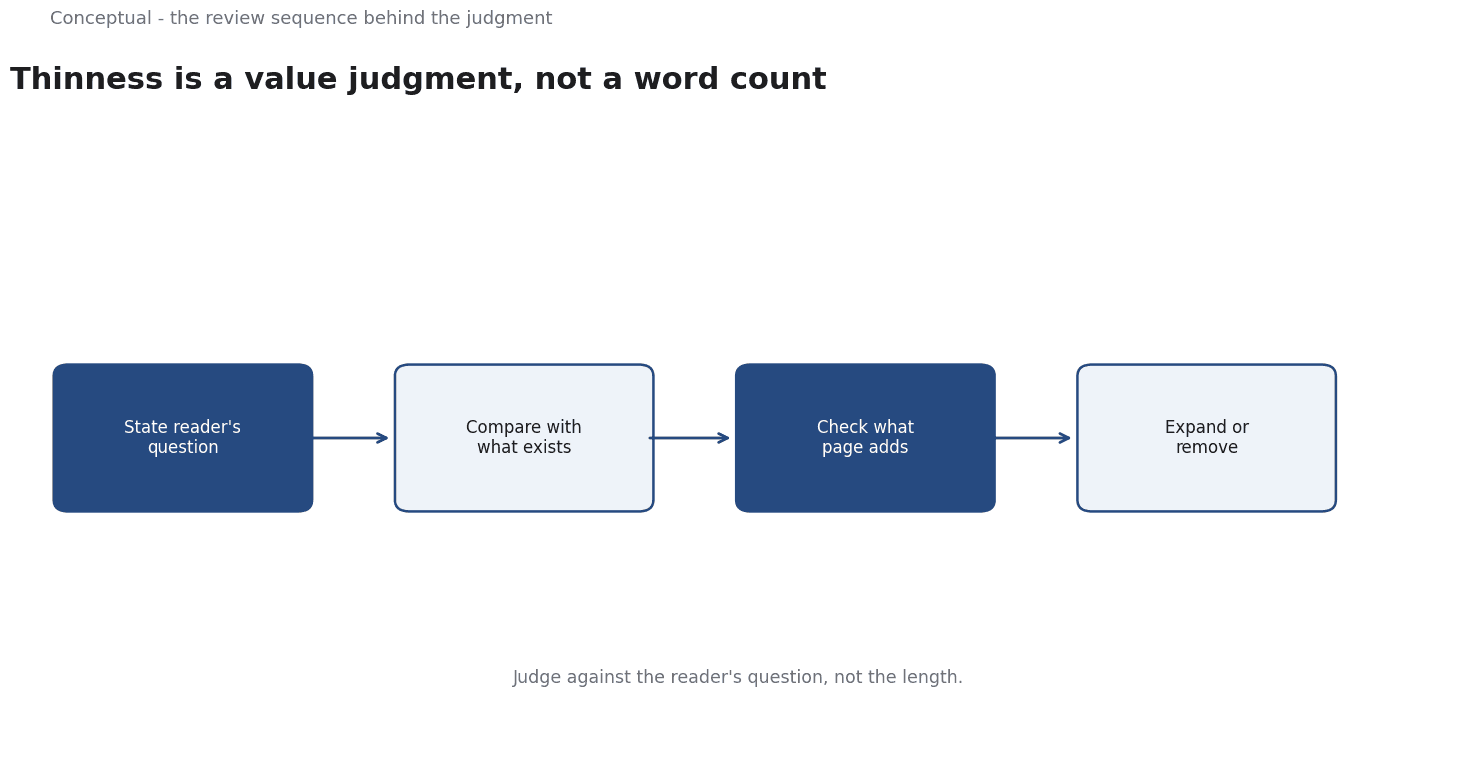
The second point is the reader's question. The marketing-communications entry treats a message as received, which means a page should be judged against the question that brought the reader. A page that answers a different question thoroughly is still unhelpful.
The third point is evidence. A page that asserts without showing how a claim was checked gives the reader nothing to rely on. Adding sources, methods, or limits increases value without necessarily adding length, which is why length is a poor proxy for quality.
The sequence is: state the reader's question, compare with what exists, check what the page adds, then decide whether to expand or remove. The judgement is local, so the conclusions are inferred; the guidance is source-reported.
Worked examples
Illustrative. A page of 1,500 words repeats general advice available on many sites. It is thin despite its length.
A second example: a page of 300 words documents a specific error, the condition that triggers it, and the verification step. It is substantial despite its length.
A third: a category page with no products in stock offers nothing a shopper can act on, which is thin whatever the text says.
The outcome is a judgment about value, not a word count. The scenarios are hypothetical; the method is the contribution.
Evidence status
| Claim | Status | Source | Verified | Recheck when |
|---|---|---|---|---|
| Helpful content offers something beyond the obvious | source-reported | Google helpful-content guidance | 2026-11-18 | Guidance updated |
| Messages are received by a reader | source-reported | Wikipedia, Marketing communications | 2026-11-18 | Practice changes |
| Judge against the reader's question | inferred | Derived from both | 2026-11-18 | Audience changes |
Why short can be better
A short answer that resolves the question respects the reader's time and gives them a reason to trust the page.
A further consideration is that helpfulness is relative to available alternatives. A page that was unique when published can become redundant after competitors cover the same ground, which is why a review should compare against the current web rather than the web at publication.
The guidance also describes intent, not just text. A page that answers a question but leaves the reader unable to act may still be unhelpful, and the fix is often a clearer next step rather than more explanation. Judging the whole experience is the correction.
Finally, a short page can be thin for a different reason: it may omit the evidence that would let a reader trust it. Adding a source or a method can make a short page substantial, which is the distinction between brevity and emptiness.
A page should be reviewed against the answer a reader needs, not against a target length.
A short answer with evidence is more substantial than a long answer with none.
A page should be judged against the question it answers, which is narrower than a word count.
Redundancy is the real test, and it has little to do with the number of words on the page.
What it cannot do
It cannot make an empty page useful by adding words. It does not guarantee that a substantive page will be found. And it cannot replace an understanding of the audience.
The counterargument that longer pages rank better is fair as an observation and incomplete as a rule for what to write.
A decision test
- State the reader's question.
- Compare with existing answers.
- Identify what this page adds.
- Check the evidence.
- Expand or remove accordingly.
- Record the review and recheck date.
For the broader principle, see Content Marketing.
References & Further Reading
- Google, 2026. Creating Helpful, Reliable, People-First Content — The documented content-quality guidance.
- Wikipedia contributors, 2026. Marketing communications - Wikipedia — The coordination of messages across channels and the distinction between consistent and identical communication.