Content Marketing: Building Trust Before Asking for the Sale
Content works when it changes a decision, not when it fills a calendar. Read how to connect what you publish to the moment of choice.
Content marketing is usually described as a long game of building trust, and the metaphor is harmless until it becomes an excuse for not measuring anything. Publishing useful material can earn attention, and attention can become demand — but only if the content reaches a person at a decision point and answers the question that person actually has.
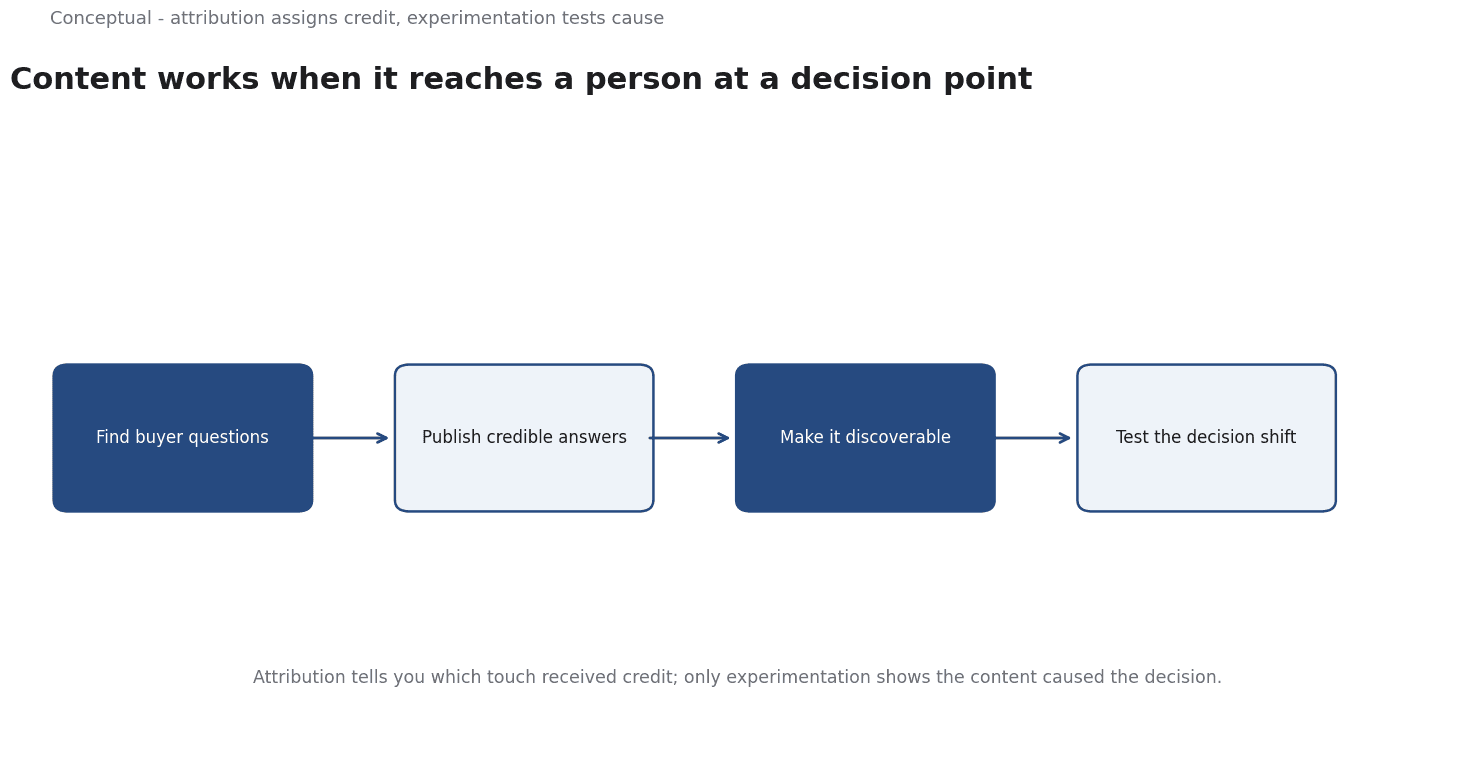
Direct answer: Content earns trust by reducing the buyer's uncertainty about a specific choice, and it converts when it is available at the moment that choice is made. That means the work is about the decision, not the calendar: identify the questions that precede a purchase, produce the most credible answer you can, make it discoverable and readable, and connect it to a path to act. Attribution can describe which interactions received credit — Google Ads describes models as a way to "choose how much credit each ad interaction gets for your conversions" — but only experimentation tells you whether the content changed the outcome.
What "trust" means operationally
Trust is not an emotion you instil with a friendly tone. In a buying decision it is a reduction in specific uncertainties:
- Will this work for my situation? Evidence from comparable customers, a clear description of the boundaries, and honest limitations.
- Do I understand what I am buying? Plain language, a definable scope, and a price that is legible.
- What happens if it goes wrong? Refund terms, support, and an identifiable human behind the product.
- Can I trust the source? Named authors, dated evidence, and a willingness to say when the answer is "we do not know".
Content that addresses these questions builds trust.
Porter's trade-off argument is relevant here in an unexpected way. "A strategic position is not sustainable unless there are trade-offs with other positions." For content, the trade-off is refusing to write about everything. A brand that publishes useful material only inside a defined domain signals what it is actually expert in; one that chases every trend signals nothing. The refusal is the signal.
Discoverability is part of the work
A credible answer that nobody finds has not reduced anyone's uncertainty, and discoverability has two layers.
The first is technical. Search engines need pages that can be crawled, rendered, and understood, which is why Google's own starter guide names crawlable structure, sitemaps, canonical signals, and accessible content as the requirements. An article that exists only in a JavaScript-rendered widget or behind an interaction is invisible to the systems that would surface it.
The second is relevance. A page earns a position when it answers the question the searcher actually asked, which requires knowing that question. Search query data, customer interviews, and the language salespeople hear in objections are more useful than a keyword list generated from a tool.
These two layers are complements, and neither substitutes for the other. Perfect technical SEO on a page that answers the wrong question is wasted; a perfect answer that cannot be crawled is equally wasted.
Measure the decision, not the output
The most common content metrics — pageviews, time on page, number of articles — measure production. The decision-relevant measures are:
- Did the reader arrive before a decision point? Organic search and direct visits from a buying context matter differently from a social referral with no intent.
- Did they take the next step? A defined action that indicates the uncertainty was reduced — a trial, a consultation, a signup, a reply.
- Did the action lead to retained value? A signup that never activates is a conversion event, not an outcome.
- Which questions were asked repeatedly? Those are the topics the content should cover next, and the ones a sales team is currently answering one at a time.
Attribution will tell you which touch received credit; it cannot tell you whether the content caused the decision.
Google's published approach to measuring advertising effectiveness with geo experiments — "one approach that Google has successfully employed" — is the right instrument when a content programme operates at a market or brand level, while a randomised holdout works for a specific page or sequence.
A way to run it
- List the five questions a buyer asks before choosing in your category, using sales conversations and search queries.
- Write the best available answer to each, with named sources, dated evidence, and stated limits.
- Make the answer technically discoverable — crawlable, rendered, structured, and linked.
- Give it a clear next action that matches the reader's stage.
- Instrument the action, not just the visit, and connect it to retained value.
- Use experiments for the large bets and attribution for diagnosis.
- Refuse topics outside the position. Therefusal is what makes the content credible, and it is what Porter's trade-off logic predicts.
For the distribution question, see Why Distribution Is Often More Important Than Product Quality; for the measurement side, see How Data Changes the Way Marketing Decisions Are Made.
A worked example
The following is hypothetical and illustrative. Imagine a company selling analytics software whose sales team keeps answering the same question before every purchase: how does this tool handle data with missing values? That repeated question is a signal, the same kind the decision framework above treats as the starting point. The company publishes one precise answer, with the method stated, the boundaries named, and the cases where the answer is "we do not know." It makes the page crawlable and readable, then gives the reader a single next action matched to the stage: a small trial using their own messy dataset.
The measurement question is not how many people read the page. It is whether the page changed the decision. Because this operates at a narrow scale, a randomised holdout on the trial offer is the right instrument; because attribution only decides "how much credit each ad interaction gets," it cannot answer the causal question on its own. If the holdout shows no difference in activation, the content did not reduce the uncertainty that mattered, and the next article should address a different question.
Where the reasoning breaks down
The chain from content to revenue has several weak links, and each is a place where a programme can look healthy while doing nothing. A page can be discoverable and still answer the wrong question; it can answer the right question and still fail to offer a next action; it can drive an action that never becomes retained value. Attribution obscures all of these, because a credited touch is not a proven cause.
Geo experiments are the cleaner instrument for market-level bets, but they have their own limits: they need enough geographic units and enough volume to detect an effect, and they measure a market average rather than a single reader. For a small programme, the honest answer may be that the effect cannot be measured yet. That is a reason to sequence bets carefully, not a reason to substitute pageviews for outcomes.
A decision test
Before publishing, run five checks. Does the piece answer a question that precedes a purchase? Is the answer credible, with named sources and stated limits? Can a search engine crawl and understand it? Is there a next action matched to the reader's stage? Is the action instrumented so retained value can be seen?
A sixth check is the hardest: does the topic sit inside the position the brand has chosen? Porter's argument that a position is unsustainable without trade-offs applies here. Refusing a topic is not a missed opportunity; it is what makes the rest of the content believable.
A counterargument
A fair objection is that the article's measurement standard outruns its evidence. Its strongest prescription - only experimentation tells you whether content changed the outcome - rests on Vaver and Koehler's geo experiments, which the piece concedes need enough volume and measure a market average, not a reader. For small programmes, that instrument is unavailable, so the advice to "use experiments for the large bets" leaves everyday decisions unmeasured. The Google Ads source says only that attribution models "choose how much credit each ad interaction gets"; it does not support treating a holdout's activation difference as proof that "the content reduced the uncertainty that mattered".
Even the claim that refusing topics makes content credible comes from Porter's trade-off argument, a strategy analogy rather than evidence about readers.
References & Further Reading
- Google Ads Help, 2026. About attribution models - Google Ads Help — First-party documentation of attribution models and their limits.
- Brian Vaver and Koehler, 2011. Measuring Ad Effectiveness Using Geo Experiments — Geo experiments for incrementality, the cleanest way to attribute marketing spend.