Threat Modeling Checklist
Threat modeling finds failure before code ships. Read a repeatable checklist, a worked example, and why the output must change something.
Threat modeling is often reduced to a brainstorm about what could go wrong, which produces a list of fears rather than a set of decisions. A useful session has a defined system boundary, a method for identifying threats, and an output that changes the design or the controls. Without those, it is a meeting that satisfies a checklist.
Direct answer: Model threats by defining the system, identifying assets and trust boundaries, enumerating threats with a recognised framework such as MITRE ATT&CK, and assigning a control and owner to each material risk. Zero-trust principles apply where implicit trust based on location is assumed. The boundary: a threat model covers what can be anticipated; novel attacks require red teaming and monitoring, as AI Red Teaming: A Practical Methodology explains.
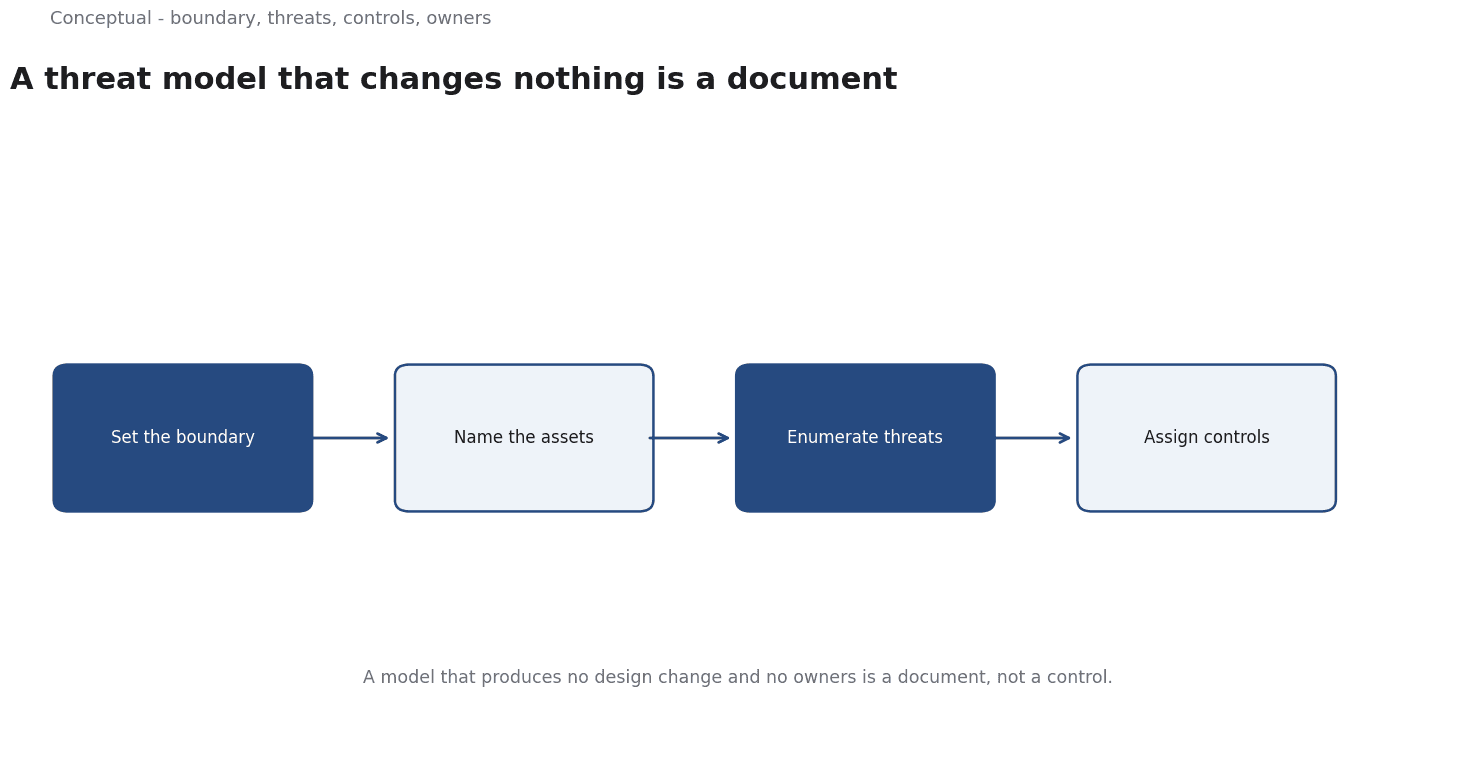
The checklist
Define the boundary. What is in scope — the service, the data store, the third-party integrations — and what is assumed external. A model without a boundary produces threats everywhere and prioritises nothing, which the risk-assessment article treats as a failure of scope.
Identify assets and trust boundaries. What needs protecting, and where does trust change — a user becoming authenticated, a service calling another service, data entering from an external source. Zero Trust's principle is that location alone does not confer trust, which the security-fundamentals article explains.
Enumerate threats. Use a recognised structure such as MITRE ATT&CK, which catalogues adversary tactics and techniques based on real observations. The structure prevents the session from fixating on the most recent headline, as the AI red-teaming article argues for coverage over intuition.
Assign controls and owners. Each material threat gets a control — validation, authorisation, segmentation, monitoring — and an owner. A threat with no control is either accepted explicitly or blocks release, which the pre-deployment checklist requires.
A worked example
The following is hypothetical and illustrative. A team models a service that accepts file uploads and serves them to other users.
With the boundary defined, three threats emerge. An attacker uploads a malicious file that is executed on the server; the control is to store files outside the execution path and validate type, with validation at the tool boundary as the tool-calling article recommends. A user guesses another user's file identifier; the control is object-level authorisation, which the OWASP-based security checklist treats as a design failure when missing. A poisoned file is served and executed in a user's browser; the control is content-type enforcement and a download disposition, as the output-handling guidance in the security checklist describes.
Three checks decide whether the model worked. First, did any threat change the design, such as moving storage outside the web root, which the architecture article treats as a structural decision? Second, are the controls testable, as the evaluation-rubric article requires for concrete criteria? Third, is there an owner for each, as the governance checklist requires for accountability?
A model that produces no design change and no owners is a document, not a control.
Making the model a living artefact
New endpoints, new integrations, and new dependencies create paths the original session never considered, which the monitoring article treats as a change trigger for any control. The model should therefore carry a date and an owner, and it should be revisited when the architecture changes rather than on a fixed calendar alone, as the pre-deployment checklist recommends for evidence that stays current.
The most useful teams treat the model as a conversation starter rather than a final document.
When a new feature is designed, the question is not whether the old model is complete but which of its assumptions still hold, which the design-brief article frames as specifying boundaries before work begins. This keeps threat modeling close to engineering decisions, where it changes outcomes, instead of in a separate security review that happens after the design is fixed.
Finally, the output should be prioritised. Not every threat deserves a control at the same time, which the risk-assessment article treats as a question of impact and likelihood. A short list of material risks with owners is more actionable than an exhaustive catalogue, and it is the form most likely to be read when a decision has to be made quickly, as the decision-memo article argues for records that change behaviour.
What threat modeling cannot do
It cannot anticipate every attack, which the red-teaming article treats as the reason for adversarial testing. It cannot fix an insecure architecture by listing controls; some designs need to change, as the microservices article explains for distributed failure modes. And it goes stale when the system changes, which the monitoring article treats as a review trigger.
The counterargument that threat modeling is too heavy for a small team is fair when applied to every change. The response is proportionality: model the consequential boundaries, and revisit after material changes, as the risk-assessment article recommends.
A decision test
- Define the system boundary in one sentence.
- List assets and trust boundaries.
- Enumerate threats with a recognised framework, such as MITRE ATT&CK.
- Assign a control and an owner to each material threat.
- Block release on high-impact threats without controls.
- Test the controls with red teaming, as AI Red Teaming: A Practical Methodology advises.
- Review on material change, as the monitoring article requires.
For the broader discipline, see Cybersecurity Fundamentals; for the adversarial test, see AI Red Teaming.
References & Further Reading
- MITRE, 2026. MITRE ATT&CK — The adversary tactic and technique knowledge base used for detection engineering.
- NIST, 2020. Zero Trust Architecture — The official zero-trust architecture and its tenets.