Time Management for Small Teams
A small team's constraint is attention, not hours. Read the decisions that matter, a worked week, and why every tool is not a calendar.
Time management advice aimed at individuals — prioritise, focus, avoid distraction — does not transfer cleanly to a small team. The constraint is shared attention: the same people must build, support, meet, and decide, and a hour spent in a meeting is an hour not spent on the work. The useful question is what the team should stop doing, which the engineering-management article treats as the substance of capacity decisions.
Direct answer:
Manage a small team's time by making priorities explicit, limiting work in progress, and protecting blocks of uninterrupted work, with a review of what actually consumed the week.
The re:Work material treats management practices as researchable, and O*NET's task descriptions help define the work. The boundary: no technique creates hours, and a calendar that ignores the team's real work is a plan nobody follows, as the content-operations article argues for artefacts people use.
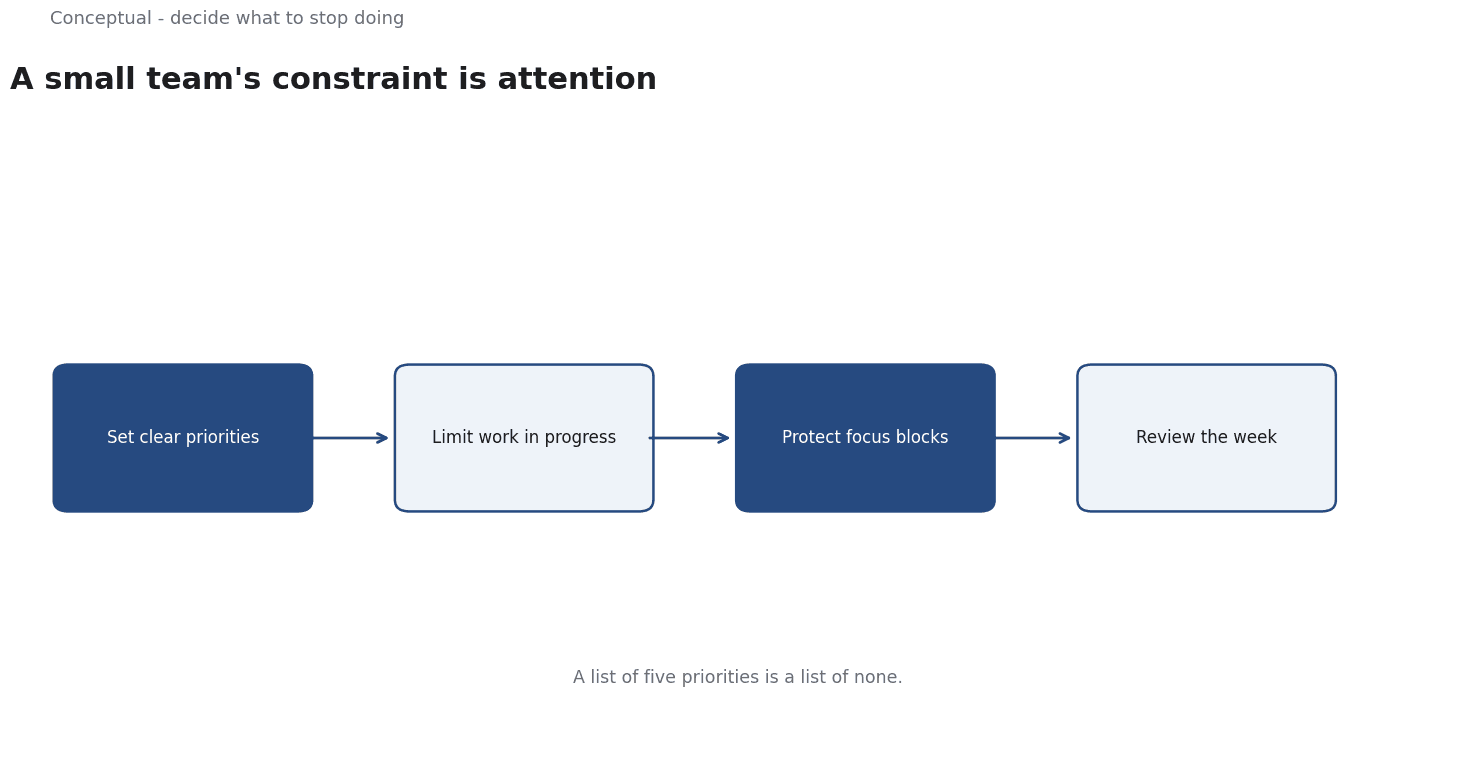
The decisions
What is the priority? The team should be able to state the one outcome that matters this week, as Engineering Management: Hiring, Culture, Metrics, and Career Ladders advises for clarity.
What is in progress? Work in progress consumes attention even when nobody is actively working on it, which the batching-economics article treats as queueing, as the Kanban literature would predict. Limiting it is a decision, not a productivity trick, as the AI-integration blueprint recommends for bounded experiments.
What is interruptible? Support, incidents, and requests arrive regardless of plans, which the incident-response article treats as a reality to design for, as the observability article recommends for alerting with an owner. A team that pretends otherwise will abandon its plan, as the crisis-planning article argues for rehearsed response.
What did the week actually contain? A review of real work, not intended work, which the time-tracking literature treats as the basis for improvement, as the retrospective method in the incident article recommends, as the decision-memo article requires for a recorded judgement.
Three consequences follow. The plan should be visible where work happens, which the documentation article advises. The team should be able to say no, which the negotiation article treats as a skill, as the marketing-budget article argues for allocation. And the plan should be reviewed after a change, as the monitoring article treats as a trigger.
A worked week
The following is hypothetical and illustrative. A five-person team plans a week with one priority, three active projects, and a support rotation.
Three checks decide whether the plan holds. First, is the priority stated in terms of an outcome, as the evaluation-rubric article requires for concrete criteria? Second, does the support rotation have a named owner and an escalation path, as Site Reliability Engineering: SLOs, Error Budgets, and Incident Response requires? Third, did the week's actual work match the plan, which the retrospective method in the incident article recommends, as the decision-memo article requires for a recorded review?
Three conclusions follow. The support rotation protected the rest of the team, which the incident article advises for containment. Three projects were still too many for five people, as the work-in-progress limit suggests, as the batching article explains for queueing. And the review produced a specific change for the next week, as the decision-memo article requires.
What time management cannot do
It cannot fix an unclear strategy, which the value-proposition article treats as prior, as the positioning article argues for direction before execution. It does not remove support load, which the incident article treats as a design question, as the observability article recommends for useful alerts. And it cannot create more people, which the capacity discussion in the engineering-management article treats as a real constraint.
The counterargument that a tool solves coordination is fair for visibility and wrong about decisions, which the dashboard article argues for metrics tied to action, as the content-operations article treats roles as the substance of a process.
A decision test
- State one outcome as the week's priority, as the decision-memo article advises.
- Limit work in progress to what the team can finish, as the batching article suggests.
- Name the support owner and escalation path, as Site Reliability Engineering: SLOs, Error Budgets, and Incident Response requires.
- Protect a block of uninterrupted work, as the deep-work literature recommends.
- Review actual work at the end of the week, as the retrospective method advises.
- Change the plan from evidence, as the evaluation-rubric article requires.
- Revisit after a team or priority change, as the monitoring article advises.
For the management substance, see Engineering Management; for the response pattern, see Incident Response.
References & Further Reading
- Google, 2026. Google re:Work — A large company's published people practices, including hiring and growth frameworks.
- U.S. Department of Labor, 2026. O*NET OnLine — The standard occupational taxonomy used to compare roles across industries.