Trade Promotions in Practice
A trade promotion pays the channel, not the shopper. Read how it works, a worked example, and why sell-in can hide weak sell-through.
A trade promotion is an incentive offered to a retailer or distributor, which makes it different from a consumer discount. The sales-promotion entry describes short-term incentives, as the discount entry covers price reductions, as the retail-channel article treats channel economics, as Wholesale Pitfalls warns about margin and customer ownership, as the unit-economics article requires for contribution, as the publication standard forbids guaranteed outcomes.
Direct answer:
Run trade promotions with a defined channel outcome, a sell-through measure, and a margin check — not a shipment target alone.
Wikipedia's sales-promotion entry provides the mechanism, and the discount entry covers price incentives. The boundary: a large sell-in order is not evidence of consumer demand, which the sell-in versus sell-out article explains, as the publication standard forbids guaranteed outcomes.
The mechanism
The incentive goes to the channel. A retailer is paid to stock, display, or feature a product, which the sales-promotion entry describes, as Wholesale Pitfalls treats channel economics, as the discount entry covers price incentives, as the unit-economics article requires for contribution, as the cash-flow article requires for cash spent, as the decision-memo article requires for a record.
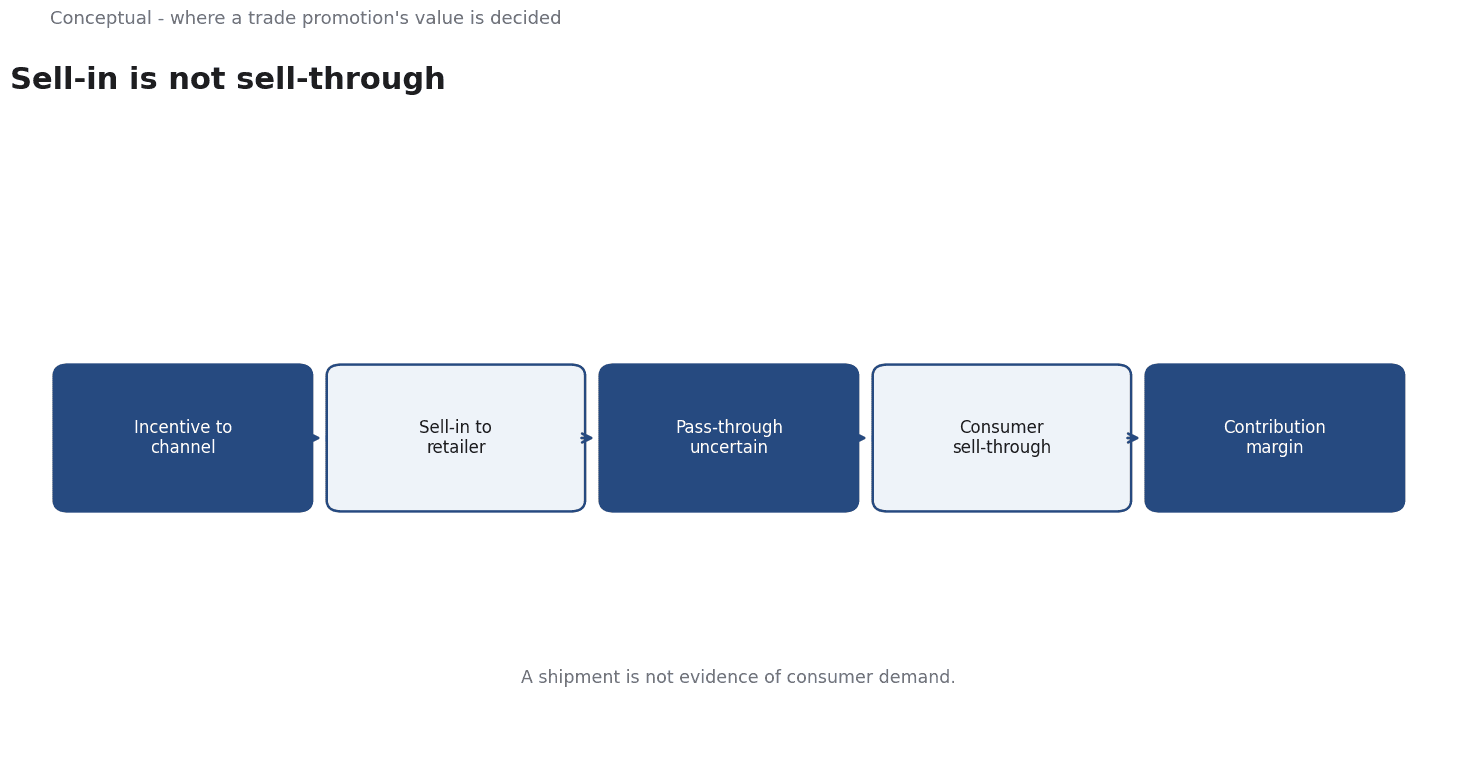
Sell-in is not sell-through. Shipments to a retailer are not purchases by consumers, which the sell-in versus sell-out article explains, as the inventory article treats stock as cash, as the supply-chain article treats service level, as the demand-forecasting article advises for metric choice, as the attribution article warns about credit rules, as the risk article requires residual risk.
Pass-through is uncertain. A channel may keep the incentive rather than lower the price, which the sales-promotion entry implies, as the pricing-psychology article treats framing, as the discount article warns about signals, as the value-proposition article argues for the buyer's evaluation, as the rubric article requires concrete criteria, as the monitoring article advises for review.
Margin decides. A promotion that raises volume while lowering contribution is not growth, which the unit-economics article requires, as the profitability article explains for accounting layers, as the cash-flow article requires for cash, as the dashboard article argues for metrics tied to decisions, as the risk article requires residual risk.
Three consequences follow. The channel outcome comes before the shipment, as the sell-in versus sell-out and rubric articles advise, as the dashboard article argues, as the unit-economics article requires, as the cash-flow article requires, as the data-governance article requires dated figures, as the monitoring article advises for review, as the risk article requires residual risk, as the value-proposition article argues, as the pricing-psychology article treats framing, as the discount article warns, as the attribution article warns about credit rules.
A worked example
The following is hypothetical and illustrative. A brand offers a retailer a discount to feature a product for a month.
Three checks decide. First, how much of the volume reached consumers rather than the warehouse, as the sell-in versus sell-out and inventory articles advise, with a measure, as the dashboard article requires? Second, did the retailer pass the saving on, as the sales-promotion entry and pricing-psychology article advise, with a criterion, as the rubric article requires? Third, what happened to contribution, as the unit-economics and cash-flow articles require, with dated figures, as data governance requires, as the risk article requires residual risk?
Three conclusions follow. Sell-in overstates demand, which the first check reveals.
And the decision should be recorded, as the decision-memo article requires.
What trade promotions cannot do
They cannot create consumer demand, which the value-proposition and demand-generation articles treat as prior, as the publication standard forbids guaranteed outcomes, as the risk article requires residual risk. They do not guarantee pass-through, which the pricing-psychology and discount articles advise, as the rubric article requires criteria, as the monitoring article advises for review. And they cannot fix a margin problem, which the unit-economics and profitability articles require, as the cash-flow article requires for cash, as the decision-memo article requires a reversal condition, as the risk article requires residual risk.
The counterargument that a large order proves success is fair for logistics and incomplete for consumer demand, which the worked example shows, as the sell-in versus sell-out and inventory articles advise, as the dashboard article argues, as the risk article requires residual risk.
A decision test
- Define the channel outcome, as the rubric article requires.
- Measure sell-through, as the sell-in versus sell-out article advises.
- Check pass-through, as the pricing-psychology article advises.
- Compute contribution, as the unit-economics article requires.
- Use dated figures, as data governance requires.
- Treat credit rules as claims, as the attribution article warns.
- Record the decision and residual risk, as the decision-memo and risk articles require.
For the distinction, see Sell-In vs Sell-Out; for the channel, see Wholesale Pitfalls.
References & Further Reading
- Wikipedia contributors, 2026. Sales promotion - Wikipedia — The mechanisms and costs of short-term promotional incentives.
- Wikipedia contributors, 2026. Discount - Wikipedia — The mechanics of price reductions and their strategic use.