The Difference Between Sell-In and Sell-Out in Retail
Sell-in measures what retailers buy from suppliers; sell-out measures what consumers buy from retailers. Confusing the two masks inventory problems and overstates demand.
A supplier reports record shipments to retailers, but store shelves are full and consumers are not buying. The supply chain looks healthy; the end customer tells a different story. The gap is the difference between sell-in and sell-out.
Direct answer: Sell-in is the volume of products a supplier sells to retailers or distributors. Sell-out is the volume those retailers sell to end consumers. Sell-in is a leading indicator of distribution success; sell-out is a lagging indicator of actual demand.
Confusing the two can make inventory buildup look like consumer demand and mask products that are sitting unsold in stores.
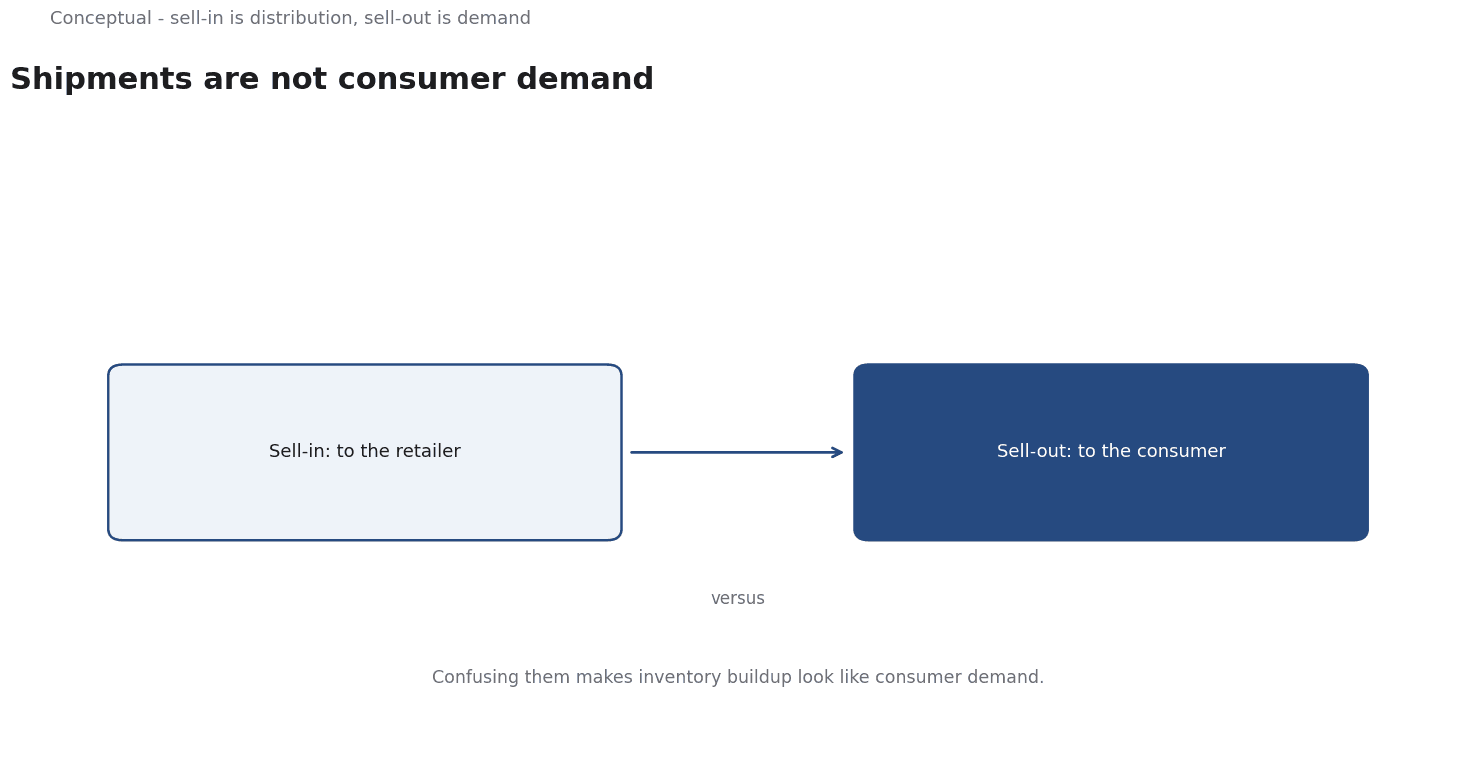
What sell-in measures
Sell-in records transactions between the supplier and the retail channel. When a beverage company delivers 100,000 cases to supermarket chains, that is sell-in. The supplier books revenue, and the retailer now owns the inventory.
Sell-in answers: how much product is in the channel? It is useful for production planning, revenue recognition, and supply chain coordination. But it says nothing about whether consumers want the product. A retailer may accept a large shipment because of a promotional allowance, a slotting fee, or a sales representative's target—not because shoppers are asking for it.
What sell-out measures
Sell-out records transactions between the retailer and the end consumer. When a shopper buys one case of that beverage at the register, that is sell-out. It is the true demand signal.
Sell-out answers: how much product is actually being consumed? It is harder to measure because it requires point-of-sale data from many independent retailers, but it is the number that ultimately matters. A product with high sell-in and low sell-out is accumulating inventory in retail channels, which eventually leads to returns, discounts, or delisting.
Why the gap matters
The difference between sell-in and sell-out is channel inventory. When sell-in exceeds sell-out, inventory builds up at retailers. This is not necessarily bad—retailers may be stocking ahead of a holiday—but sustained gaps signal trouble:
- Returns: retailers send unsold stock back to the supplier, reversing revenue.
- Markdowns: retailers discount to clear stock, eroding margin for both parties.
- Delisting: retailers remove the product from shelves, cutting off distribution.
A supplier celebrating strong sell-in while sell-out stagnates is celebrating inventory that will come back.
Measuring sell-out requires retailer cooperation
Suppliers do not always see sell-out data. Many retailers treat point-of-sale data as proprietary and share it selectively, if at all. Without sell-out visibility, a supplier is flying blind: shipments look strong while products gather dust in store backrooms.
Some categories and retail relationships provide better visibility. Direct-to-consumer brands see sell-out directly because they are the retailer. Large suppliers to major chains may receive regular POS data feeds. Small suppliers often rely on retailer sell-in orders and third-party market data, which are weaker signals.
Seasonality and forward buying
Sell-in can spike ahead of sell-out for legitimate reasons. Retailers build inventory before holiday seasons, product launches, or anticipated price increases. This forward buying inflates sell-in relative to sell-out temporarily. The key is whether sell-out catches up within a reasonable window. If holiday inventory is still on shelves in February, the sell-in was not forward buying; it was overestimation.
A practical check before celebrating growth
Before citing sell-in growth as evidence of demand:
- Is sell-out growing at a similar rate? If not, inventory is accumulating.
- Are returns or markdowns increasing? They often precede sell-in declines.
- Is the sell-in driven by promotions or forward buying? Temporary incentives can pull demand forward without creating new demand.
- Do you have visibility into retailer inventory levels? Without it, sell-in is an incomplete signal.
Sell-in gets products into stores. Sell-out gets them into homes. Only the second one sustains a business.
For the related question of how retailers decide which products to stock and how much, see Why Product Assortment Matters More Than Having More Products.
A worked example
The following is hypothetical and illustrative. A beverage supplier delivers 100,000 cases to a supermarket chain and books the revenue; that is sell-in. If shoppers buy one case at a time, sell-out is counted at the register, not at the warehouse. The two numbers can diverge for months, and the gap is inventory sitting in the channel rather than demand in the market.
Now suppose sell-out grows far more slowly than those shipments. The inventory does not disappear; it returns, gets discounted, or loses its shelf space. Returns reverse revenue, markdowns erode margin for both supplier and retailer, and delisting cuts off distribution. A supplier celebrating the 100,000-case quarter is celebrating stock that may come back.
The alternative explanation is forward buying: the chain stocked ahead of a holiday or a price increase, and sell-out will catch up. The test is timing. If the cases are still on shelves after the season passes, the shipments were not forward buying but overestimation. The same shipment looks like success or error depending on what happens downstream.
Where the reasoning breaks down
The core difficulty is visibility. Many retailers treat point-of-sale data as proprietary, so a supplier sees its own shipments clearly and the consumer's purchases dimly. Large suppliers to major chains may receive regular feeds; smaller ones rely on sell-in orders and third-party market data, which are weaker signals.
Published channel figures help frame the question. Data of the kind the National Retail Federation releases, and the retail e-commerce estimates the Census Bureau publishes, describe different layers of activity; neither tells a specific supplier whether its own cases moved off a shelf.
Working backwards, the method Bryar and Carr describe in the Amazon material, starts from the end consumer rather than the shipment. Ask what must be true at the register for the quarter to be a genuine success, then check whether the evidence supports it. Sell-in gets products into stores; only sell-out gets them into homes.
A counterargument
A reasonable critic would say the article leans too hard on sell-out as "the true demand signal." Its own sources describe layers, not a single clean answer: the Census figures cover retail e-commerce only, and the NRF channel data, as the article itself notes, cannot tell a specific supplier whether its own cases left a shelf. The Bryar and Carr working-backwards method is a reasoning discipline, not a feed of consumer truth. Even perfect sell-out counts register purchases, not consumption, and a case bought on promotion is still sell-out. The article concedes that forward buying legitimately widens the gap, which weakens its own "inventory buildup looks like demand" framing. The distinction it draws is real; the certainty it attaches to sell-out is not fully supported by the sources it cites.
References & Further Reading
- National Retail Federation, 2026. NRF Press Releases | Latest Statements & Announcements | NRF — Primary retail-sales and channel data for sell-in versus sell-out definitions.
- U.S. Census Bureau, 2026. Quarterly Retail E-Commerce Sales — The official definition and estimates for retail e-commerce sales.
- Colin Bryar and Bill Carr, 2019. Amazon Company News — Primary company material on how the working-backwards method is applied.