Wholesale Pitfalls
Wholesale trades margin for reach. Read the pitfalls, a worked channel review, and why a larger order does not mean a better business.
Wholesale looks like growth: more doors, bigger orders, simpler logistics than selling directly. The pitfalls appear later, when margins are thinner than expected, the retailer controls the customer relationship, and inventory decisions are made by someone else, as E-commerce vs Brick and Mortar: The Economics of Retail Channels treats channel economics as a structure, as the distribution-channels article explains how reach is obtained, as Private Label: a Decision Framework warns about who owns the customer.
Direct answer:
Enter wholesale deliberately by modelling the margin after retailer discounts and returns, defining who owns the customer relationship, and checking inventory and demand signal.
The demand-generation overview explains the stages a channel serves, and NRF statements provide primary retail context. The boundary: this is educational orientation, not a guarantee — channel terms and retail conditions change, as the industry lens requires scope and limits, as the publication standard forbids guaranteed outcomes.
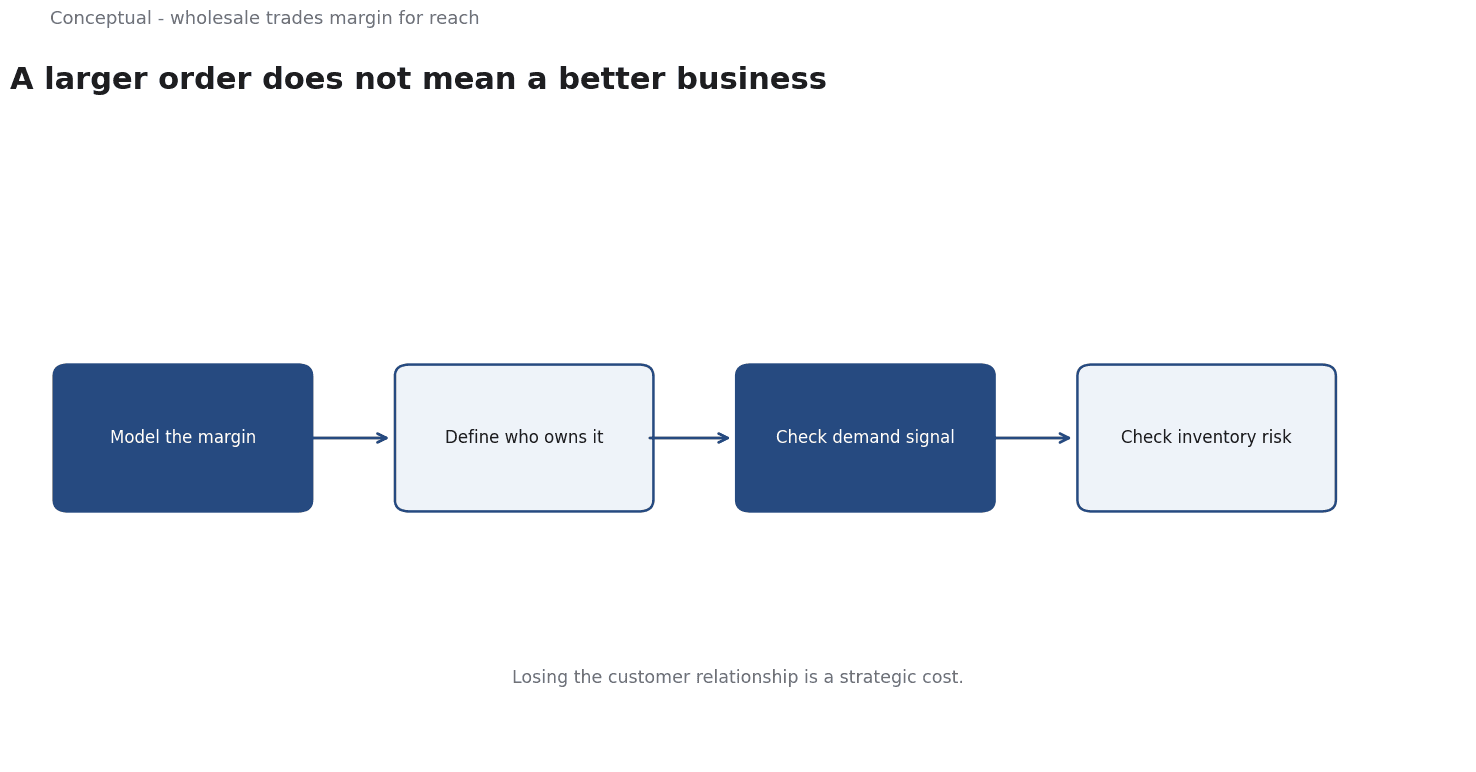
The pitfalls
Confusing sell-in with sell-through. A large order to a retailer is inventory moving to a warehouse, not necessarily to a customer, which the retail-channel article treats as a distinction between channels, as the inventory article treats stock as a cash decision, as the demand-generation article advises on preference before capture.
Ignoring the full margin. Retailer discounts, returns, and slotting costs can erase the headroom, which the unit-economics article requires for contribution, as the pricing article treats margin as a constraint, as the cash-flow article requires for the cash actually received.
Losing the customer relationship. In wholesale, the retailer often owns the end customer, which the private-label article treats as a strategic risk, as the advocacy article argues for genuine connection, as the voice-of-customer article treats direct feedback as a signal.
Assuming demand signals transfer. Orders from a retailer reflect their forecast, not final demand, which the supply-chain article treats as a signal problem, as the demand-forecasting article advises for metric choice, as the bullwhip literature would warn about amplification.
Three consequences follow. The economics should be modelled before entry, as the unit-economics article requires, as the worked review shows. The customer relationship should be explicit, as Private Label: a Decision Framework advises. And the channel should be reviewed after a change, as the monitoring article treats as a trigger, as the decision-memo article requires for a recorded judgement.
A worked channel review
The following is hypothetical and illustrative. A brand considers selling through a national retailer alongside its direct channel.
Three checks decide. First, what is the margin after the retailer's discount, returns, and required support, which the unit-economics article requires, as the pricing article treats as a constraint, as the cash-flow article requires for the cash received? Second, who owns the customer relationship and the feedback, which the private-label and voice-of-customer articles treat as strategic, as the demand-generation article advises on preference? Third, what demand signal will the brand actually see, as the supply-chain and demand-forecasting articles advise, with a dated series from NRF statements for retail context, as the data-governance article requires for provenance?
Three conclusions follow. A bigger order is not a better business if the margin is thin, which the economics check reveals.
And the decision should be recorded with the assumptions, as the decision-memo article requires.
What wholesale analysis cannot do
It cannot guarantee retail placement or volume, which the publication standard forbids claiming, as the NRF material provides context rather than forecasts. It cannot replace direct demand evidence, which the voice-of-customer and demand-forecasting articles advise, as the inventory article treats stock as a cash decision. And it does not remove the need for a value proposition, which the value-proposition article treats as prior, as the positioning article argues for direction before channel.
The counterargument that wholesale is simpler than direct sales is fair about logistics and incomplete about margin and customer ownership, which the worked review shows, as E-commerce vs Brick and Mortar: The Economics of Retail Channels advises for channel economics.
A decision test
- Model the full margin after discounts and returns, as the unit-economics article requires.
- Distinguish sell-in from sell-through, as E-commerce vs Brick and Mortar: The Economics of Retail Channels advises.
- Define who owns the customer relationship, as Private Label: a Decision Framework warns.
- Check the demand signal available, as the supply-chain article advises.
- Use dated retail context, as the data-governance article requires.
- Treat the channel as a hypothesis, as the competitive-intelligence article warns.
- Record the decision and review on change, as the decision-memo article requires.
For the channel economics, see E-commerce vs Brick and Mortar; for the strategic risk, see Private Label.
References & Further Reading
- Wikipedia contributors, 2026. Demand generation - Wikipedia — An overview of demand generation as a marketing discipline distinct from lead generation; secondary reference used with the lead-generation entry.
- National Retail Federation, 2026. NRF Press Releases | Latest Statements & Announcements | NRF — Primary retail-sales and channel data for sell-in versus sell-out definitions.