Venture Capital and Private Equity: How Startups Get Funded
Funding is a sequence of instruments, not a ladder. Read how venture capital actually works, what it prices, and what it is not for.
Venture capital is usually described as a ladder: you raise a seed round, then a Series A, then a B, and each rung gets you further along. That picture is tidy and wrong in two important ways — the instruments on each rung are different in kind, not just in size, and the ladder is not the only funding route, or even the most common one.
Direct answer: Venture funding works because the investor is buying a large expected return from a small probability of an extreme outcome, and the mechanism that makes it work is a set of instruments — equity, convertible notes, SAFEs — that transfer risk asymmetrically and control the terms. Most companies that raise external capital never raise venture capital at all, and a business that needs financing rather than risk capital should be looking at debt. The first question for any founder is therefore not "which investors" but "am I raising capital or risk capital", and the two have different instruments, different prices, and different consequences.
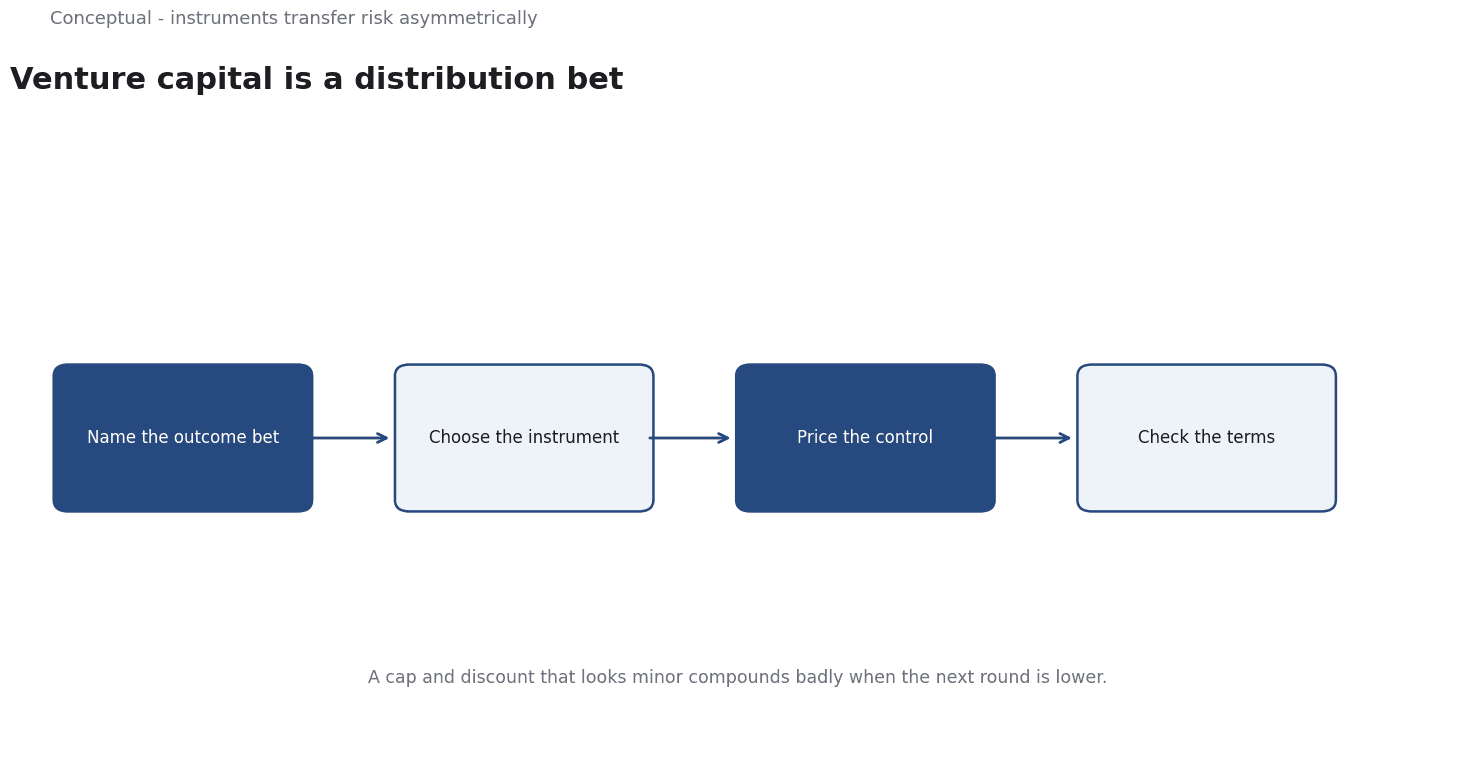
The asymmetry that makes it work
The reason venture capital exists is that it can absorb failure. A fund that makes ten investments and one becomes enormous can return multiples of its fund size; a lender that makes the same ten loans and one defaults has a problem. So venture capital is structurally risk-bearing in a way that debt is not, and the terms reflect that.
Two consequences follow, and they explain most of what founders find surprising.
First, the required return is very high, because the investor is compensated for bearing the whole downside. That is why a venture-backed company is usually told to prioritise growth over margin, and why the same advice applied to a profitable bootstrapped business is wrong. The capital is priced for the risk, and the plan has to match the capital.
Second, control matters. Because the payoff is so skewed, the investor needs influence over decisions that materially change the probability of the extreme outcome — which is why rounds come with board seats, information rights, liquidation preferences, and anti-dilution terms. These are not incidental legal details; they are the mechanism by which the asymmetry is priced.
The instruments are different in kind
Calling everything "a round" hides the part that matters.
Equity is the simplest: you sell ownership. The price per share is negotiated, and it is a claim on future value with no defined downside. It is the most expensive form of capital in terms of what the founders give up.
Convertible notes are debt that converts to equity at a later price, with a cap and often a discount. They let a company raise money quickly without setting a valuation immediately, and they defer the valuation conversation to a later, larger round. The trade-off is that they accumulate, and a company that keeps extending them signals a problem to later investors.
SAFEs — simple agreements for future equity — are a simpler instrument with no interest and no maturity. They were designed to solve a specific problem: letting a startup raise without a priced round when the company preferred not to set a valuation yet.
The practical advice is to know which instrument you are signing, what the conversion terms do to the next round's price, and how many outstanding instruments you have.
What venture capital is actually for
The honest framing: venture capital is for businesses whose outcome distribution justifies the required return.
That means a large addressable market, a technology or business model that could scale, and a founder or team with evidence they can execute. If a business has predictable revenue, positive unit economics, and modest capital needs, it is a poor fit for venture capital — and it is a good fit for debt.
The alternative routes are worth taking seriously because they are cheaper:
Debt, where the lender is repaid with interest regardless of how the company performs. The Small Business Administration's programmes exist here, and the framing is instructive: SBA-guaranteed loans "generally have rates and fees that are comparable to non-guaranteed loans", and Lender Match connects a borrower with participating lenders. Debt pricing does not depend on a growth story; it depends on cash flows and collateral.
Revenue-based financing, where repayment scales with collections. It is expensive and it consumes cash flow ahead of other obligations, but it does not dilute.
Customer capital, which is the cheapest money available and is usually overlooked: prepayments, annual contracts paid in advance, or a customer who invests.
Bootstrapping and retained earnings, which is what most successful companies actually do. The selection effect is worth naming: the companies you read about in a technology publication were the ones that raised, because raising was part of the story.
Private equity is a different animal
Private equity is not venture capital with a bigger cheque, and the difference is structural. PE funds buy mature companies with predictable cash flows, use leverage, and improve or reposition them for an exit. The return comes from operational improvement and multiple expansion rather than from an extreme outcome, which is why it can price risk differently and why the management team's incentive structure matters so much.
Two implications for anyone considering PE capital. First, the leverage is part of the model, so the business must tolerate debt in a downturn — the risk profile of a PE-backed business is not the same as a founder-owned one. Second, the time horizon is bounded by the fund's life, which creates pressure for a visible exit. That pressure is not automatically bad, but it is real, and it belongs in the conversation before the transaction rather than after.
How the external environment shows up in the terms
Venture terms are not set in a vacuum. Rates drive discount rates, which drive the valuations investors can pay and the returns they need; the rate environment is published, dated, and public.
The Federal Reserve's monetary policy page is the place to read the current state of the framework and its tools, and the H.15 release provides "Selected Interest Rates (Daily)" — the series that anchors both discount-rate arguments and the returns that make a target return plausible in a given environment. The Federal Reserve Bank of St. Louis's FRED database makes the wider macro set available with release dates attached.
The point for a founder is narrow but important: the price of capital is not a constant, and a term sheet negotiated in one environment can look indefensible in the next. Read the environment at the time you negotiate, and revisit it if the round takes longer than expected.
A checklist before you sign anything
- Are you raising capital or risk capital? If the business has predictable revenue and modest needs, compare debt and revenue-based financing before an equity round.
- What are you giving up, in ownership and in control? Model the post-money ownership and the board and consent terms, not just the headline valuation.
- What happens at the next round if this one does not work? Cap, discount, and conversion terms compound; model them.
- How many instruments are outstanding, and what does the total cap table look like to the next investor?
- Does the lead's value add up for you beyond the money? A good investor opens doors, and a bad one consumes the time you would spend building the business.
- What is the market rate environment today, and what does the target return imply?
- What is the alternative use of this capital? If the company would be better with two engineers and no investors, the comparison matters more than the valuation.
For the corporate-finance mechanics underneath the decision, see Corporate Finance Essentials; for the rate environment, see Interest Rates and Their Effect on Technology Companies.
A worked example
The following is hypothetical and illustrative. Consider a founder of a small software business with steady subscription revenue and a need for a modest sum to hire two engineers. The question is whether the need is capital or risk capital. The first check is the fit test: with predictable revenue and modest needs, the business resembles a debt candidate, not a venture case, so the founder compares an SBA-guaranteed loan via Lender Match with an equity round. The second check is instrument mechanics: the founder models a SAFE's cap and discount, and sees that if the next round is priced lower than expected, those terms convert into a larger ownership giveaway exactly when cash is tightest. The third check is the environment: before signing, the founder reads the current rate from the Federal Reserve's H.15 "Selected Interest Rates (Daily)" series and FRED rather than assuming last year's price of capital. The outcome is bounded: the founder takes the guaranteed loan, keeps the cap table clean, and resolves to revisit the rate environment if financing takes longer than planned.
A counterargument
A reasonable critic would push back on the article's confidence that a founder can classify the business as needing 'capital' or 'risk capital' before the outcome distribution is known, which is precisely the uncertainty the early stage creates. The piece itself notes that cap and discount terms compound and that the rate environment changes the price of capital, yet it presents the instrument choice as a one-time rational decision;
a SAFE that defers valuation can harden into terms that constrain the very round it was meant to enable.
The prescription to bootstrap also leans on a selection effect the article names but does not resolve: the successful bootstrapped companies are the ones still visible to tell the story.
References & Further Reading
- U.S. Small Business Administration, 2026. Access affordable 7(a), 504, and microloans — How SBA-guaranteed lending works, including Lender Match and the note that guaranteed loans generally carry rates and fees comparable to non-guaranteed ones.
- U.S. Securities and Exchange Commission (Investor.gov), 2026. Introduction to Investing — Primary regulator guidance on market mechanics and investor protection.
- Federal Reserve Bank of St. Louis, 2026. FRED economic data — The primary time-series database used for macro indicators.