Interest Rates and Their Effect on Technology Companies
Rates move the cost of capital, the price of future cash flows, and customer budgets. Read which channel actually dominates your company.
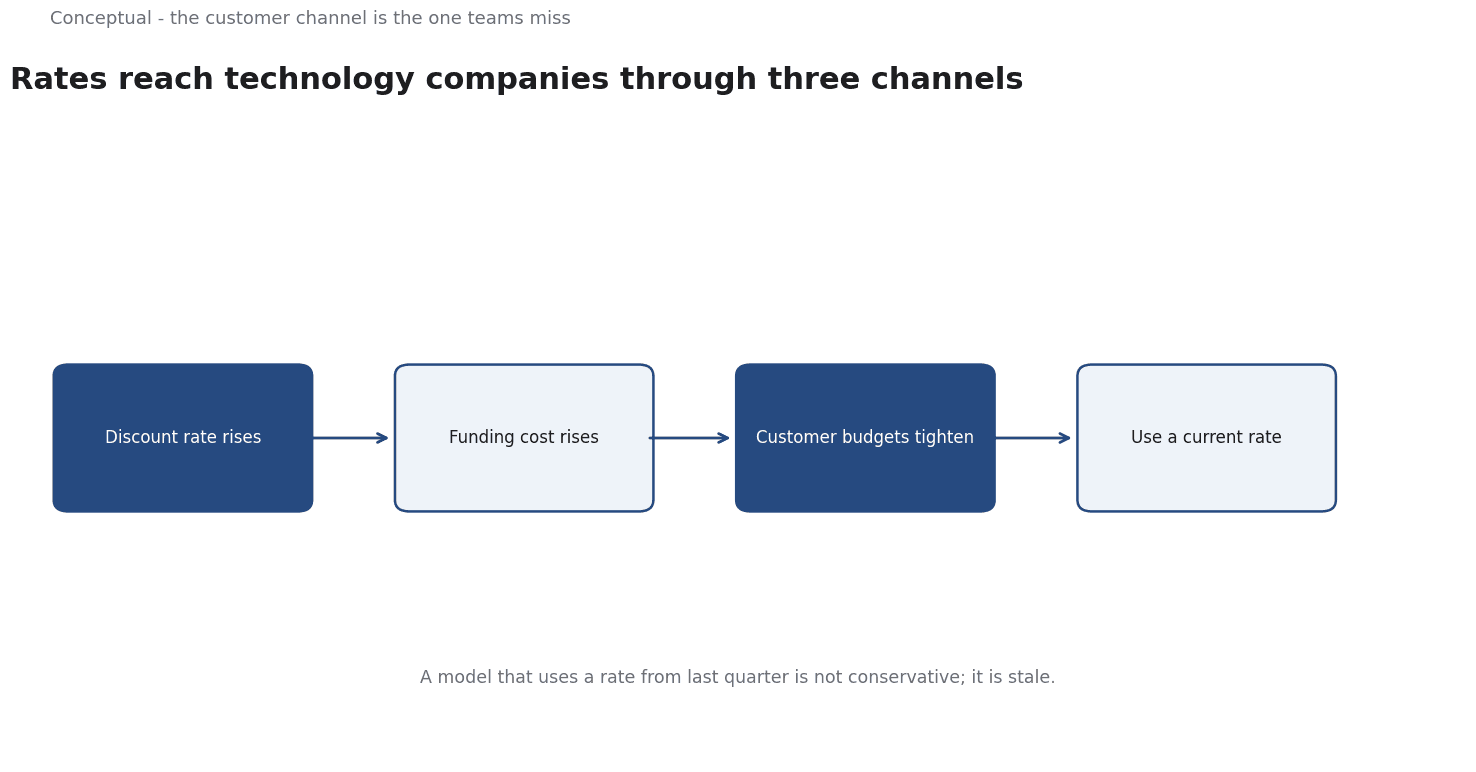
Technology companies are often described as unusually sensitive to interest rates, and the claim is true for several different reasons that are rarely separated. A rate change affects the discount rate in a valuation, the cost of funding a loss-making business, the budget of a customer whose spending depends on credit, and the attractiveness of holding a long-duration asset. Those channels operate on different timescales, and the one that matters depends on the company's stage.
Direct answer:
The direct channel is the cost of capital: a higher risk-free rate raises the discount rate and reduces the present value of cash flows that arrive far in the future, which is exactly the profile of a growth technology company.
The indirect channels run through customer budgets and funding availability. The risk-free rate is published rather than estimated — the Federal Reserve's H.15 release provides selected interest rates daily, including Treasury yields — so the first discipline is to date the input rather than argue about it from memory.
The valuation channel is arithmetic
A company whose cash flows are expected to grow far in the future has a valuation that depends heavily on the discount rate, because distant cash flows are discounted more. When the risk-free rate rises, the whole discount rate typically rises with it, and the present value of those distant flows falls.
This is why the same company can be described as worth very different amounts in different rate environments without anything in its operations changing. The operating business did not deteriorate; the price of money did. That is not a reason to ignore the change — financing conditions are real — but it is a reason to distinguish a valuation effect from a business one.
Corporate finance valuation depends on more than the risk-free rate: the equity risk premium, the company's beta, and its capital structure all enter the WACC. But the risk-free component is the one that can be observed on a specific date, which is why a valuation should record it with its observation date.
The funding channel depends on stage
A profitable business with no external funding need is barely affected by rates in its operations. A loss-making business that raises equity to fund growth is affected in a different way: when rates rise, investors' required returns rise, valuations compress, and the terms of new rounds become harder.
This is one of the reasons the advice "grow at all costs" is environment-dependent. It makes sense when capital is cheap and the required return is low; it stops making sense when the price of capital changes, even if the product and the market have not. The operational consequence is a shorter runway for the same cash balance, and a need to demonstrate efficiency rather than growth alone.
For smaller companies, debt is often the alternative. The Small Business Administration's programmes are a useful reference point: its guaranteed loans generally have "rates and fees that are comparable to non-guaranteed loans", and its Lender Match service pairs borrowers with participating lenders. The point is that the rate environment reaches small technology businesses through financing channels that are visible in published terms.
The customer channel is the one teams miss
A customer's ability to buy is affected by the same rate environment. If your customers are businesses whose budgets depend on credit, or consumers whose discretionary spending depends on borrowing costs, a rate change reaches your revenue with a lag.
That lag is why a company can report a strong quarter and still face a demand problem that has not shown up yet. The Federal Reserve's Beige Book is useful here as a qualitative source on regional economic conditions, and the Monetary Policy Report provides the broader assessment — both are published on a schedule you can plan around.
The practical response is not to forecast the customer's budget. It is to segment customers by their exposure to credit and to watch those segments separately, so a demand shift is visible early rather than after it reaches the aggregate.
What to do
- Date the risk-free rate in every valuation, from the latest H.15 release.
- Separate the valuation effect from the operating effect when explaining a changed number to a board or an investor.
- Stress the funding plan at a rate higher than the current one, and check the runway under that assumption.
- Segment customers by credit exposure and watch the vulnerable ones as a leading indicator.
- Read the Fed's own materials — the framework, the tools, the Monetary Policy Report — rather than a summary.
- Revisit the pricing decision separately. Macro affects the environment; elasticity and value decide the price.
For the valuation mechanics, see Corporate Finance Essentials; for the sector context, see Real Estate Markets.
A worked example
The following is hypothetical and illustrative. Consider a mid-stage software company with 18 months of runway and no debt, preparing both a valuation for its board and a plan to raise equity. Three checks follow the article's channels. First, the valuation memo records the 10-year Treasury yield from a dated H.15 release rather than a figure remembered from last quarter, and lists the equity risk premium and beta beside it. Second, the funding plan is stressed at a rate two percentage points above the current one, and the runway is recomputed under that assumption rather than assumed unchanged. Third, customers are split by credit exposure, and the credit-sensitive segment is watched through the Beige Book and Monetary Policy Report rather than folded into the aggregate. In this imagined case the valuation falls while operations are flat, the stressed runway shortens, and the vulnerable segment softens before the total does. The team can then name which channel moved and avoid calling a price-of-money effect a business decline.
A counterargument
A reasonable critic would object that separating the channels is an analytic convenience that understates how they arrive together. The cited sources (FRED, the ECB's strategy review, and Damodaran's datasets) supply observable rates and valuation inputs, but none establishes that a rate move reaches a company through one channel at a time; compressed valuations, tighter funding terms, and credit-constrained customers can hit the same firm at once, which the stage-by-stage framing tends to separate. There is also a sourcing gap: the instruction to date the risk-free rate from the Federal Reserve's H.15 release is central to the 'what to do' list, yet H.15 appears only in the body and not among the references, so the most operational step rests on an uncited source.
A critic could argue the taxonomy is useful for explanation but thinner as a guide to action than its checklist suggests.
References & Further Reading
- Federal Reserve Bank of St. Louis, 2026. FRED economic data — The primary time-series database used for macro indicators.
- European Central Bank, 2026. Evaluating our strategy — Primary material on the inflation-targeting framework.
- Aswath Damodaran, 2026. Damodaran Online: Home Page for Aswath Damodaran — Publicly maintained datasets for industry averages, WACC, and valuation.