Webinar Marketing Best Practices
Webinars are web conferences used for demand generation. Read how the format maps to a demand decision, with a worked example and claim-status table.
Webinars are often treated as a simple lead-capture tactic, but their value depends on how they generate demand and on what the web conferencing format can actually deliver. The web conferencing entry describes the technology of online meetings, and the demand generation entry describes building awareness and interest. The real problem is connecting the format to a demand outcome rather than counting registrations.
Direct answer:
A webinar is a web conference used as a demand-generation asset, so its success should be judged by the interest and pipeline it creates, not by attendance alone.
The two entries supply the format and the goal; the linking rule here is a synthesis.
Delta: This article adds a claim-status table and a worked example beyond the two sources: it maps web conferencing capabilities to demand-generation decisions, with claim status explicit.
The mechanism
The web conferencing entry describes tools that let people meet, share content, and interact online in real time. These capabilities, such as slides, screen sharing, chat, and question channels, define what a webinar can do during a session. A practical consequence is that the format supports two-way interaction, not just broadcast. A session that uses only the broadcast features leaves the interactive capabilities unused, and the demand effect is weaker.
The demand generation entry describes activities that create awareness and interest in a product or brand. Demand generation is a process that spans before, during, and after an event. A webinar sits inside that process as one asset. Its job is to move an audience from awareness to interest, and sometimes to intent. Judging it only by sign-ups confuses the top of the process with the outcome.
The connection between the two is the audience's attention. Web conferencing provides a channel that holds attention for a defined period, while demand generation provides the goal that attention should serve. The practical consequence is that promotion, content, and follow-up must be designed together. A well-run session with no follow-up lets interest decay, and strong follow-up cannot rescue a session that fails to deliver useful content.
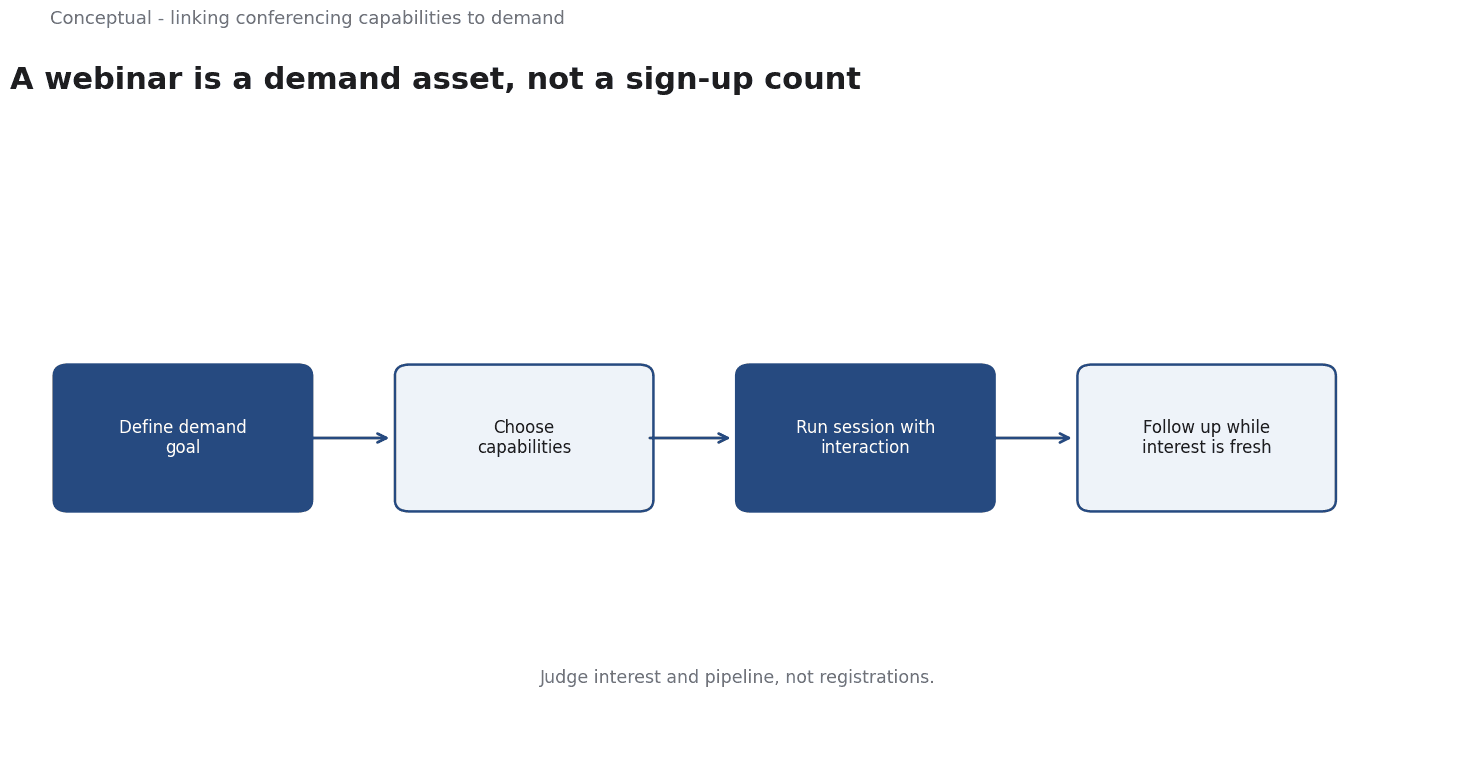
The sequence is to define the demand goal, choose which conferencing capabilities serve it, run the session around that choice, and follow up while interest is fresh. The existence of the format and the concept of demand generation are source-reported. The practice of judging a webinar by pipeline rather than attendance is inferred from those concepts, and it should be rechecked when the buying cycle changes.
A worked example
The following is hypothetical and illustrative. A team runs a monthly webinar and reports strong registration numbers, yet sales reports little interest from attendees. Three checks decide the response. First, did the promotion target an audience with a real problem, or a broad list with weak intent? Second, did the session use the interactive capabilities, such as questions and chat, or was it a one-way presentation? Third, did follow-up occur while interest was fresh, with a clear next step? The outcome is a redesign around a specific demand goal and a follow-up sequence, rather than more promotion of the same format. The scenario is hypothetical; the mapping from format to demand decision is the contribution.
Evidence status
| Claim | Status | Source | Verified | Recheck when |
|---|---|---|---|---|
| Web conferencing supports real-time interaction | source-reported | Wikipedia, Web conferencing | 2026-11-18 | Feature set changes |
| Demand generation builds awareness and interest | source-reported | Wikipedia, Demand generation | 2026-11-18 | Definition changes |
| Judge webinars by pipeline, not attendance | inferred | Derived from the sources | 2026-11-18 | Buying cycle changes |
The table separates the format and the goal from the measurement rule added here. Both source-reported rows are stable descriptions. The inferred row carries the most uncertainty because it depends on how a particular market buys, so it needs the earliest recheck. When the sales cycle lengthens or shortens, the window for judging interest and following up changes with it.
What it cannot do
Webinar marketing cannot create demand where none exists. A web conference is a channel, and a channel amplifies an underlying interest rather than inventing it. The demand generation entry is about building awareness and interest over time, which means a single session cannot substitute for the work that precedes it. If the audience does not recognize a problem, a polished session will not produce intent, and a high registration count will not convert.
The hidden cost is the time and attention consumed, both by the team and by the audience. Producing a good session requires preparation, and promotion competes with other demands on a marketing calendar. Attendees give up time that they could spend elsewhere, and a session that wastes it damages trust rather than building interest. The web conferencing entry describes capabilities, but it does not guarantee that a session uses them well, and poor execution carries a reputational cost.
Registration is easy to inflate with broad promotion, and it measures the success of the invitation, not the success of the session or the demand it creates. A team that rewards registrations will keep widening the audience, while the number of genuinely interested participants stays flat. The result is a metric that rises as the outcome stagnates, which is the opposite of a useful signal.
The boundary is that these sources describe a format and a concept, not a measurement system. Web conferencing provides the channel and demand generation provides the goal, but neither supplies the attribution needed to connect a session to pipeline. Linking attendance to later purchases requires tracking choices that the sources do not address. A team must decide how to connect the two, and that decision is local and reviewable.
For these reasons the demand goal and the follow-up window need regular review. A format that worked when the buying cycle was short may fail when decisions take longer and interest must be nurtured over months. The capabilities of the conferencing tool also change, and new interaction features may change what a session can achieve. A best practice is a current hypothesis, not a permanent rule, and it should be tested against the demand outcome it claims to serve.
The counterargument that registrations are the simplest metric to track is fair for reporting activity and incomplete for demand, because a count of sign-ups does not show whether interest became intent.
A decision test
- Define the demand goal for the session.
- Choose conferencing capabilities that serve that goal.
- Promote to an audience with a relevant problem.
- Run the session using interaction, not only broadcast.
- Follow up while interest is fresh.
- Measure interest and pipeline, not just registrations.
- Record the goal, the result, and a recheck date.
The steps turn a webinar from an isolated event into a demand asset with a reviewable outcome. Their value is not a larger registration list but a clearer line from the session to the interest it created. For a related treatment of how marketing measurements enter decisions, the reading below offers context without repeating this method.
For further reading, see Marketing Dashboards without the Hype.
References & Further Reading
- Wikipedia contributors, 2026. Web conferencing - Wikipedia — Live online presentations and events.
- Wikipedia contributors, 2026. Demand generation - Wikipedia — An overview of demand generation as a marketing discipline distinct from lead generation; secondary reference used with the lead-generation entry.