Web Accessibility at Scale
Accessibility fails in the gaps between components. Read how to address it across a large site, a worked audit, and why a scanner is only a start.
A single accessible page is a design problem; an accessible site at scale is a systems problem. The same pattern repeats across templates — a missing label, a low-contrast state, a control that cannot be reached by keyboard — which is why fixing pages one at a time cannot keep up, as the WebAIM WCAG material explains the standards, as MDN's accessibility reference covers implementation, as the design-system article treats components as the unit of reuse.
Direct answer: Address accessibility at scale by fixing shared components, adding automated checks to the build, and testing with assistive technology on representative journeys. WebAIM covers the standards, and MDN covers implementation. The boundary: automated checks find a subset of issues, which the WebAIM material implies, and no tool certifies full accessibility, as the publication standard forbids guaranteed outcomes, as the evaluation-rubric article requires for concrete criteria.
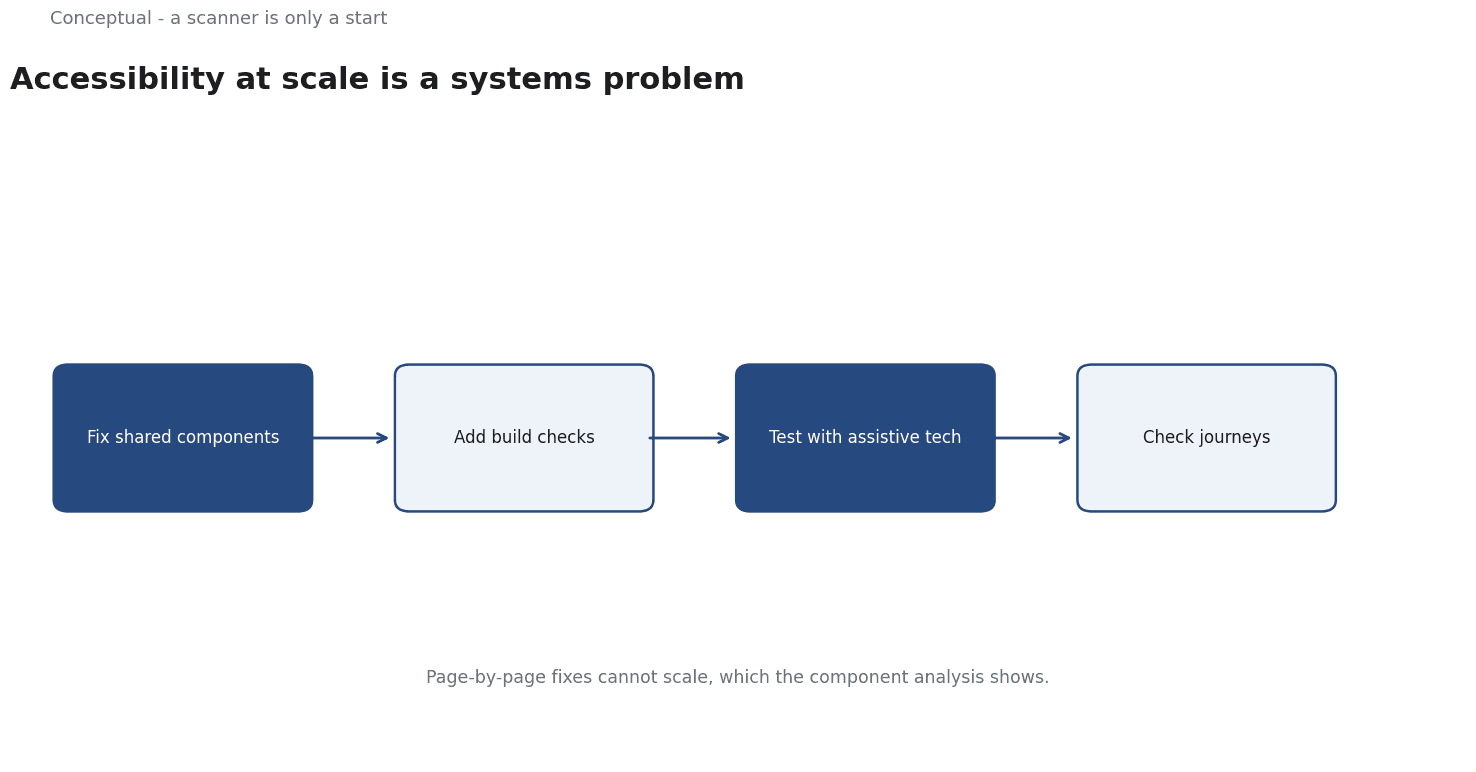
The approach
Fix the component, not the page. A defect in a shared button appears everywhere the button is used, which the design-system article treats as the unit of change, as the component-library article advises for governance, as Technical Debt: The Hidden Cost of Shortcuts warns about repeated fixes.
Automate what can be checked. Missing labels, contrast, and structure can be checked in CI, which the testing article advises for a gate, as the evaluation-rubric article requires for concrete criteria, as the linting article treats mechanical checks as a baseline.
Test journeys with assistive technology. Keyboard and screen-reader paths must work in practice, which MDN's accessibility reference covers, as the usability-testing method advises for real users, as the customer-journey article argues for evidence from real people.
Keep a record. Which components are affected, which checks run, and which journeys were tested, which the data-governance article requires for provenance, as the decision-memo article requires for a recorded judgement.
Three consequences follow. The fixes compound, which the design-system article argues, as the component-library article advises for ownership. The automated gate catches regressions, as the testing article advises, as the monitoring article treats as a review trigger. And the manual testing finds what automation misses, as the customer-journey method advises, as the WebAIM material implies for standards.
A worked audit
The following is hypothetical and illustrative. A site with 10,000 pages reports accessibility defects across templates.
Three checks decide the response. First, which defects come from shared components, as the design-system article asks, so a fix propagates, as the component-library article advises? Second, what can the automated gate catch in CI, as the testing article advises, with concrete criteria, as the rubric article requires? Third, do the main journeys work by keyboard and screen reader, as MDN's reference and the customer-journey method advise, with evidence from real people, as the customer-journey article argues?
Three conclusions follow.
Page-by-page fixes cannot scale, which the component analysis shows.
Automation handles the mechanical layer, as the testing article advises, as the linting article treats as a baseline. And manual testing covers the rest, as the customer-journey method recommends, as the decision-memo article requires for a record.
What accessibility at scale cannot do
It cannot certify full accessibility, which the publication standard forbids claiming, as the WebAIM material treats the standards as guidance, as the rubric article requires for concrete criteria.
It does not remove the need for user testing, which the customer-journey method advises, as the customer-journey article argues for evidence from real people. And it cannot fix a design that excludes users, which the inclusive-design literature treats as a prior question, as the value-proposition article argues for the buyer's evaluation.
A decision test
- Identify which defects originate in shared components, as the design-system article advises.
- Fix the component, as the component-library article recommends.
- Add automated checks to the build, as the testing article advises.
- Test key journeys with assistive technology, as MDN's reference advises.
- Record the components and journeys tested, as data governance requires.
- Review after a template change, as the monitoring article advises.
- Record the decision, as the decision-memo article requires.
For the compounding cost of repeated fixes, see Technical Debt; for the discipline of recording what was tested, see Content Operations. The component approach explains why a shared fix matters more than a page fix, as the design-system literature argues for a single unit of change, as the evaluation-rubric article requires for concrete criteria, as the decision-memo article requires for a recorded judgement, as Data Quality advises for a defined quality bar.
For the standards, see WebAIM WCAG; for the implementation, see MDN Accessibility.
References & Further Reading
- WebAIM, 2026. WebAIM: Web Content Accessibility Guidelines — Accessible explanation of the WCAG standards.
- MDN Web Docs, 2026. Accessibility | MDN — Developer reference for accessible web interfaces.