What Brand Lift Measurement Actually Measures
Brand lift tracks self-reported awareness change, not incremental sales. Read what it measures, a worked example, and the budget decision it can support.
Brand lift results are often presented as evidence that an advertising campaign worked. The real problem is that a lift in a survey response is a change in what people say they remember or recognize, which is not the same thing as a change in what they bought. A campaign can move awareness while leaving sales untouched, and the number that gets reported does not tell the two apart.
Direct answer: Brand lift measures the change in self-reported awareness, recognition, or recall associated with a campaign, along with related communication effects such as stated preference. It does not measure incremental sales or prove that the campaign caused later purchases. The sources define awareness and the communication mix; the causal limit is a synthesis.
Delta: This article adds a claim-status table beyond the sources: it maps a brand-lift result to one budget decision, with claim status explicit.
The mechanism
The brand awareness entry describes how familiar consumers are with a brand, commonly distinguished as recognition, when a person identifies a brand they have seen, and recall, when they can name it without a cue. The mechanism is retrieval from memory: awareness is demonstrated when a person can recognize or recall the brand in a survey. The practical consequence is that brand lift, when it is measured this way, records a change in what respondents can retrieve at the moment of asking. That is a real mental effect, but it is an effect on memory, not a transaction, and it depends on who was asked and how.
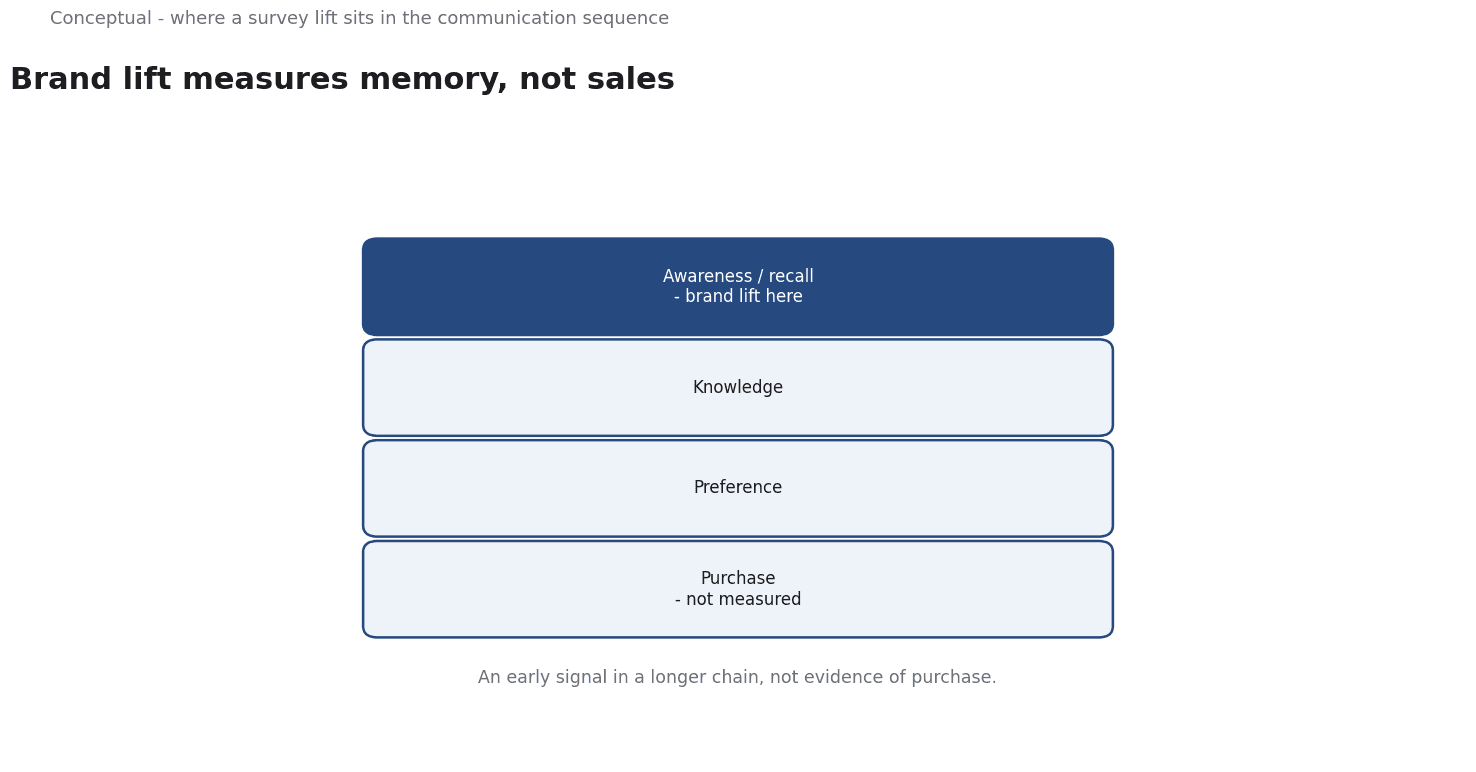
The marketing communications entry describes the mix of tools used to communicate with an audience, including advertising, public relations, sales promotion, direct marketing, and personal selling, often organized as a progression of effects from awareness through knowledge and preference to purchase. The mechanism is that different communication activities are assigned different objectives along that progression. The practical consequence is that a lift at the awareness stage is an early signal in a longer chain, not evidence that the later stages occurred. A campaign can succeed at the first step and still fail to move preference or purchase.
Read together, the two sources place brand lift near the top of the communication sequence. Awareness is a recognized objective, and the survey methods for recognition and recall give a way to observe change in it. But the same progression that makes awareness meaningful also shows its limit: purchase sits several steps later, with many influences in between.
The practical consequence is that a brand-lift result should be read as evidence that the communication reached a mental stage, and then treated as an input to a budget question rather than as the answer to it.
The final element is the comparison that produces the lift figure. A change in awareness is only interpretable relative to a baseline, such as a group not exposed to the campaign or a measurement taken before it ran. The mechanism is a contrast between an exposed and a reference condition, where the difference is attributed to the activity. The practical consequence is that the credibility of a lift number rests on how comparable those conditions were: if the groups differed at the start, or if other activity reached one and not the other, the difference reflects more than the campaign. That attribution is an inference, not something the sources assert.
A worked example
The following is hypothetical and illustrative. A brand reports a ten-point rise in aided awareness after a campaign and proposes to double the media budget on that basis. Three checks decide. First, the measurement check: was the same question asked of comparable groups before and after, or was the rise measured only among people who had already seen the campaign? Second, the chain check: did stated preference or purchase intent move as well, or did only recognition change while the later stages of the communication sequence stayed flat? Third, the alternative-cause check: did a concurrent promotion, a price change, or a competitor's absence reach one group more than the other? The outcome is a qualified decision: hold the increase until the lift survives a comparable-group check and shows some movement beyond recognition. The figures are hypothetical; the sequence of checks is the contribution.
Evidence status
| Claim | Status | Source | Verified | Recheck when |
|---|---|---|---|---|
| Brand awareness is measured through recognition and recall of a brand | source-reported | Brand awareness - Wikipedia | 2026-11-18 | when the entry's definitions of recognition and recall change |
| Marketing communications pursue objectives from awareness through to purchase | source-reported | Marketing communications - Wikipedia | 2026-11-18 | when the entry's account of the communication mix changes |
| Brand lift does not by itself establish incremental sales or causation | inferred | Derived from the sources | 2026-11-18 | when measurement research links awareness change directly to sales |
The first two rows report what the sources state and can be checked against them directly. The third is an inference: it follows from placing awareness early in a longer sequence, but neither source makes a claim about what a lift result can prove. Recheck conditions point back to the sources or to new research, keeping the status of each row explicit rather than implied.
What it cannot do
Brand lift cannot show that a campaign sold anything. It records a change in what people report about a brand, usually their ability to recognize or recall it, and that change can occur with no corresponding purchase. A respondent can remember an advertisement and still buy a competitor, so a lift in awareness is compatible with flat revenue. Treating the two as the same thing lets a campaign claim credit for sales driven by price, distribution, or a competitor's mistake, because the survey contains none of those factors and cannot separate their influence.
A hidden cost lies in the measurement itself. Reliable lift requires a defensible baseline, a question asked consistently, and enough respondents to detect a change, all of which consume time and money that could be spent on the campaign. There is also a cost in what the survey primes: asking people about a brand can make it more salient, so the act of measuring may nudge the very response being recorded. On top of that, reported awareness reflects willingness to answer as well as memory, and social desirability can push responses upward when a brand is well regarded, adding noise that is easy to mistake for lift.
A lift from one study may use aided recognition while another uses unaided recall, and the two are not interchangeable because one supplies a cue and the other does not. Teams can then rank channels by numbers that were produced by different questions. The opposite failure is ignoring the reference group altogether and reading a high post-campaign awareness level as a lift, when that level may have existed before the campaign began. In both cases the reported figure is real as a number and misleading as a comparison.
The boundary is that these sources define a mental state and a set of communication activities, not an effectiveness standard. The brand awareness entry describes recognition and recall; it does not claim that raising either produces sales. The marketing communications entry lays out a progression of objectives; it does not validate a budget rule based on an early stage. Using them responsibly means treating brand lift as evidence about communication reach into memory and looking elsewhere for evidence about commercial return, without presenting the pairing as a proven measure of campaign performance.
Because audiences and media shift, the reading needs scheduled review. The questions that capture awareness can drift in meaning, the channels that reach a group change, and a lift that once signaled healthy communication can become a routine fluctuation nobody acts on. The practical requirement is to revisit, on a fixed cadence, whether the measurement method is still consistent and whether the lift still leads to movement at later stages of the communication sequence. Without that review, the number turns into a ritual figure reported each quarter and rarely questioned.
The counterargument that brand lift is a useful early indicator of campaign health is fair for tracking communication reach and incomplete for justifying spend on expected sales.
A decision test
- Define which communication objective the campaign is meant to move.
- Confirm the awareness question is asked consistently across groups and waves.
- Establish a comparable baseline before attributing any change to the campaign.
- Check whether later effects, such as stated preference, moved as well.
- Rule out promotions, pricing, or competitor changes that could explain the difference.
- Label the lift as evidence about memory, not about sales.
- Require a sales or experiment signal before scaling the budget on it.
These steps keep brand lift in its proper role as an early communication signal. The mapping from a memory-based measure and a staged communication sequence to one budget decision is what prevents a survey result from being read as a sales forecast. A passed test leaves a consistent measurement, a checked baseline, and a clear account of what the lift did and did not establish.
For further reading, see What AI Search Actually Measures.
References & Further Reading
- Wikipedia contributors, 2026. Brand awareness - Wikipedia — Extent to which consumers recognise a brand.
- Wikipedia contributors, 2026. Marketing communications - Wikipedia — The coordination of messages across channels and the distinction between consistent and identical communication.