What Category Design Actually Measures
Category design is a claim about how buyers frame a problem. Read what can be measured, a worked example, and why a new name is not a new market.
Category design is often described as creating a market, which sounds like a one-time act of naming. The measurable part is quieter: whether buyers use a new frame to evaluate options, whether the frame changes what they compare, and whether the change holds beyond the launch, as the blue-ocean article treats a new value curve as a strategic move, as Category Design: Create a Market Instead of Competing argues for creating a distinct space. A name that nobody adopts is not a category.
Direct answer:
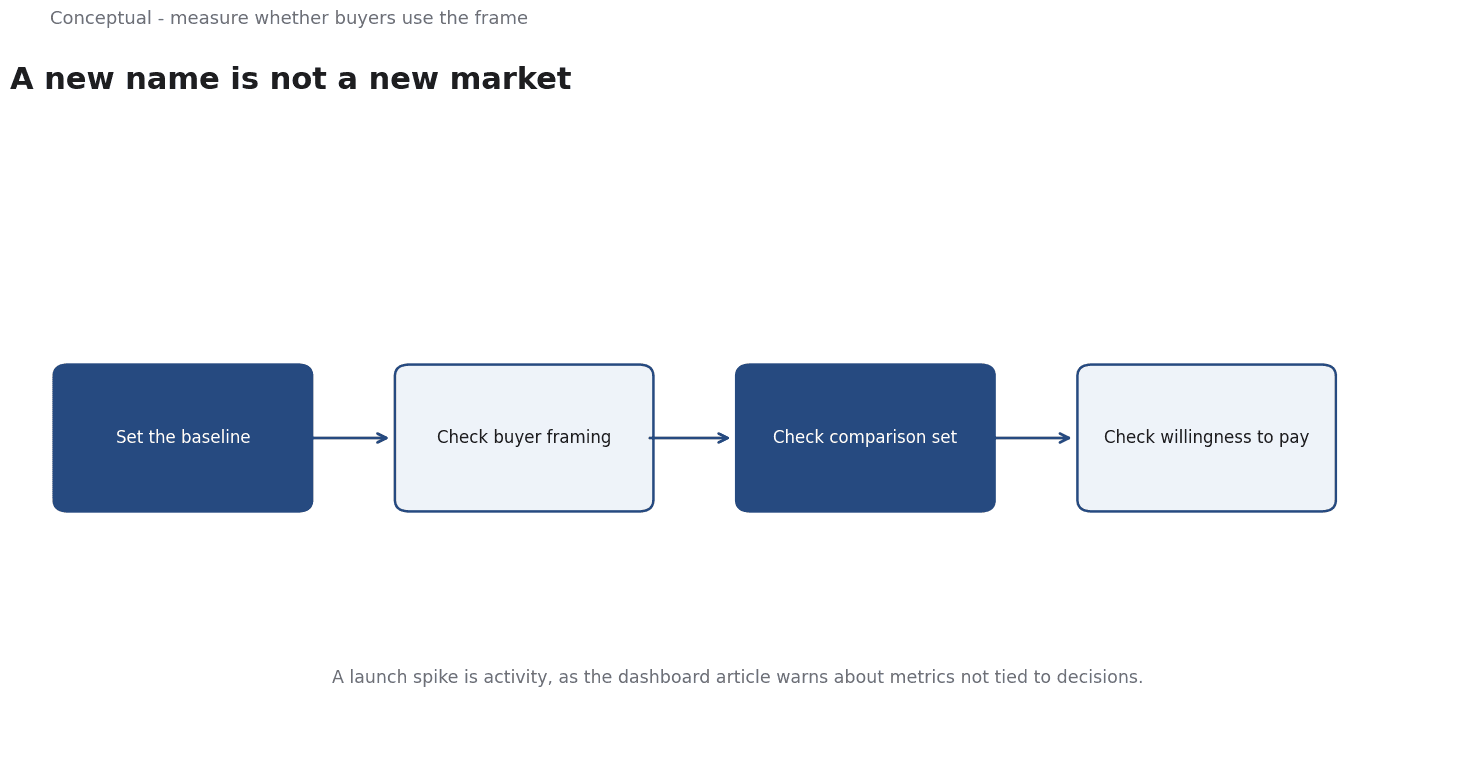
Category design should be measured by changes in buyer framing, comparison set, and willingness to pay, against a baseline.
Blue Ocean Strategy provides the strategic source, and AAPOR's standards apply to any survey used to test framing. The boundary: a new category cannot be willed into existence by naming, which the positioning article treats as a choice of competitive dimension, as the market-definition material requires a defined market, as the publication standard forbids guaranteed outcomes.
What to measure
Buyer framing. Do customers describe the problem in the new terms without being prompted, which the survey-design article advises for neutral wording, as AAPOR's standards require, as the jobs-to-be-done article treats the situation as the unit of demand? Unaided language is stronger evidence than a prompted agree/disagree, as the brand-awareness article explains for aided versus unaided recall.
Comparison set. What alternatives do buyers consider, which the positioning-ladders article treats as the dimension on which they compete, as the competitive-intelligence article warns about defining the market too broadly? A new category should change the comparison, as the market-definition material advises.
Value curve. Which attributes does the new offer emphasise and de-emphasise, which the blue-ocean source treats as the reconstruction of value, as the value-proposition article requires for a specific buyer evaluation, as the comparables article requires consistent definitions?
Durability. Does the frame hold after the campaign ends, which the monitoring article treats as a change signal, as the evaluation-rubric article requires for outcome measures over time?
Three consequences follow. The measurement needs a baseline, as the evaluation-rubric article requires, as the geo-experiment guidance recommends for comparisons. Any survey must be neutrally worded, as AAPOR's standards require. And the result should be recorded with the frame's limits, as the decision-memo article requires.
A worked example
The following is hypothetical and illustrative. A company positions a product as a new category rather than as a cheaper alternative in an existing one.
Three checks decide whether the category took hold. First, in unaided interviews, do buyers describe the problem in the new terms, as the survey-design article advises for neutral wording, as AAPOR's standards require? Second, in win/loss records, do buyers compare the product against the old category or against a different set, which the positioning-ladders article treats as the competitive dimension, as the market-definition material advises? Third, did the frame and the willingness to pay persist after the launch period, as the monitoring article advises, as the evaluation-rubric article requires for outcome measures?
Three conclusions follow. A changed name without a changed comparison set is repositioning, not a new category, which the positioning article argues. Unaided language is stronger evidence than a prompted rating, as the brand-awareness article explains. And the decision should be recorded with the evidence and its limits, as the decision-memo article requires.
What category measurement cannot do
It cannot create demand by naming, which the market-definition material treats as a prior question, as the demand-generation article argues for preference built before capture. It does not guarantee a durable advantage, which the blue-ocean source treats as a strategy to be renewed, as the monitoring article advises, as the publication standard forbids guaranteed outcomes. And it cannot replace a clear positioning, which the positioning-ladders article treats as the choice of dimension, as the value-proposition article requires for a specific buyer.
The counterargument that category design is only branding is fair when it stops at a name and misses the point when the frame changes comparison and value, which the worked example shows, as the blue-ocean source argues for a value curve.
A decision test
- Define the buyer and the problem situation, as the jobs-to-be-done article advises.
- Establish a baseline for framing and comparison, as the rubric article requires.
- Use unaided language as evidence, as the brand-awareness article advises.
- Check whether the comparison set changed, as Positioning Ladders: Competing on the Right Dimension requires.
- Check willingness to pay and durability, as the evaluation article requires.
- Word any survey neutrally, as AAPOR's standards require.
- Record the result with its limits, as the decision-memo article requires.
For the strategy, see Category Design: Create a Market; for the competitive frame, see Positioning Ladders.
References & Further Reading
- Wikipedia contributors, 2026. Blue Ocean Strategy - Wikipedia — The strategy framing of creating uncontested market space rather than competing in an existing one; secondary reference.
- American Association for Public Opinion Research, 2026. AAPOR — The professional association for public opinion and survey research; its standards and resources underpin the survey-design discussion.