What Commodity Markets Actually Measure
A commodity price is a discovery process, not a verdict. Read what the market measures, a worked example, and why a price is not a forecast.
A commodity price is often read as an official judgment about value, which it is not. The commodity-market entry describes a venue where standardised products trade, and the futures entry explains contracts, as the price discovery literature treats the result as an aggregation of expectations, as the time-series article warns about non-stationarity, as the publication standard forbids guaranteed outcomes.
Direct answer:
Commodity markets measure the marginal price at which buyers and sellers agreed under current information, for a specific grade, location, and time.
The commodity-market entry provides the structure, and the futures entry covers contracts. The boundary: that price is not a forecast or an intrinsic value, which the scenario-analysis article treats as conditional, as the risk-assessment article requires residual risk, as the publication standard forbids guaranteed outcomes.
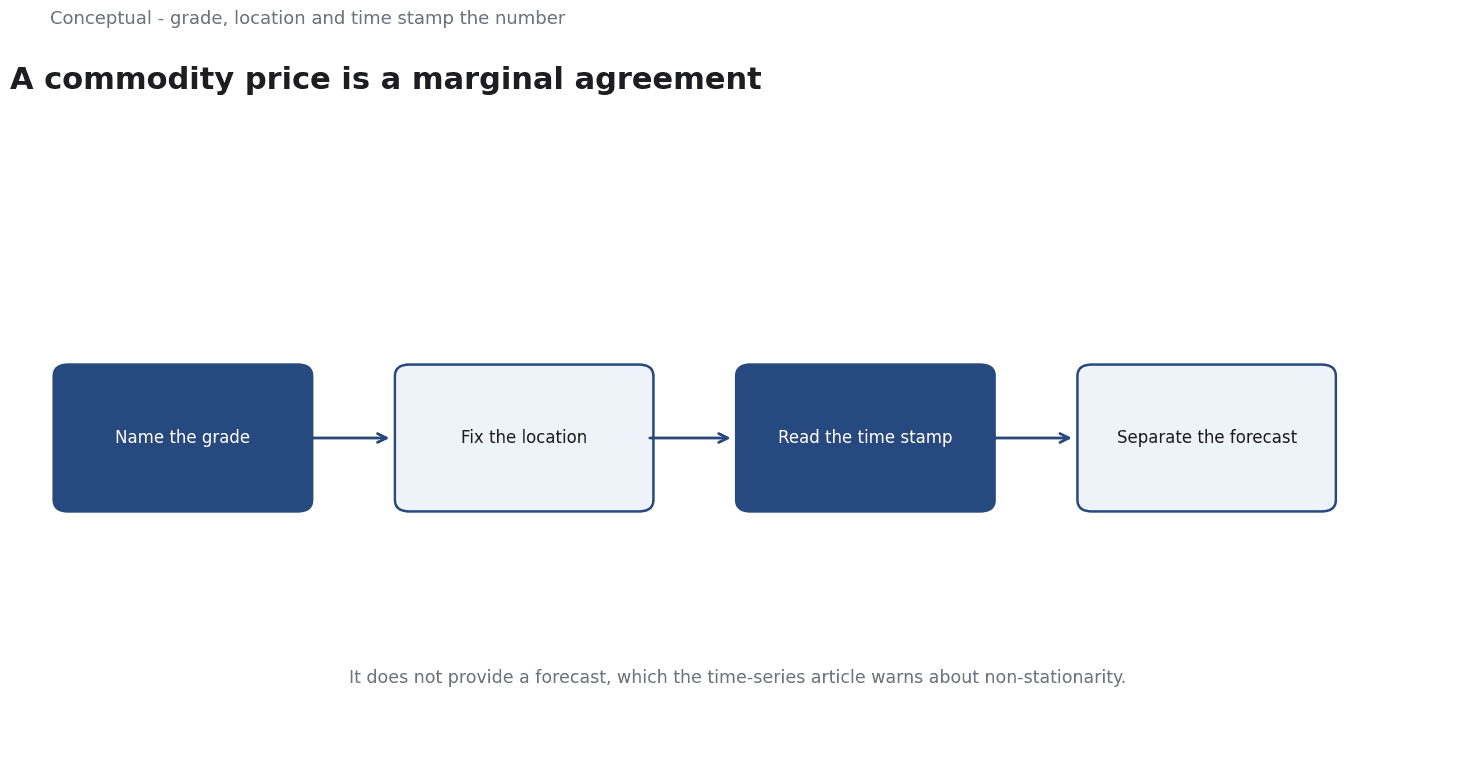
What the price contains
Marginal agreement. The price clears the quantity traded at that moment, which the commodity-market entry describes, as the supply-and-demand analysis explains, as the limit-order-book literature treats matching, as the data-governance article requires for dated figures.
A specific contract. Grade, location, and delivery date define what is priced, which the futures entry explains, as the comparables article requires consistent definitions, as the basis-risk discussion in the hedging article warns about mismatch, as the term-sheet article treats terms as substance.
Information available now. Expectations about supply and demand are embedded, which the EIA oil explainer describes for energy, as the time-series article warns about non-stationarity, as the forecasting literature treats conditional estimates, as the monitoring article advises for change.
Not a forecast. The price is not a statement about the future, which the scenario-analysis article requires you to treat conditionally, as the causal-inference article distinguishes from a cause, as the risk article requires residual risk.
Three consequences follow. The price should be read with the contract, as the futures entry advises, as the comparables article requires. It should be dated, as data governance requires, as the EIA series provides dated releases. And any forward claim should be conditional, as the scenario-analysis article requires, as the decision-memo article requires for a recorded judgement.
A worked example
The following is hypothetical and illustrative. A benchmark price rises sharply on a supply disruption.
Three checks decide how to read it. First, what contract and grade does the price describe, as the futures entry and comparables article require, with basis risk, as the hedging article warns? Second, what information was available, as the EIA explainer and data-governance article require, with a dated series? Third, is the forward claim conditional, as the scenario-analysis article requires, with residual risk, as the risk article requires, as the decision-memo article requires for a record?
Three conclusions follow. The price is a marginal agreement, which the checks show. Grade and date matter, as the futures and comparables articles advise. And the result should be recorded with residual risk, as the decision-memo and risk articles require.
Why the time stamp matters
A price is a snapshot of an agreement at a moment, which the commodity-market entry describes, as the EIA oil explainer provides dated releases, as the data-governance article requires for provenance, as the time-series article warns about non-stationarity, as the monitoring article advises for review, as the decision-memo article requires for a recorded judgement, as the futures entry explains how a contract specifies a delivery period, as the comparables article requires consistent definitions, as the hedging article warns about basis risk, as the risk article requires residual risk to be stated, as the causal-inference article treats explanation as a separate question.
What price measurement cannot do
It cannot tell you why the price moved, which the causal-inference article treats as a different question, as the correlation article warns about association, as the scenario-analysis article requires conditional thinking.
And it cannot remove exposure, which the hedging article treats as risk reduction, as the risk article requires residual risk.
The counterargument that the price is the market's truth is fair about the agreement and wrong about the future, which the worked example shows, as the scenario-analysis and time-series articles advise.
A decision test
- Read the contract, grade, and location, as the futures entry requires.
- Use dated figures, as data governance requires.
- Separate the price from a forecast, as the scenario-analysis article advises.
- Check basis risk, as the hedging article warns.
- Treat causal claims as separate, as the causal-inference article requires.
- State residual risk, as the risk article requires.
- Record the judgement, as the decision-memo article requires.
For the contract mechanics, see Futures exchange; for the strategic use, see Commodity Best Practices.
References & Further Reading
- Wikipedia contributors, 2026. Commodity market - Wikipedia — Structure of markets for raw materials and commodities.
- Wikipedia contributors, 2026. Futures exchange - Wikipedia — The structure of futures contracts, exchanges, clearing and margin; a secondary reference.