Commodity Markets Best Practices
Commodities are priced by supply, demand, and storage. Read the practices, a worked example, and why a hedge is not a forecast.
A commodity market trades a standardized product, which makes prices comparable across participants. The practices are about understanding what drives the price and what a position actually does, as the commodity-market entry describes the structure, as the futures entry explains the contract, as Hedging Best Practices treats risk reduction as a deliberate choice.
Direct answer: Approach commodities by defining the underlying exposure, reading supply and demand with dated data, and using futures or options for a stated risk rather than a directional bet. The commodity-market entry provides the structure, and the futures entry covers contracts. The boundary: this is educational orientation, not trading advice — prices are volatile and contracts have obligations, as the options article warns about margin, as the tax article requires a dated check, as the publication standard forbids guaranteed outcomes.
The practices
Define the exposure. Is the organisation a buyer or a seller of the physical commodity, and what does a price move do to it, which the risk-assessment article requires, as Hedging Best Practices advises, as the value-at-risk article treats aggregation?
Use dated supply-and-demand data. Inventories, production, and consumption move prices, which the commodity-market entry explains, as FRED provides dated series, as the data-governance article requires for provenance, as the time-series article warns about non-stationarity.
Distinguish hedge from bet. A hedge reduces an existing exposure, which the hedging article treats as the purpose, as the derivatives article explains for offsetting positions, as the options article warns about obligations, as the risk-assessment article requires residual risk.
Read the contract. Standardization helps comparison, but the contract specifies quantity, quality, and delivery, which the futures entry explains, as the term-sheet article treats formal terms as the substance, as the basis-risk discussion in the hedging article warns about imperfect matches.
Three consequences follow. The exposure should be stated before the instrument, as Hedging Best Practices advises. The data should be dated, as data governance requires. And the outcome should be recorded with residual risk, as the decision-memo article requires, as the risk article requires.
A worked example
The following is hypothetical and illustrative. A food manufacturer buys a commodity input and worries about a price rise.
Three checks decide. First, what is the physical exposure, as the risk-assessment article asks, with a quantity and a window, as Hedging Best Practices advises? Second, does a futures position reduce that exposure or create a new one, as the hedging and derivatives articles distinguish, with a contract that matches the input, as the futures entry requires, as basis risk warns about imperfect matches? Third, are supply-and-demand figures dated, as data governance requires, with FRED series, as the commodity-market entry advises?
Three conclusions follow. A hedge should be sized to the exposure, which the check reveals. A mismatched contract creates basis risk, as Hedging Best Practices warns. And the decision should be recorded with the residual risk, as the decision-memo article requires.
Why the physical position comes first
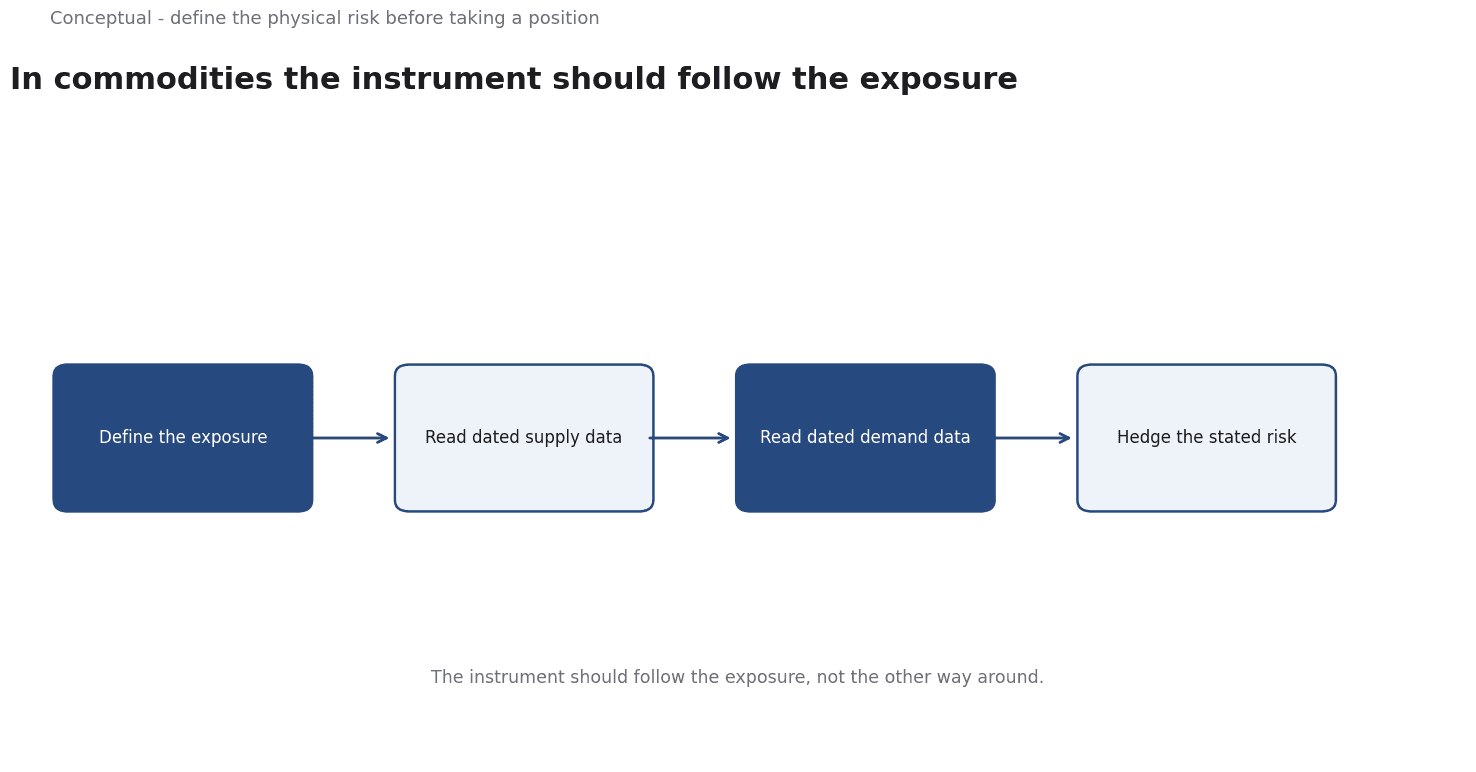
The instrument should follow the exposure, not the other way around.
A processor that buys a commodity has a different risk from a producer that sells it, which the risk-assessment article treats as the starting point, as Hedging Best Practices advises, as the value-at-risk discussion treats aggregation.
Storage also shapes the price, which the commodity-market entry explains, and the cost of carrying inventory changes the economics of holding a physical position, as the inventory article treats stock as cash, as the cash-flow article requires for cash spent. A model that ignores storage can misread the basis, as the futures entry advises, as Hedging Best Practices warns about imperfect matches, as the risk article requires residual risk to be stated.
What commodity practices cannot do
They cannot predict prices, which the time-series article warns about non-stationarity, as the scenario-analysis article requires conditional thinking, as the publication standard forbids guaranteed outcomes. They do not remove risk, which the hedging article treats as reduction, as the risk-assessment article requires residual risk. And they cannot remove contract obligations, which the futures entry explains, as the options article warns about margin, as the term-sheet article requires for reading terms.
The counterargument that a futures position is simple speculation is fair for a position without an underlying exposure and misses the hedge case, which the worked example shows, as Hedging Best Practices advises.
A decision test
- Define the physical exposure, as the risk-assessment article requires.
- Use dated supply-and-demand data, as data governance requires.
- Distinguish hedge from bet, as Hedging Best Practices advises.
- Match the contract to the exposure, as the futures entry requires.
- Check basis risk, as Hedging Best Practices warns.
- Check margin and tax treatment, as the options and tax articles advise.
- Record the decision and residual risk, as the decision-memo article requires.
For the structure, see Commodity Markets; for the instrument, see Hedging Best Practices.
References & Further Reading
- Wikipedia contributors, 2026. Commodity market - Wikipedia — Structure of markets for raw materials and commodities.
- Wikipedia contributors, 2026. Futures exchange - Wikipedia — The structure of futures contracts, exchanges, clearing and margin; a secondary reference.