What Debt Restructuring Actually Measures
A restructuring is often read as debt reduced. See what the terms and the credit spread actually measure about cash-flow health and market confidence.
A restructuring announcement is often reported as if the company's debt problem were solved. That reading misses what the transaction actually measures: whether the new terms fit the borrower's cash flows and whether the market now believes the borrower can honor them. The two sources frame the answer: debt restructuring changes existing obligations, and the credit spread records the market's perception of default risk.
Direct answer:
A restructuring measures the terms of relief and the credibility of the plan, not the mere fact that debt was rewritten.
Test whether interest and principal coverage improves under the new schedule, then check whether the borrower's credit spread narrows against a matched benchmark.
Delta: This article adds a claim-status table beyond the sources: it maps restructuring terms to cash-flow coverage and the credit spread to a verification decision, with claim status explicit.
The mechanism
Debt restructuring modifies the terms of existing debt obligations, typically when a borrower cannot comfortably service them as written. Maturities may be extended, coupons reduced, or debt converted into equity. The practical consequence is that the headline figure, the amount of debt reduced, is less informative than the new payment schedule. A company can shrink its face debt while still facing a cash-flow squeeze if the remaining terms are poorly matched to its earnings.
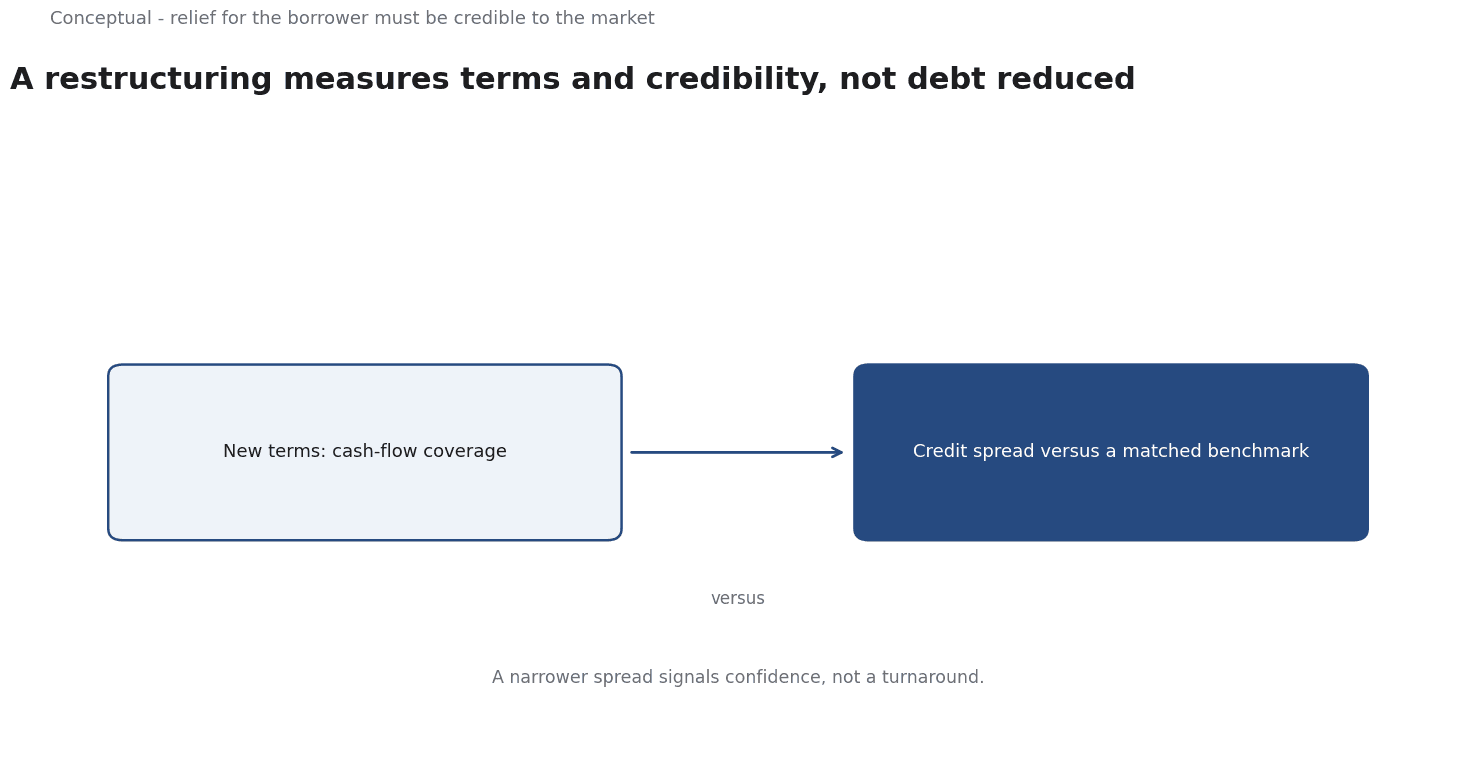
The purpose is to restore the ability to service debt and to avoid default or disorderly bankruptcy. Creditors often accept less than full repayment, a haircut, in exchange for a better recovery than a failed borrower would offer. A restructuring therefore measures a negotiated trade-off: relief for the borrower purchased with a real loss for the creditor. Treating it as a free improvement ignores the value transferred, which is why the terms deserve as much attention as the announcement.
The credit spread is the difference in yield between a risky bond and a comparable risk-free benchmark of similar maturity. It encodes the market's perception of default risk: a wider spread signals greater perceived risk, a narrower spread signals improving confidence. The practical consequence is that the spread supplies an external, forward-looking check on whether the restructuring was credible, independent of management's own account of the plan.
The sequence is: identify which terms changed, recompute coverage under the new schedule, compare the borrower's spread with its benchmark before and after, and state what would falsify the claimed improvement. The definitions of restructuring and credit spread are source-reported; using the spread as the verification signal is inferred. Making that distinction explicit lets a reviewer separate what the sources define from what this article recommends.
A worked example
The following is hypothetical and illustrative. An analyst reviews a company that extended maturities and cut its coupon, then announced that its debt burden had been reduced. Three checks decide whether the claim holds. First, does interest coverage genuinely improve given current operating cash flow, or only on an optimistic projection? Second, did the bond's credit spread narrow relative to a matched benchmark after the announcement, or did it stay wide, suggesting the market doubts the plan? Third, what did creditors give up, and does the size of that concession point to a deeper problem? In the example, cash coverage improves modestly but the spread remains wide, so the market stays skeptical and the label fixed is withheld. The scenario is illustrative; the use of spread as a check is the point.
Evidence status
| Claim | Status | Source | Verified | Recheck when |
|---|---|---|---|---|
| Restructuring modifies existing debt terms | source-reported | Debt restructuring (Wikipedia) | 2026-11-18 | Definition changes |
| Credit spread reflects perceived default risk | source-reported | Credit spread (Wikipedia) | 2026-11-18 | Pricing convention changes |
| Spread narrowing signals improved credibility | inferred | Derived from the sources | 2026-11-18 | Market conditions change |
The first two rows restate definitions from the restructuring and credit-spread entries and are source-reported, so they should be revisited if those references change. The third row is inferred: reading a narrower spread as improved credibility follows from the source concept but is a judgement about interpretation. It should be rechecked when market conditions shift, since spreads respond to more than one company's news.
What it cannot do
A restructuring is not a turnaround. It changes the financing terms of existing obligations, not the underlying business. A company can complete a textbook restructuring and still fail if its operations do not generate enough cash, because lower payments do not create revenue. Reading a completed restructuring as evidence that the company is now healthy confuses a change in the capital structure with a change in the business. The distinction matters whenever someone treats the announcement as the end of the story.
The relief carries real costs that are easy to understate. Creditors give up value through haircuts, lower coupons, or longer maturities, and existing equity holders may be diluted when debt is converted to equity. The borrower also pays in reduced future flexibility, since new covenants can constrain decisions and a weakened credit story limits the ability to borrow again. What looks like a clean fix transfers value from one group to another and trades present relief for future constraints, so any balance sheet that seems improved should be read alongside who paid for the improvement.
A repeated restructuring is a distinct failure mode. A company that returns to the table again and again has not solved the underlying problem; it has merely postponed it. The market learns this pattern, and the credit spread can stay wide or widen even when the latest terms look generous on paper, because the history signals that the plan is unlikely to hold.
The credit spread has boundaries as evidence. It is influenced by more than the borrower's own prospects: benchmark yields, liquidity conditions, and broad risk sentiment all move it. A narrower spread does not prove that the restructuring caused the improvement, and a comparison requires a stable benchmark and a matching maturity to be meaningful. A spread is also a perception, not an accounting measure of leverage, so it can improve while the balance sheet remains fragile or worsen momentarily in a stressed market even if the plan is sound.
Because the terms and the market backdrop both evolve, the assessment needs review. Covenants, maturities, and pricing change, and a spread comparison is only as good as the benchmark chosen. The conclusion should be rechecked whenever interest rates move sharply, a new restructuring occurs, or the company's operating performance changes materially. Without that discipline, a one-time snapshot hardens into a story that no longer describes the borrower.
The counterargument that the spread is fair for gauging market sentiment and incomplete for measuring the borrower's actual cash-flow health is fair: it captures perception and timing, not the accounts that determine whether debt can be served.
A decision test
- List which debt terms actually changed.
- Recompute interest and principal coverage from current cash flow.
- Identify what creditors gave up and who bore the loss.
- Compare the bond's spread with a matched benchmark before and after.
- Check for repeated restructurings or worsening terms.
- State what observation would falsify the claimed improvement.
- Recheck when rates, terms, or market conditions change.
The test keeps the two questions separate: did the terms improve the borrower's capacity, and does the market believe it? An answer to one is not automatically an answer to the other. Holding them apart is what prevents a restructuring announcement from being mistaken for a recovered business.
For further reading, see Cash Flow Forecasting: A 13-Week Operating Model.
References & Further Reading
- Wikipedia contributors, 2026. Debt restructuring - Wikipedia — The process of renegotiating debt terms between borrower and lenders.
- Wikipedia contributors, 2026. Credit spread - Wikipedia — The difference between a risky bond yield and a comparable risk-free yield, and what a widening spread signals; a secondary reference used with FRED and investor-education material.