What Digital Shelves Actually Measures
Digital shelves record planogram placement and merchandising choices, not shopper demand. Read the mechanism, a worked example, and what the record can support.
A digital shelf record tells a team where products sit, how much facing they get, and whether a listing is live. The real problem is that this record is often read as evidence of shopper demand or attention, when it is really a snapshot of decisions someone made about placement and presentation. A tidy shelf can look like proof that a category is working while containing no information about whether a single shopper acted on it.
Direct answer:
Digital shelves measure the state of a planogram and the merchandising choices applied to it: placement, facings, category adjacency, and listing availability.
They do not measure what shoppers noticed, preferred, or bought. The two sources describe how space and presentation are planned; the limit on what that state can prove is a synthesis.
Delta: This article adds a claim-status table beyond the sources: it maps the recorded arrangement of a shelf to one assortment decision, with claim status explicit.
The mechanism
The planogram entry describes a diagram that specifies where products should be placed on shelves or display fixtures, with the aim of making presentation consistent and using space effectively. The mechanism is deliberate allocation: facing, height, and adjacency are decided in advance rather than left to chance. The practical consequence is that a digital shelf record captures an intention, such as giving a product eye-level placement or more facings, and that intention is a decision about visibility, not a measurement of shopper response. Reading it as a response conflates the plan with the result.
The merchandising entry covers how products are promoted and presented to encourage purchase, including choices about product selection, pricing, placement, and display. The mechanism is that presentation is treated as a lever on behavior: the working assumption is that a better presented product will sell more. The practical consequence is that a shelf record encodes a hypothesis about what will work, set by a merchandiser, rather than an outcome showing that it worked. The record is an input to a commercial bet, not the settling of it.
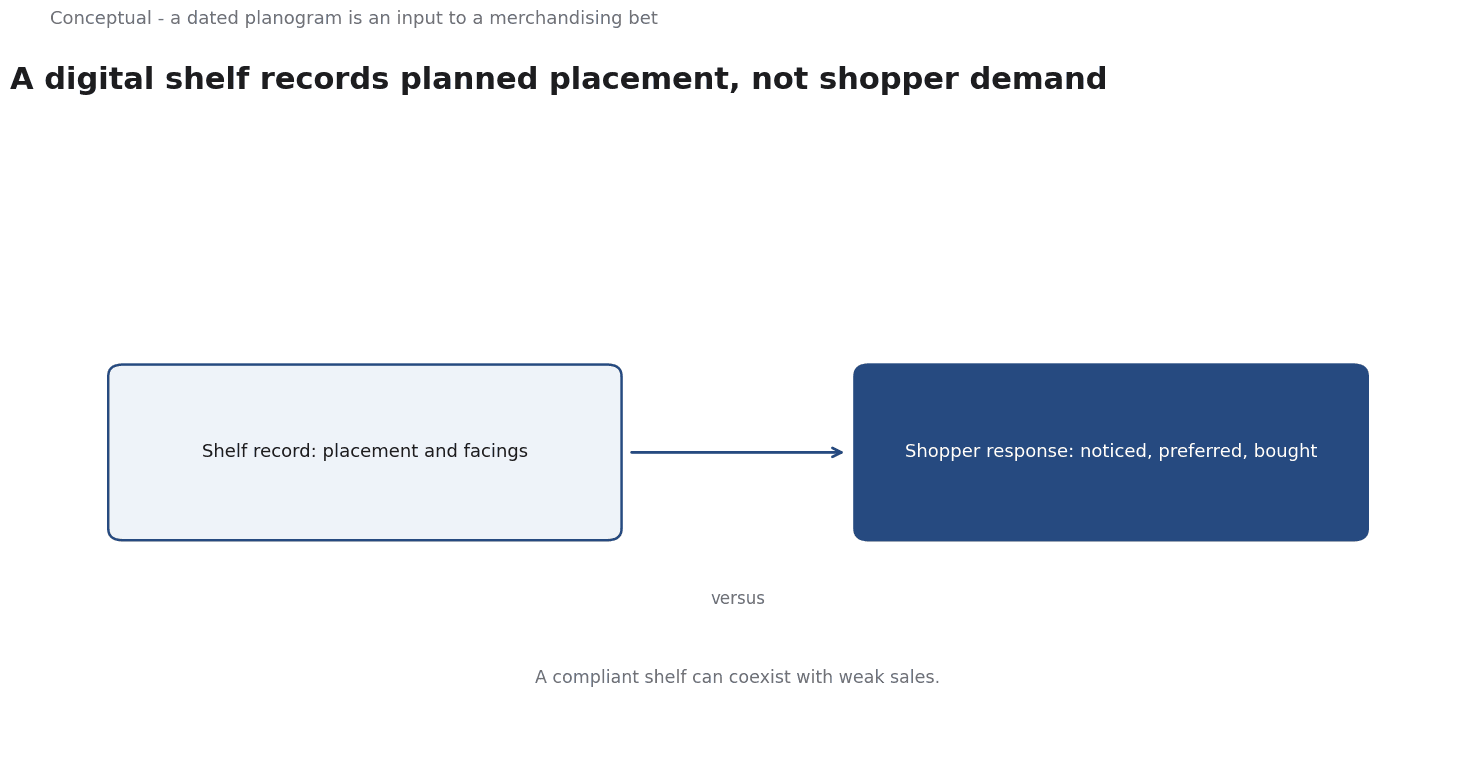
Read together, the two sources put the shelf in the category of planned inputs. A digital shelf states what was placed where, under which rules, at a point in time. It says nothing directly about whether the arrangement was seen, understood, or acted on. The practical consequence is that a clean, fully compliant shelf can coexist with weak sales, and a messy one can coincide with strong sales, because the record describes supply-side decisions while sales depend on shopper behavior the record does not contain.
The final piece is change over time. A shelf is a moving state: listings go live, facings change, and planograms get revised. The mechanism is a versioned record, where each arrangement is a snapshot with a date. The practical consequence is that the useful question is not whether the shelf looks right today but which arrangement was in place when an outcome was observed, so a sales change can be lined up with the layout that preceded it. That alignment is an inference, not something the sources assert.
A worked example
The following is hypothetical and illustrative. A retailer relaunches a category with a new digital planogram and sees the number of live listings and facings rise, then reads higher reported in-store traffic as proof the arrangement worked. Three checks decide. First, the compliance check: does the live shelf match the planned placement by facing and adjacency, so the intended arrangement actually shipped? Second, the timing check: did the traffic change occur after the shelf change, or did both move with a promotion that ran at the same time? Third, the counterfactual check: how did comparable stores without the new planogram move over the same period? The outcome is a qualified reading: the shelf record confirms that placement changed as planned, but traffic can be credited to the arrangement only if it outpaces the control stores. The figures are hypothetical; the sequence of checks is the contribution.
Evidence status
| Claim | Status | Source | Verified | Recheck when |
|---|---|---|---|---|
| Digital shelves record placement, facings and listing state from a planogram | source-reported | Planogram - Wikipedia | 2026-11-18 | when the entry's description of planogram purpose changes |
| Merchandising uses product selection, pricing, placement and display to encourage purchase | source-reported | Merchandising - Wikipedia | 2026-11-18 | when the entry's scope of merchandising changes |
| A shelf record cannot by itself establish shopper attention or demand | inferred | Derived from the sources | 2026-11-18 | when shelf or shopper research links placement to measured attention |
The first two rows report what the sources state and can be checked against them directly. The third is an inference: it follows from treating the shelf as a record of planned inputs, but neither source offers it as a limit on what a shelf can prove. Recheck conditions point back to the sources or to new research, keeping the status of each row explicit rather than implied.
What it cannot do
A digital shelf record cannot show that a shopper noticed anything. It states that a product was assigned a position, a number of facings, or a live listing, but not that a person looked at it or chose it. Attention and preference happen in the shopper, not in the planogram, and the record has no direct entry for either. Treating a well-placed shelf as proof of attention skips the entire chain between visibility and choice, so a team can point to a perfect planogram and still have no idea whether the placement changed a single decision.
A hidden cost sits in maintaining the arrangement itself. Planograms promise consistency, but keeping a digital shelf in compliance takes work: listings must be updated, facings adjusted, and exceptions handled when stock runs short. That effort is real and finite. When it absorbs the time that would have gone into testing whether the arrangement helps, the shelf gets tidier while the question it was supposed to answer goes untested. There is also an opportunity cost in rigidity: a fixed planogram can lock a category into last season's logic and make it slow to respond to a shift in what shoppers want.
A shelf that matches the plan exactly feels like a success, and teams can celebrate a high compliance score while sales stay flat. The reason is that compliance measures adherence to a decision, not the quality of the decision. If the original placement was wrong, perfect execution reproduces the mistake at scale. The opposite failure is treating the shelf as a live demand signal: because the record updates quickly, it is tempting to read each change as shopper feedback, when it is usually just a merchandiser editing the layout.
The boundary is that these sources describe a planning tool and a business practice, not a measurement method. The planogram entry explains how space and product placement are laid out; it does not claim that any arrangement drives a particular outcome. The merchandising entry describes how presentation is used to encourage purchase; it does not validate a metric for shelf effectiveness. Using them responsibly means treating the shelf as a record of planned inputs and looking elsewhere for evidence of shopper response, without presenting the combination as a tested measure of shelf performance.
Because retail conditions move, the reading needs scheduled review. Competitors change their own shelves, shopper habits shift, and a planogram that once encoded a sound hypothesis can become a habit nobody questions. The practical requirement is to revisit, on a fixed cadence, whether the current arrangement still matches the assumptions it was built on and whether the outcomes once attributed to it still hold. Without that review, the shelf record quietly becomes a description of the past presented as a guide to the present.
The counterargument that a compliant shelf is a useful proxy for merchandising effort is fair for tracking execution and incomplete for judging whether the execution worked.
A decision test
- State the assortment or placement decision the shelf record is meant to inform.
- Confirm the live shelf matches the planned arrangement by facing, position, and availability.
- Date each arrangement so outcomes can be lined up with the layout that preceded them.
- Separate the placement decision from any promotion or price change in the same period.
- Compare against stores or periods where the arrangement did not change.
- Label what the record proves and what it merely suggests.
- Review the assumption behind the planogram on a fixed cadence.
These steps keep the shelf in its proper role as a record of planned inputs. The mapping from a laid-out planogram and a presentation practice to one concrete assortment decision is what turns a tidy diagram into something a team can act on. A passed test leaves a dated arrangement and a clear account of what it did and did not show, rather than a general impression that the category looks better.
For further reading, see Data Quality in Practice.
References & Further Reading
- Wikipedia contributors, 2026. Planogram - Wikipedia — The placement of products on shelves.
- Wikipedia contributors, 2026. Merchandising - Wikipedia — Presentation and promotion of products in retail.