What Dividend Policy Actually Measures
A dividend is an outcome of cash, opportunity, and expectation. Read what the policy reveals, a worked example, and why a payout is not a promise.
Dividend policy is often read as a verdict on management confidence, which overstates what a payment can show. The dividend-policy entry describes how firms decide distributions, as Damodaran's framework insists on explicit assumptions, as the free-cash-flow article distinguishes cash from profit, as the earnings-quality article warns about clean figures, as the publication standard forbids guaranteed outcomes.
Direct answer:
Dividend policy measures a choice about cash allocation under constraints and expectations, not a guarantee of future payments.
Wikipedia's dividend-policy entry provides the context, and Damodaran's work provides the valuation discipline. The boundary: a payout can reflect an absence of opportunities, which the dividend-policy entry notes, as the valuation article requires conditional claims, as the risk article requires residual risk.
What it reflects
Cash generation. A payout is limited by cash actually available, which the free-cash-flow article explains, as the cash-flow article requires, as the earnings-quality article warns about accruals, as the data-governance article requires dated figures, as the risk article requires residual risk, as the decision-memo article requires for a record.
Investment opportunities. Cash paid out is not reinvested, which the dividend-policy entry treats, as the valuation article requires conditional claims, as the DCF and WACC articles advise, as the scenario-analysis article requires conditional thinking, as the rubric article requires concrete criteria, as the decision-memo article requires a question.
Expectations and consistency. A cut can be costly because of expectations, which the dividend-policy entry describes, as the reputation article treats a public record, as the crisis article treats recovery, as the monitoring article advises for review, as the decision-memo article requires a reversal condition, as the risk article requires residual risk.
Signal limits. A high yield can reflect a lower price, which the dividend-policy entry notes, as the credit-spreads article treats market pricing, as the benchmarks article warns about broad results, as the earnings-quality article warns about clean figures, as the data-governance article requires dated figures, as the risk article requires residual risk.
Three consequences follow. The cash check comes first, as the free-cash-flow and cash-flow articles advise, as the earnings-quality article warns, as the data-governance article requires dated figures, as the risk article requires residual risk, as the decision-memo article requires for a record, as the valuation article treats conditional claims, as the DCF and WACC articles advise, as the scenario-analysis article requires conditional thinking, as the rubric article requires criteria, as the dividend-policy entry treats expectations, as the reputation and crisis articles advise, as the monitoring article advises, as the credit-spreads and benchmarks articles warn, as the risk article requires residual risk.
A worked example
The following is hypothetical and illustrative. A company maintains a dividend while its free cash flow declines.
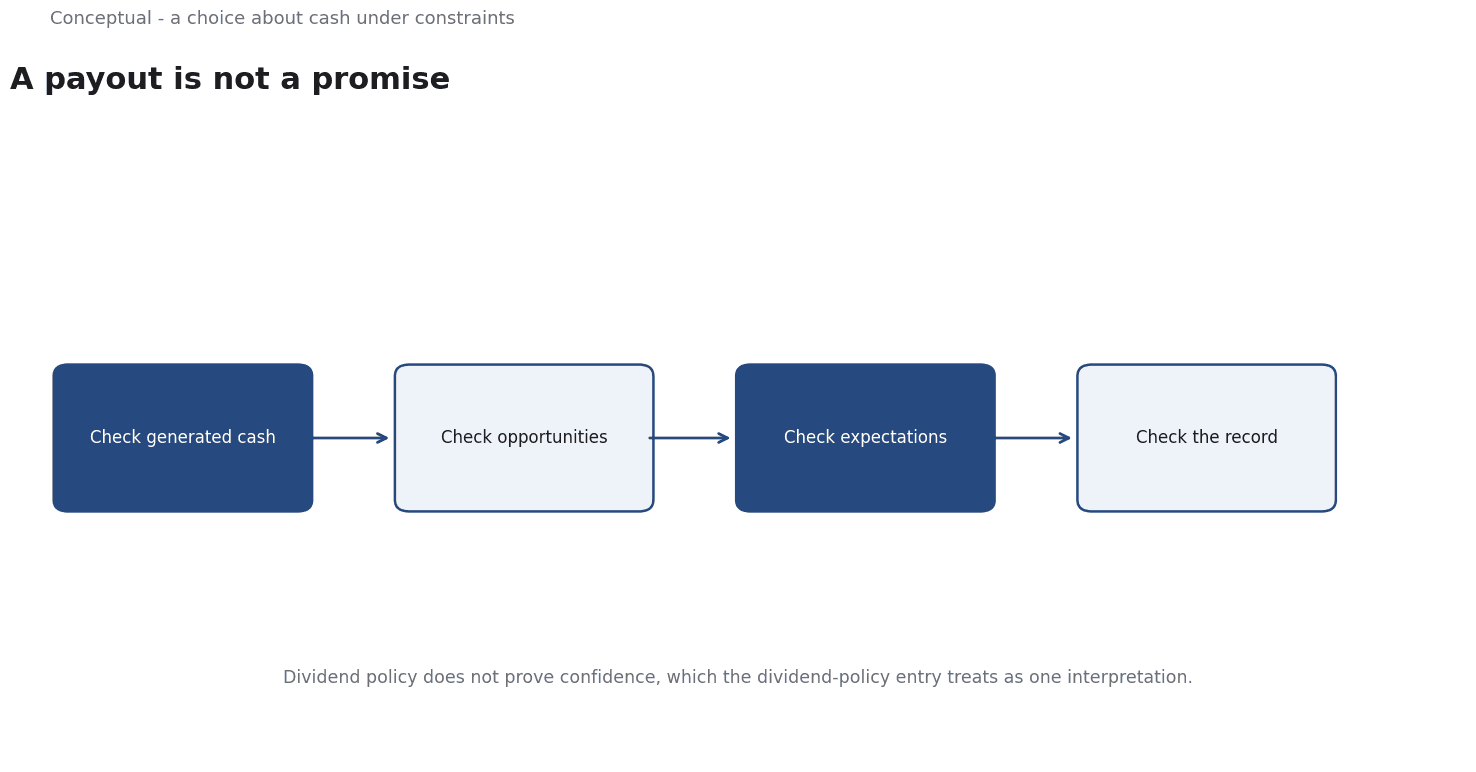
Three checks decide. First, is the payout covered by cash, as the free-cash-flow and cash-flow articles require, with dated figures, as data governance requires? Second, is the company forgoing opportunities, as the dividend-policy and valuation articles ask, with a conditional claim, as the DCF and WACC articles advise? Third, what would a cut cost in expectations, as the dividend-policy and reputation articles advise, with a reversal condition, as the decision-memo article requires, as the risk article requires residual risk?
Three conclusions follow. A maintained payout is not a sign of strength by itself, which the checks reveal. Cash coverage is the prior question, as the free-cash-flow article advises. And the decision should be recorded, as the decision-memo article requires.
What dividend policy cannot measure
It cannot measure future cash, which the free-cash-flow and cash-flow articles advise, as the publication standard forbids guaranteed outcomes, as the risk article requires residual risk.
And it cannot remove tax obligations, which the tax article makes jurisdiction-specific, as the legal article requires a dated check, as the governance checklist requires an owner, as the risk article requires residual risk.
The counterargument that a maintained dividend signals strength is fair for some firms and incomplete when cash is declining, which the worked example shows, as the free-cash-flow and dividend-policy articles advise, as the earnings-quality article warns, as the risk article requires residual risk.
A decision test
- Check cash coverage, as the free-cash-flow article requires.
- Compare with opportunities, as the dividend-policy entry advises.
- Read yield as a question, as the dividend-policy entry advises.
- Use dated figures, as data governance requires.
- Treat forecasts as conditional, as the valuation article requires.
- Check tax treatment, as the tax article requires.
- Record the decision and residual risk, as the decision-memo and risk articles require.
For the policy, see Dividend Policy; for the practice, see Dividend Policy Best Practices.
References & Further Reading
- Wikipedia contributors, 2026. Dividend policy - Wikipedia — How firms decide on distributions to shareholders.
- Aswath Damodaran, 2026. Damodaran Online: Home Page for Aswath Damodaran — Publicly maintained datasets for industry averages, WACC, and valuation.