What Privacy Sandbox Actually Measures
Privacy Sandbox reports aggregates, not individual journeys. Read what it measures, a worked example, and why the report is not the campaign.
Privacy Sandbox is often discussed as if it preserved the same measurement as third-party cookies, which it does not. The Wikipedia entry describes proposals to limit tracking while supporting advertising, and web analytics covers what can be measured. The question is what the resulting reports actually contain.
Direct answer: Read Privacy Sandbox reports as aggregated signals with specific limitations, and match them to decisions they can support. The sources describe the proposals; the method is a synthesis.
Delta: This article adds a claim-status table and a worked example, separating documented proposals from local judgements about interpretation.
The mechanism
The first point is aggregation. The Privacy Sandbox entry describes mechanisms designed to limit cross-site tracking, which means reports are less granular than individual-level data. That is a design choice, and it changes which questions can be answered.
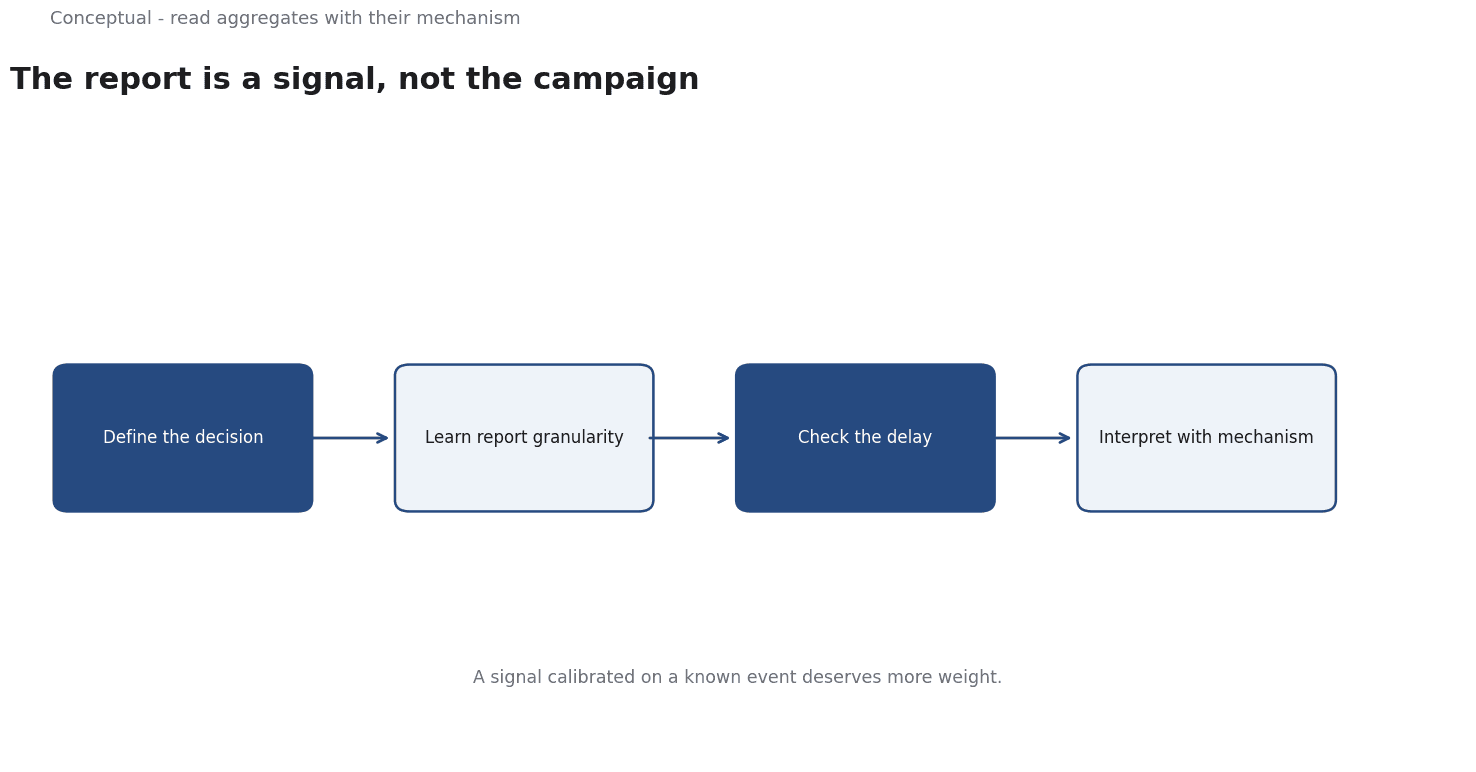
The second point is timing. Aggregated reports often arrive with a delay, because the system groups events before reporting them. A decision that needs immediate feedback cannot wait for a delayed aggregate, and the mismatch should be recognised before the tool is adopted.
The third point is interpretation. The web-analytics entry describes collection and interpretation as distinct, which applies here. A report is a signal produced by a mechanism with rules; reading it as a direct observation of behaviour mistakes the measurement for the thing measured.
The sequence is: define the decision, learn what the report contains, check the timing, then interpret with the mechanism in mind.
The choices are local, so the conclusions are inferred; the proposals are source-reported.
A worked example
Illustrative. A team wants to know which creative drove conversions.
Three checks decide. First, does the report have the granularity to distinguish the creatives, or only a combined total? Second, is the delay compatible with the decision cadence? Third, what would a known event look like in the report, so the team can calibrate its interpretation?
The outcome is a decision about which questions the report can answer. The scenario is hypothetical; the method is the contribution.
Evidence status
| Claim | Status | Source | Verified | Recheck when |
|---|---|---|---|---|
| Proposals limit tracking while supporting ads | source-reported | Wikipedia, Privacy Sandbox | 2026-11-18 | Proposals change |
| Analytics separates collection from interpretation | source-reported | Wikipedia, Web analytics | 2026-11-18 | Definition changes |
| Match granularity and timing to the decision | inferred | Derived from both | 2026-11-18 | Decision changes |
Why the report is not the campaign
A report is the output of a measurement mechanism. It reflects what the mechanism can observe, which is not the same as everything the campaign did.
A further limitation is that the mechanism's definitions can change. A metric that meant one thing when it was introduced may be refined, and a comparison across versions can be misleading. Recording which version produced a figure is the only way to judge whether a later change belongs to the campaign or to the measurement.
The report also lacks the context that an individual-level record provides. A conversion reported in aggregate cannot be traced to a specific path, which limits the questions it can answer, but that limitation is the point of the design rather than a defect. Accepting it means choosing decisions that can be made from aggregates.
Finally, the signal should be calibrated with an event the team can see directly. Comparing a known occurrence with what the report showed establishes how much weight the signal deserves, which is more useful than assuming it is exact.
A report without its version is hard to compare across periods, which is why the version belongs in the record.
A signal calibrated against a known event is more trustworthy than one assumed to be exact.
The granularity of a report sets a limit on the questions it can answer, whatever the tool's label.
A report should be read with the mechanism that produced it, not as a raw observation.
What it cannot do
It cannot reproduce individual-level attribution. It does not remove the need for a lawful basis. And it cannot guarantee that the signal answers a specific question.
The counterargument that an aggregate is enough is fair for high-level decisions and incomplete for detailed optimisation.
A decision test
- Define the decision.
- Learn the report's granularity.
- Check the delay.
- Calibrate with a known event.
- Interpret with the mechanism in mind.
- Record the limitation and recheck date.
For the trade-offs, see Privacy Sandbox Trade-offs.
References & Further Reading
- Wikipedia contributors, 2026. Privacy Sandbox - Wikipedia — Browser proposals to limit tracking while supporting advertising.
- Wikipedia contributors, 2026. Web analytics - Wikipedia — Collection and interpretation of website behaviour data.