What Pricing Psychology Actually Measures
Pricing psychology measures how presentation frames choices. Read the source definitions, a decision-linked example, and why anchors and fairness need testing.
Pricing is often described as a matter of perception, as if the right frame can make any price acceptable. The Wikipedia pricing entry describes how prices are set, and the behavioural finance entry describes how judgement departs from pure calculation. The real problem is that pricing psychology measures responses to how a price is presented, not the value a product delivers.
Direct answer: Pricing psychology measures how presentation - anchors, framing, and fairness cues - shifts stated or observed choice. The sources describe pricing methods and judgement biases; the link to a specific pricing decision is a synthesis.
A measured shift in response is evidence about framing, not proof of underlying value.
Delta: This article adds a claim-status table and a decision-linked framing test beyond the sources: it maps each psychological lever to the pricing choice it can inform, with claim status explicit.
The mechanism
The pricing entry describes how sellers set prices using costs, competition, and what buyers will pay. Behavioural finance adds that judgement is not a clean calculation: people use reference points and shortcuts when they evaluate numbers. Together these describe two layers of a price. One layer is the economic setting, the costs and alternatives that constrain a sustainable price. The other is the presentation, the context in which a buyer sees the number. Pricing psychology studies the second layer.
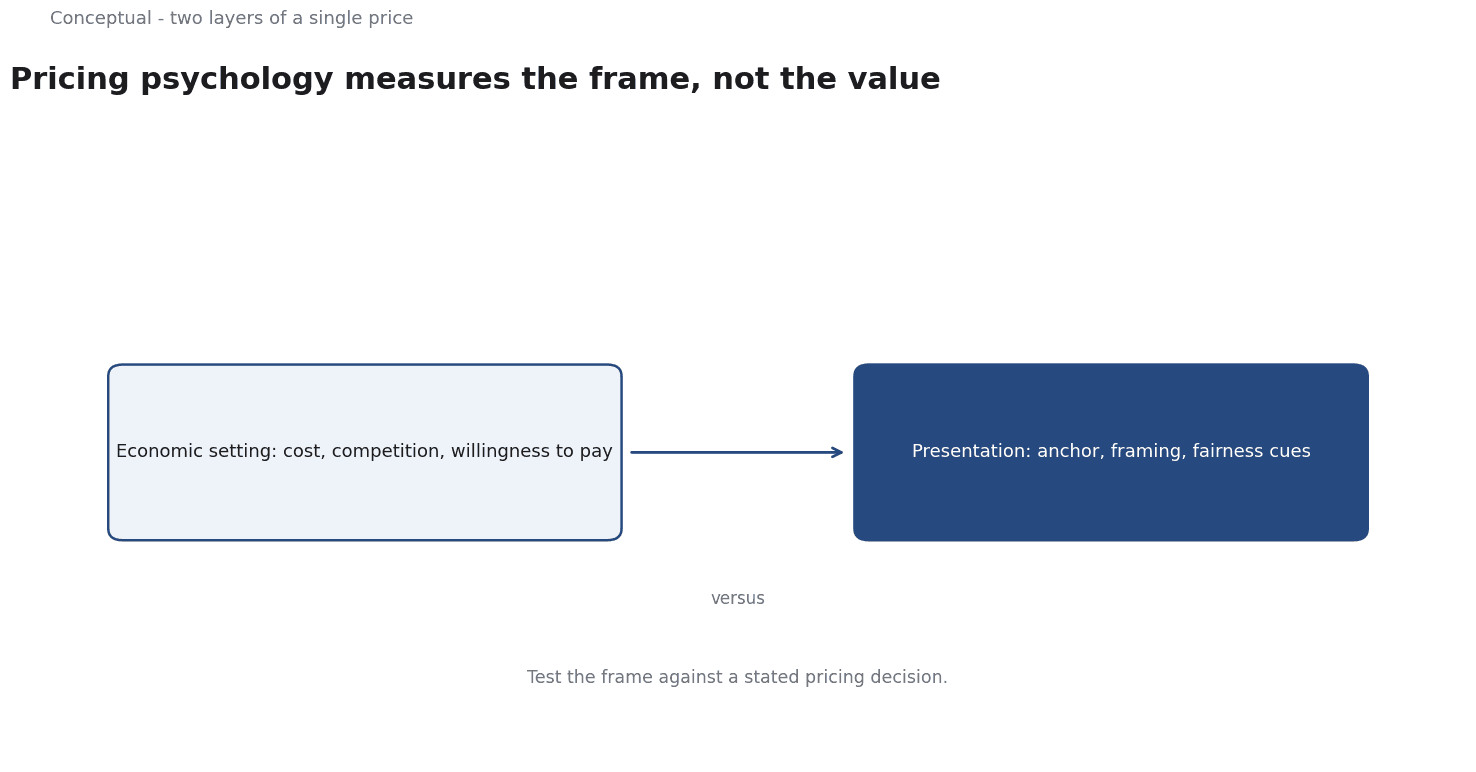
An anchor is a reference number that influences how a later number is judged. A high initial price can make a discounted price look reasonable, even when the absolute level is unchanged. Framing works similarly: the same price reads differently as a monthly fee, a daily cost, or a one-time charge. The practical consequence is that the number a buyer encounters is rarely evaluated in isolation. It is evaluated against something, and that something is often chosen by the seller. A team that changes a price without controlling the reference point cannot tell whether response moved because of the price or the frame.
Fairness is a third lever. Buyers compare what they pay with what others pay and with what they expect, and perceived unfairness can reduce willingness to buy even when the price is economically attractive. The behavioural finance entry frames such judgements as departures from pure calculation. For practice, this means a price change has to be read alongside the comparison a customer is likely to make. A surcharge that is efficient from a cost view can read as unfair if it appears arbitrary or disguised.
The sources describe pricing methods and biased judgement; they do not prescribe which lever a particular business should pull. Choosing a lever and testing it is inferred, not source-reported. A useful discipline is to state the decision first - which price, which segment, which window - and then ask which frame could plausibly move it. That reverses the habit of adopting a tactic because it worked elsewhere. It also makes the result interpretable, because each tested frame has a stated purpose and a stated decision it was meant to change.
A worked example
The following is hypothetical and illustrative. A software team plans to raise a monthly price and is considering showing the old price beside the new one as an anchor. Three checks decide the test. First, what is the decision - the new price level for a named segment in a defined renewal window. Second, which frame is being tested, and is the comparison a customer will actually understand? Third, what outcome would count as evidence, such as acceptance at renewal rather than clicks on a pricing page? The team runs the comparison against a plain-price version and finds that acceptance is similar while complaints about fairness rise in the anchored version. It drops the anchor and keeps the price change. The numbers are hypothetical; the verification method is the contribution.
Evidence status
| Claim | Status | Source | Verified | Recheck when |
|---|---|---|---|---|
| Pricing uses costs, competition, and buyer willingness to pay | source-reported | Wikipedia, Pricing | 2026-11-18 | Pricing definitions revised |
| Judgement uses reference points and departs from pure calculation | source-reported | Wikipedia, Behavioural finance | 2026-11-18 | Bias descriptions revised |
| Tie each framing lever to a stated pricing decision before testing | inferred | Derived from the sources | 2026-11-18 | Decision or segment changes |
The first two rows restate descriptions found in the sources. The third row is a synthesis, since neither source prescribes how to run a pricing test. Recheck the definitions if the source entries change, and recheck the inferred claim when the segment, price, or decision window changes.
What it cannot do
Pricing psychology cannot tell you what a product is worth. It measures how a presentation shifts response, not the value a buyer receives or the cost a seller must recover. A frame that raises acceptance can do so by confusing the buyer about the real total. The pricing entry describes how prices are set; it does not claim that perception settles value. Treating a measured response as a valuation mistakes the reaction for the thing being priced.
The hidden cost is that framing effects can decay. A reference price that works in one period can lose force once buyers adapt or competitors publish comparable numbers. Because the sources describe mechanisms rather than durabilities, the lifespan of an effect is unknown from them. A team that reads a short lift as permanent will bake a tactic into the price architecture and then struggle to explain the later reversal.
A team can run many presentation variants and record which one wins a click, while never asking whether the change helped the business. When the metric is clicks rather than acceptance or margin, the winning frame may simply be the loudest. This risk is an inference from the gap between measuring a response and making a pricing decision; the sources do not address test design.
There is a boundary around fairness. Perceived fairness depends on comparisons a company does not control, including what other customers pay and what the market expects. A frame that is internally consistent can still be judged unfair from outside. The behavioural finance entry describes biased judgement, not the social rules that set fairness expectations, so those expectations must be observed in the specific market rather than assumed from a general principle.
Because references and expectations move, framing choices need periodic review. Each active lever should be checked against the decision it was meant to support and retired when it no longer moves that decision or produces side effects such as complaints. The test result, the segment, and a recheck date should be recorded together. Without that record, a new team member cannot tell why a price is displayed the way it is.
The counterargument that framing tests are fair for presentation choices is incomplete when no decision or value baseline is stated, because a winning frame can raise response while leaving the underlying price problem untouched.
A decision test
- Name the pricing decision, including segment and window.
- Identify the economic baseline: cost, competitors, and current price.
- List the framing levers under consideration.
- Choose the outcome that would count as evidence.
- Test the frame against a plain presentation.
- Record fairness signals and side effects.
- Review the result and set a recheck date.
Framing is a variable to be tested, not a trick to be assumed. The test ties each lever to a stated decision and makes the evidence condition explicit, so a reviewer can see what was measured and when it should be questioned. For further reading, see Marketing Dashboards without the Hype.
References & Further Reading
- Wikipedia contributors, 2026. Pricing - Wikipedia — How prices are set and what they signal.
- Wikipedia contributors, 2026. Behavioural finance - Wikipedia — Psychology applied to financial decisions.