What Problem Solving Actually Measures
Problem solving is often judged by the answer reached, but the process matters too. See what the frameworks measure, a worked example, and where a clean solution can still fail.
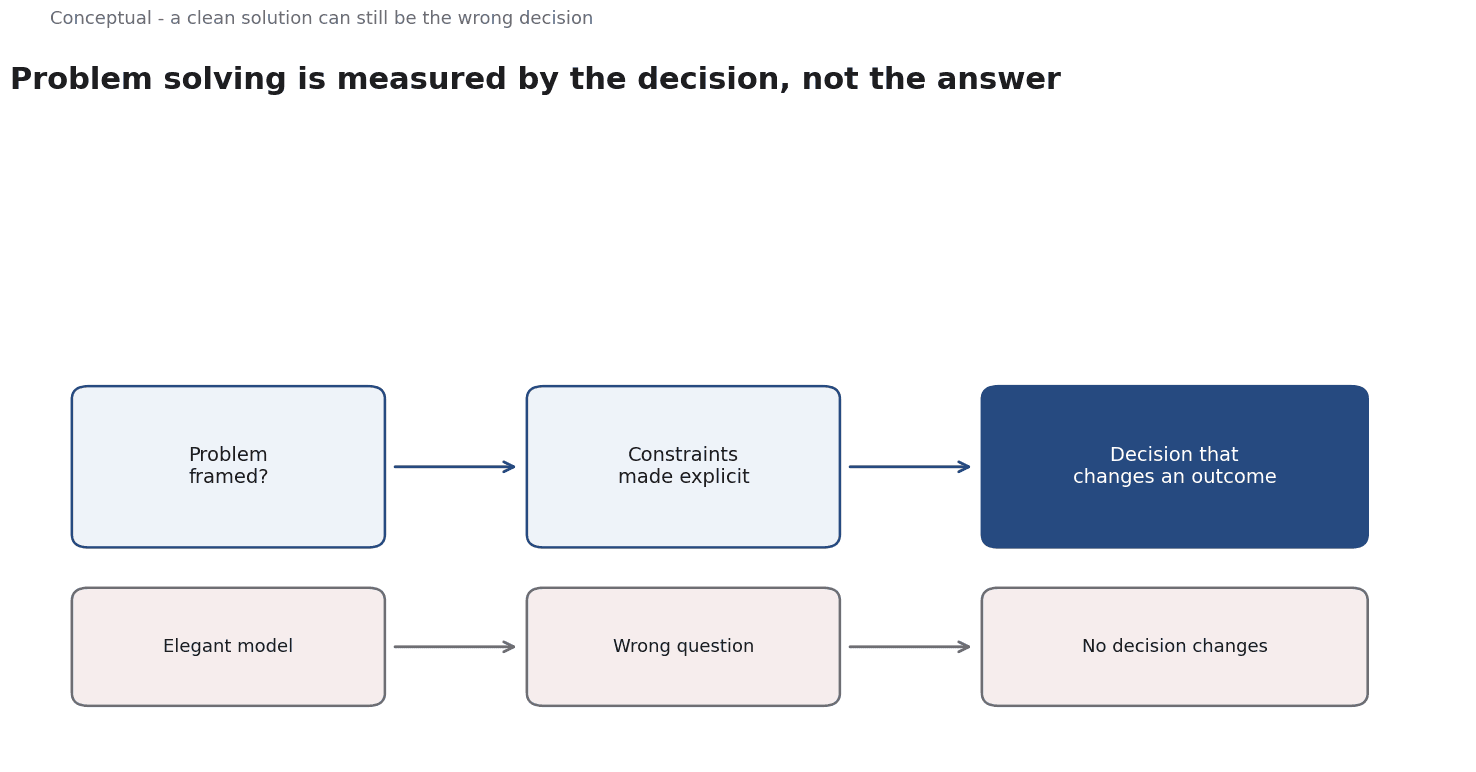
Problem solving is often judged by whether a tidy answer was produced. The Problem solving entry describes processes for finding solutions to difficult situations, and the Decision-making entry describes selecting among alternatives. The real problem is that a plausible solution can be measured by the wrong thing: reaching a decision is not the same as choosing well under uncertainty.
Direct answer: Problem-solving frameworks describe how a solution is reached, and decision-making frameworks describe how a choice is selected from alternatives. The sources define these processes but do not supply a score for solution quality.
A clean process is therefore evidence of rigor, not proof that the outcome was correct.
Delta: This article adds a claim-status table and a solution-quality test beyond the sources: it maps each step of the process to the decision it supports, with claim status explicit.
The mechanism
The Problem solving source describes systematic approaches to finding solutions, often involving defining the problem, analyzing it, and generating and evaluating options. The practical consequence is that the framework makes the path to an answer visible, so a team can see which step produced a conclusion. That visibility is useful for review, because a solution that cannot be retraced cannot be audited. But a structured process can still start from a badly defined problem, in which case the rigor is spent on the wrong question.
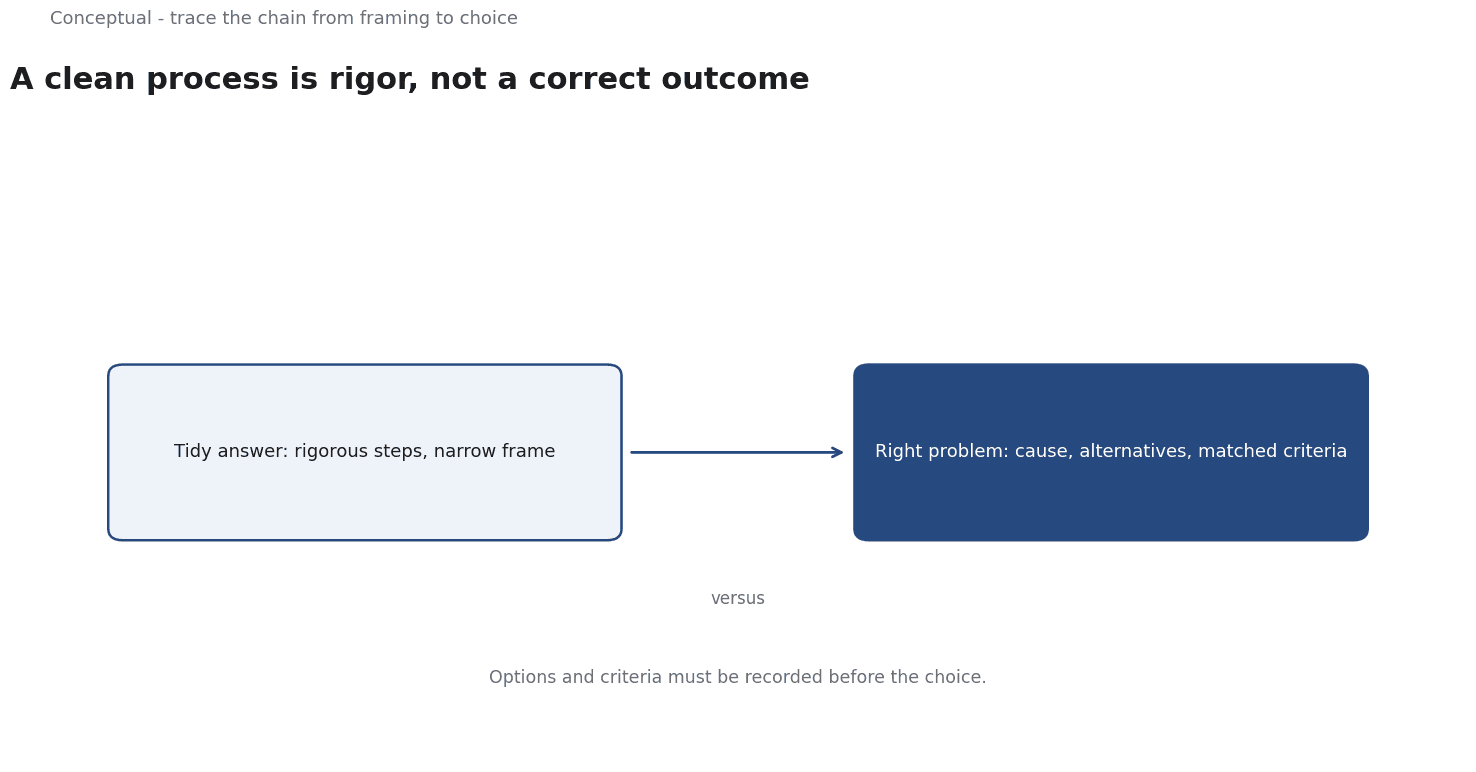
The Decision-making source describes selecting a course of action from available alternatives, often under conditions of uncertainty. The practical consequence is that the quality of a choice depends on the options considered and the criteria used, not just on the reasoning applied afterward. A team can reason carefully about a narrow set of options and still miss a better alternative. The two sources describe complementary layers: problem solving generates and refines options, while decision making commits to one.
Neither source offers a metric that scores a solution as correct, nor says which technique fits a given problem. That choice is inferred, not source-reported. A useful discipline is to separate the question of process from the question of outcome. A review should ask whether the problem was framed correctly, whether alternatives were generated, and whether the criteria matched the goal. Starting from the decision prevents a team from celebrating a tidy process that solved the wrong problem.
The consequence for practice is to treat problem solving as a traceable chain from framing to choice. Each step should have a definition and an owner so a reviewer can follow the reasoning. Options and criteria should be recorded before the choice is made, so hindsight cannot rewrite them. A process that looks rigorous but cannot show its alternatives is a narrative, not evidence of a sound decision, and the sources do not promise otherwise.
A worked example
The following is hypothetical and illustrative. A team faces repeated delays in a delivery process and proposes a fix that appears to solve the issue. Three checks decide the review. First, is the problem framed as the symptom or the cause, so the fix targets the real source of delay? Second, were alternative explanations generated before committing to the first solution? Third, do the criteria used to judge the fix match the actual goal, such as total lead time rather than one stage? The review finds that the team optimized a single stage while the true bottleneck sat elsewhere. The group reframes the problem before choosing a fix. The figures are hypothetical; the verification method is the contribution.
Evidence status
| Claim | Status | Source | Verified | Recheck when |
|---|---|---|---|---|
| Problem solving covers defining, analyzing, and evaluating options | source-reported | Wikipedia, Problem solving | 2026-11-18 | Definition revised |
| Decision making selects a course from alternatives under uncertainty | source-reported | Wikipedia, Decision making | 2026-11-18 | Definition revised |
| A rigorous process does not guarantee a correct outcome | inferred | Derived from the sources | 2026-11-18 | Decision context changes |
The first two rows restate what the sources describe. The third row is a synthesis, since neither source equates a sound process with a correct result. Recheck when the definitions change, or when the decision context, alternatives, or success criteria shift materially.
What it cannot do
Problem-solving frameworks cannot tell you whether the outcome was right. They describe how a solution is reached, not whether it works in the world. The Problem solving source outlines a process, and the Decision-making source outlines a choice among alternatives; neither evaluates the result. A team can follow every step and still be wrong if the problem was framed badly or the environment changed. A tidy method is not a guarantee of a correct answer.
The hidden cost is in defining the problem well. Framing is the most consequential step and the easiest to rush, because the frame determines which options are even considered. The sources do not discuss framing errors, so this is an inference from the gap between method and outcome. A team that inherits someone else's problem statement may solve it efficiently while ignoring the question that actually matters. That efficiency can be more dangerous than an obvious mistake.
Teams often pick the problem they can measure and then declare success when the metric improves, even if the underlying issue persists. The Decision-making source emphasizes alternatives and criteria, which are exactly what a narrow frame suppresses. Because the sources define processes without scoring outcomes, this risk is inferred. A solution that improves a proxy can move the team further from its objective.
There is a boundary around what these sources cover. They describe general processes for solving problems and making decisions, not specific techniques, statistical methods, or domain rules. They also do not address how bias, time pressure, or group dynamics distort a process in practice. A plan that assumes a clean, rational sequence ignores these factors, and the sources do not claim such a sequence exists.
Because problems and criteria change, a solution needs periodic review after it is adopted. The framing, the alternatives considered, and the success criteria should be rechecked against the current situation, with definitions and recheck dates recorded alongside the decision. Without that record, a solution that once fit can become a liability as conditions shift. A reviewer should be able to see what problem was solved and when the choice was last questioned.
The counterargument that a structured process is fair for improving consistency is incomplete when it is treated as proof that the chosen outcome was correct.
A decision test
- Name the decision the problem-solving effort is meant to support.
- State the problem as a cause, not just a symptom.
- Generate more than one plausible alternative before choosing.
- Define success criteria that match the actual goal.
- Check whether the criteria can be measured honestly.
- Decide which option to adopt and record why.
- Record the framing, owners, and a recheck date with the decision.
A problem-solving process is evidence of rigor, not a guarantee of a correct outcome. The test ties the method to a real decision and makes framing, alternatives, and criteria visible, so a reviewer can see when a clean solution addressed the right problem and when it merely looked tidy. For further reading, see Decision Memos That Survive Review.
References & Further Reading
- Wikipedia contributors, 2026. Problem solving - Wikipedia — Process of finding solutions to difficult issues.
- Wikipedia contributors, 2026. Decision-making - Wikipedia — Overview of decision processes, trade-offs and the distinction between the decision and its outcome; secondary reference.