What Referral Programs Actually Measures
Referral programs count credited signups from a tracked incentive, not total advocacy. Read the mechanism, a worked check, and the limits.
Referral programs are often read as a direct measure of customer advocacy, but the referral marketing entry describes a structured, usually incentivised mechanism while the word of mouth entry describes informal communication between people. The real problem is that a tracked referral is an attributed signup, not proof that advocacy caused the purchase or that the same customer would have stayed silent without a reward.
Direct answer:
Referral programs measure signups or purchases credited to a tracked referral mechanism, typically under an incentive.
The referral marketing entry describes that mechanism; the word of mouth entry describes the informal communication it tries to harness. The boundary: this is educational orientation, not a performance forecast, because a credited referral is not the same thing as organic word of mouth.
Delta: This article adds a claim-status table beyond the sources: it maps referral counts to an incentive decision, with claim status explicit.
The mechanism
The referral marketing entry describes a practice in which businesses encourage existing customers to bring in new ones, often by offering a reward. The practical consequence is that the referral is a tracked and deliberately incentivised action, not a spontaneous recommendation. A program can count an event precisely because it has instrumented the path from an existing customer to a new signup, and the reward is part of why that path exists at all.
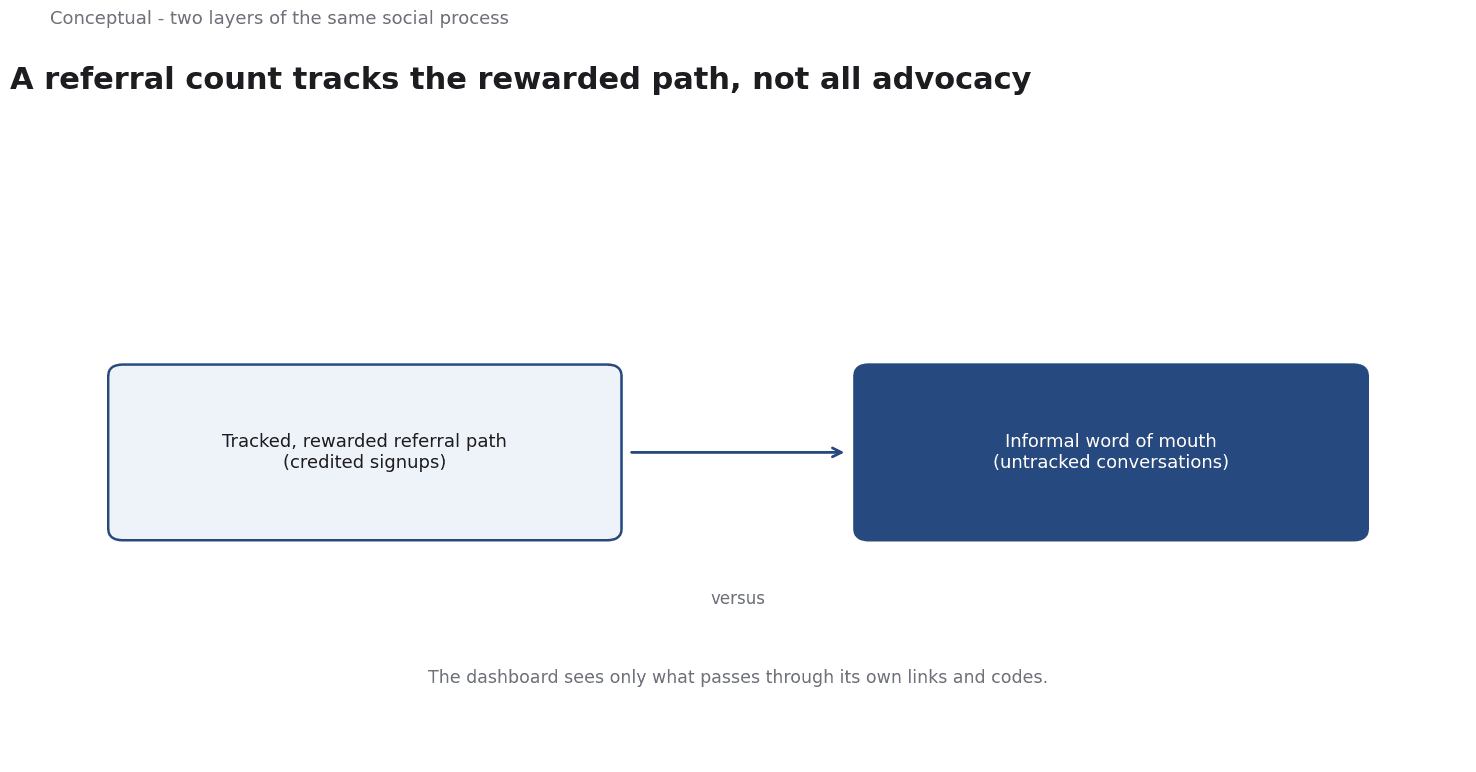
The word of mouth entry describes informal communication about a product between people, typically without commercial intent. The practical consequence is that much genuine advocacy leaves no tracking trail. A satisfied customer may recommend a product in a conversation that the business never sees, so the referral program counts only the portion of advocacy that passes through its own links and codes. The measured channel is a subset of the broader social process.
Taken together, the two concepts sit at different layers. One describes an instrumented, rewarded pathway; the other describes an informal process that often happens outside any instrument. A referral dashboard presents the instrumented part as if it were the whole. The practical consequence is that reported referrals are a property of the program design, including the size of the reward and the ease of sharing, and not just a property of customer enthusiasm.
A coherent reading keeps those layers separate. Use referral data to evaluate the incentive channel: whether the reward produces credited signups at an acceptable cost. Keep claims about total advocacy separate, because the tracking cannot see unattributed conversations. The synthesis that tracked referrals understate broader word of mouth is an inference from combining the two descriptions, since neither source measures the gap for any particular business.
A worked example
The following is hypothetical and illustrative. A company runs a referral program offering a reward to both the referring customer and the new signup, and reports a monthly referral count that looks strong. Three checks decide what that figure means. First, the analyst compares referred signups during the program with a period when no reward was offered, to see how much activity depends on the incentive. Second, the analyst checks whether referred customers resemble customers acquired through other channels, testing the possibility that many would have signed up anyway. Third, the analyst reviews other signals, such as unprompted mentions in support conversations, to estimate advocacy the program cannot see. The outcome is a qualified finding: the program generates credited signups, but the share that is truly incremental remains unknown. The numbers are hypothetical; the sequence of checks is the contribution.
Evidence status
| Claim | Status | Source | Verified | Recheck when |
|---|---|---|---|---|
| Referral marketing uses incentives to encourage customer referrals | source-reported | Wikipedia, Referral marketing | 2026-11-18 | The referral definition changes |
| Word of mouth is informal communication between consumers | source-reported | Wikipedia, Word of mouth | 2026-11-18 | The word-of-mouth definition changes |
| Tracked referrals do not capture all customer advocacy | inferred | Derived from the sources | 2026-11-18 | Attribution of offline mentions improves |
The first two rows are documented in their respective entries. The third row is an inference from pairing an instrumented, rewarded channel with an informal process that often goes untracked. Recheck it if a business gains a reliable way to observe unattributed conversations, since that would narrow the gap the inference describes.
What it cannot do
Referral data cannot establish that advocacy caused a purchase. A credited signup shows that a referral code was used, not that the recommendation was decisive. A customer might have signed up on their own and entered a code to claim the reward. The limit is structural: the tracking records that a path was traversed, not what would have happened along a different path. No referral count, by itself, resolves that question.
A hidden cost of incentives is that they can change the meaning of the metric. When a reward is introduced, referred signups may rise because the reward makes sharing worthwhile, not because customers are more enthusiastic. The cost shows up when the reward is reduced or removed and the count falls. The program then appears to have lost advocacy, when it may simply have returned to the underlying level of unprompted recommendation.
A customer may arrive through a referral link and also be counted by a paid campaign or an email promotion, depending on how credit is assigned. Adding figures from several programs can exceed the actual number of new customers. The error is hard to see because each program's figure is internally consistent; it appears only when the numbers are combined.
The boundary of the measurement is the program's own tracking environment. Referral codes and links capture activity that flows through them and exclude conversations that do not. Word of mouth frequently spreads through channels a business cannot observe, so a referral count describes a partial picture. Claims about total brand advocacy or overall customer enthusiasm exceed what the program data supports.
These figures need review whenever the reward, the attribution rule, or the sharing mechanism changes. A count that was comparable last quarter may not be comparable now if the incentive was increased or the signup flow was altered. Recording the reward level and the tracking setup alongside each figure is the only way to keep a time series interpretable. Without that record, a trend line can reflect a program change rather than a change in customer behaviour.
The counterargument that referral counts are useful for managing the reward channel is fair for consistent within-program comparisons and incomplete for judging overall advocacy, where untracked word of mouth dominates.
A decision test
- State the reward offered and the tracking rule that produced each referral count.
- Compare referred signups with a period when no incentive was active.
- Test whether referred customers differ from customers acquired through other channels.
- Keep credited referrals separate from unprompted mentions in other data.
- Avoid adding referral counts to figures from other acquisition programs.
- Record the reward level and tracking setup beside each reported figure.
- Review the count whenever the incentive or signup flow changes.
These steps turn a credited referral into a bounded incentive decision. They do not measure total advocacy, but they prevent the most common error: treating a rewarded, tracked signup as proof of organic recommendation. The result is a program choice tied to what the data can actually show. For further reading, see voice of customer: turning feedback into decisions.
References & Further Reading
- Wikipedia contributors, 2026. Referral marketing - Wikipedia — The mechanisms and incentives of referral marketing programmes.
- Wikipedia contributors, 2026. Word of mouth - Wikipedia — How recommendations spread between customers.