What Win-back Campaigns Actually Measure
A win-back campaign measures returned customers, not reopened emails. Read what it measures, a worked example, and why a reply is not a return.
Win-back campaigns are often reported by open and reply rates, which measure the message rather than the outcome. The customer-retention entry describes efforts to keep customers, and the email-marketing entry covers campaign mechanics. The gap between a reply and a returning customer is the subject of this article.
Direct answer:
Measure a win-back campaign by whether previously lapsed customers resume the behaviour that defines an active customer, measured against a comparison group.
The sources define retention and campaigns; the outcome rule is a synthesis.
Delta: This article adds an explicit distinction between message metrics and behavioural return, with a claim-status table separating source statements from the measurement rule proposed here.
The mechanism
Three distinctions from the sources matter:
- Retention is behavioural. The customer-retention entry describes keeping customers, which implies an observable state rather than a stated intention.
- Campaign metrics are intermediate. The email-marketing entry covers opens and clicks as campaign mechanics, not as proof of a business outcome.
- A reply is not a return. A customer who answers a message has not necessarily resumed using the product. The difference is the measurement problem.
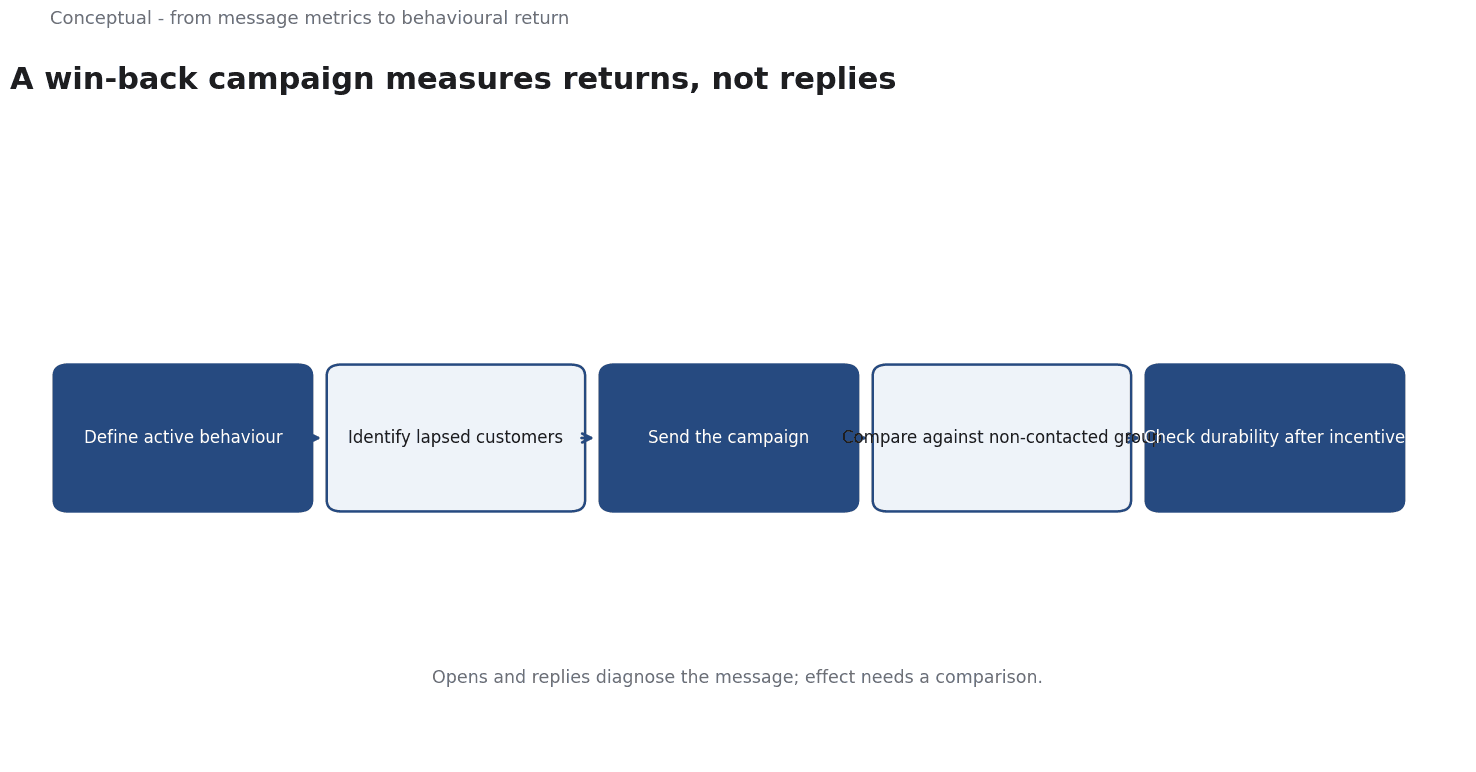
The practical sequence is: define active, identify lapsed customers, send the campaign, then compare behavioural return against a group that did not receive it. The comparison is the causal-inference distinction between association and effect. This rule is inferred; the definitions are source-reported.
A worked example
Illustrative. A subscription business emails 2,000 lapsed customers and reports a 9% open rate and 180 replies.
Three checks decide. First, what behaviour defines "active" again — a purchase, a login, or a renewal? Second, how many lapsed customers resumed it, and how many would have returned anyway? Third, was any incentive in the message large enough to buy a short-term return rather than a durable one?
The outcome is a measured return rate with a comparison and a durability check. The numbers are hypothetical; the measurement rule is the contribution.
Why opens are not returns
An open is evidence that a subject line worked. A reply is evidence that a message prompted a response. Neither is evidence that a customer came back. The distinction matters because a campaign can report healthy engagement while the business sees no change in active customers. The metric is answering a different question from the one the campaign was meant to answer.
The first fix is to define the outcome before the send. An active customer has to mean something observable: a completed purchase, a renewed subscription, a login within a defined window. A lapsed customer is then someone who previously met that definition and no longer does. With both definitions in place, the campaign has a measurable endpoint that is independent of email behaviour.
The second fix is a comparison. Some lapsed customers would return without any message, because their reason for leaving was temporary or because an external change made the product relevant again.
Comparing against a similar group that received no message is the difference between counting returns and estimating effect.
The third fix is durability. An incentive can produce a rapid return that disappears as soon as it is removed. That is not necessarily a failure, but it is a different result from a customer who resumes ordinary behaviour. Measuring the same outcome one or two cycles later tells the two apart. A campaign that buys a single transaction and a campaign that restarts a habit should not be reported with the same number.
None of this makes message metrics useless. Opens and replies are good diagnostics for deliverability and phrasing. They simply belong to a different layer of the report. Keeping the layers separate lets a team improve the message without mistaking that improvement for business impact, which is the central measurement problem in win-back work.
Evidence status
| Claim | Status | Source | Verified | Recheck when |
|---|---|---|---|---|
| Retention concerns keeping existing customers | source-reported | Wikipedia, Customer retention | 2026-11-18 | Definition revised |
| Email campaigns have measurable intermediate metrics | source-reported | Wikipedia, Email marketing | 2026-11-18 | Platform metrics change |
| Measure behavioural return against a comparison group | inferred | Derived from the two definitions | 2026-11-18 | Outcome definition changes |
What it cannot do
It cannot prove that the campaign caused a return without a comparison. It does not guarantee durability, because an incentive can produce a short-lived reversal. And it cannot replace an understanding of why customers left, which the win-back message may not address.
The counterargument that opens are the simplest measure is fair for deliverability and incomplete for business effect, which the worked example shows.
A decision test
- Define the behaviour that counts as active.
- Identify the lapsed cohort with a dated rule.
- Send the campaign with a stated purpose.
- Measure behavioural return, not opens.
- Compare against a non-contacted group.
- Check durability after the incentive ends.
- Record the decision and what remains uncertain.
For the cohorts, see How to Evaluate Retention Analytics.
References & Further Reading
- Wikipedia contributors, 2026. Customer retention - Wikipedia — Efforts to keep existing customers.
- Wikipedia contributors, 2026. Email marketing - Wikipedia — The mechanisms and measurement of email campaigns.