Why Every Business Is Becoming a Software Company
The claim is about where value and control accumulate. Read how software becomes the operating layer of an ordinary business.
"Every company is a software company" is usually said to mean that every company should hire more engineers, which is a misreading with expensive consequences. The claim is better understood as an observation about where the operating logic of a business comes from: the systems that decide what gets made, what it costs, how it reaches a customer, and how the company knows whether any of it worked.
Direct answer:
A business becomes a software company when the software is no longer support infrastructure but the mechanism by which it creates and captures value.
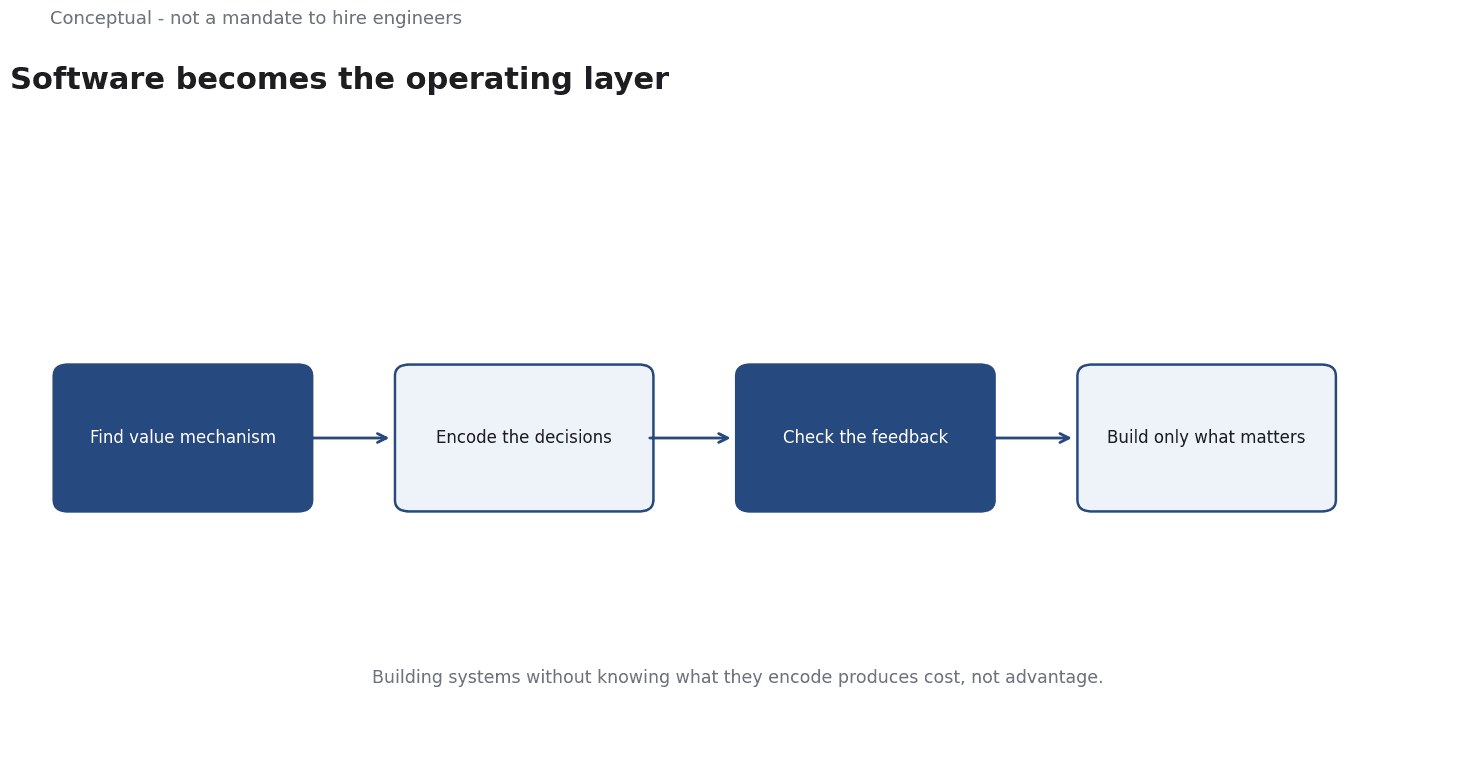
The shift is visible in three places: the product or service is mediated by a digital interface, the operational decisions are made by systems that can be changed in code, and the measurement loop is continuous rather than periodic. Porter's warning that "operational effectiveness is not strategy" applies with full force: digitising an undifferentiated operation makes it faster, not defensible. The real question is what the software lets the business do that competitors cannot easily copy.
What the phrase actually describes
The useful interpretation is about control of the value-creating logic. In a traditional business, the critical decisions are embedded in people, processes, and physical assets. In a software-mediated business, they are embedded in systems — and systems can be changed, measured, and scaled in ways that a manual process cannot.
Three properties change:
The interface becomes the business. For a bank, the app is not a brochure; it is the branch. For a retailer, the site is not marketing; it is the store. When the interface fails, the business stops trading, which is why uptime and latency become commercial rather than technical concerns.
Decisions become code. Pricing, ranking, allocation, and eligibility are determined by systems. This makes them fast to change and easy to test, and it also makes a bug a business incident rather than a technical one.
Measurement becomes continuous. A physical business learns from quarterly accounts; a software-mediated one can observe behaviour in real time. The feedback loop is shorter, which changes what can be managed — and what can be improved by experiment.
The adoption evidence supports the scale of the shift. The NBER's surveys found that "23 percent of employed respondents had used generative AI for work at least once in the previous week", and that "between 1 and 5 percent of all work hours are currently assisted" by it. That is the next wave of the same process: software moving from the infrastructure of work into the tasks themselves.
Why this is not a mandate to hire engineers
The common misreading is that the conclusion is about headcount. It is not. A business whose competitive advantage comes from a brand, a regulatory position, a distribution network, or a physical asset may need very little proprietary software, and hiring engineers to change that is expensive theatre.
What it does need is an honest account of where its value comes from and which systems carry it. Porter's framing is the right filter: "a strategic position is not sustainable unless there are trade-offs with other positions", and a business that digitises everything without choosing what to refuse ends up with a faster version of an undifferentiated operation.
Three questions separate a real software-mediated advantage from an expensive imitation:
- Does the software encode something proprietary — data, a rule, a relationship, a capability — or is it a commodity system anyone could buy?
- Does changing it change the customer's outcome? If the software only changes internal reporting, it is not the source of value.
- Can the business learn faster because of it? A short feedback loop is an advantage only if the organisation uses it to change decisions.
A company that can answer yes to all three is becoming a software company in the useful sense. One that cannot is buying tools.
The operating consequences
When software carries the business, several things become true that were not true before.
Availability becomes a commercial metric. An outage is lost revenue and lost trust, which is why service-level objectives and error budgets matter outside engineering. The Google SRE book defines an SLI as "a carefully defined quantitative measure of some aspect of the level of service that is provided", and the discipline exists because "we use intuition, experience, and an understanding of what users want" to set the target.
Latency is part of the product. A slower page converts worse; a slower API loses partners. This is why performance work has a direct commercial case, and why measurement has to reflect user experience rather than server convenience.
Change is continuous. A software-mediated business ships changes constantly, which means it needs the deployment, monitoring, and rollback machinery that MLOps and DevOps provide. The risk profile changes from occasional large releases to frequent small ones, which is generally safer — provided the checking is real.
Failure modes become abstract. A pricing bug, a bad ranking, or a mis-scoped recommendation can cause large losses without any physical event. The business needs instrumentation that can see these failures, which is why the measurement system is part of the product.
A worked example of software-encoded advantage
Consider two retailers with similar revenue. One runs on a system anyone can buy: a standard commerce platform, standard analytics, and a marketing stack configured like everyone else's. The other has spent years building a recommendation system on its own transaction history, with a feedback loop that connects what customers browse to what the warehouse stocks and what the support team sees.
Both are "software companies" in the literal sense — both run on software — and only one has a software-encoded advantage. The difference is not the presence of code but the presence of something the code captures that a competitor cannot purchase: years of domain-specific data, the operational routines built around it, and the measurement loop that improves it.
Porter's fit argument explains the durability. A competitor can copy the recommendation model, and the copy will underperform because it lacks the data and the operational routines that made the original work. The advantage lives in the system, not in any one component. This is also the warning: if the retailer's advantage were only a faster checkout, a competitor with the same vendor could match it in a quarter.
Two diagnostics follow from the example:
- Ask what would be lost if the software disappeared. For the first retailer, the business would continue with a different vendor. For the second, the accumulated data and the decisions built on it would be a genuine loss.
- Ask which part is expensive to copy. Code is cheap to copy; a decade of operational data and the organisational routines around it are not. If the answer is "the code", the advantage is temporary.
This is why the software question is a strategy question before it is an engineering question.
What the evidence supports and what it does not
The adoption data shows that AI is entering work tasks, not that every business is becoming a software business in a structural sense. "Between 1 and 5 percent of all work hours are currently assisted by generative AI" — a meaningful share and a minority one.
The energy and capital data shows that the capability has a real cost. The IEA reports that "global investment in data centres has nearly doubled since 2022 and amounted to half a trillion dollars in 2024", and that data centres were "around 1.5% of the world's electricity consumption in 2024". A business building its value on this capability should understand that the underlying cost curve is physical and concentrated.
What the evidence does not support is a forecast that every company must transform on a fixed schedule. Different businesses have different sources of value, and the software intensity that is right for one is waste in another.
A practical assessment
- Name the source of value — brand, distribution, physical asset, network, or proprietary logic.
- Trace which systems carry it. If the answer is "people and relationships", software is a support function.
- Check whether the software encodes anything a competitor cannot buy.
- Measure the loop — how long from an observation to a changed decision?
- Treat availability and latency as commercial metrics where the interface is the business.
- Invest in deployment and monitoring before scale, because frequent change without controls is a liability.
- Do not hire to match a slogan. Hire when there is a specific capability the business needs and cannot otherwise obtain.
For the underlying strategy question, see How Companies Build Competitive Advantages; for the reliability practice, see Site Reliability Engineering.
A counterargument
A reasonable critic could say the article accepts the slogan too readily and then rescues it by redefinition. By its own three-question test - does the software encode something proprietary, change the customer outcome, shorten the learning loop - most businesses would answer no, so the phrase describes a subset rather than every company; the piece already concedes that no fixed transformation schedule is supported. The evidence it cites reinforces the objection: between 1 and 5 percent of all work hours are currently assisted by generative AI, and data centres were around 1.5 percent of the world's electricity consumption in 2024, both pointing to a constrained, capital-heavy capability rather than a universal operating layer.
The framing works as a diagnostic but overstates its reach by keeping the headline.
References & Further Reading
- Erik Brynjolfsson, Danielle Li, and Lindsey R. Raymond, 2024. The Rapid Adoption of Generative AI — Workforce-level adoption data and the productivity-gap evidence.
- OECD, 2026. The AI Wonk - oecd.ai — Cross-country measurement and policy data for AI adoption.
- International Energy Agency, 2025. Energy and AI: Data Centres and Electricity Demand — Primary data on how data-centre electricity demand is growing and what that implies for energy markets.