How Companies Build Competitive Advantages
Operational effectiveness is not strategy. Read why a sustainable position needs trade-offs and activities that fit together.
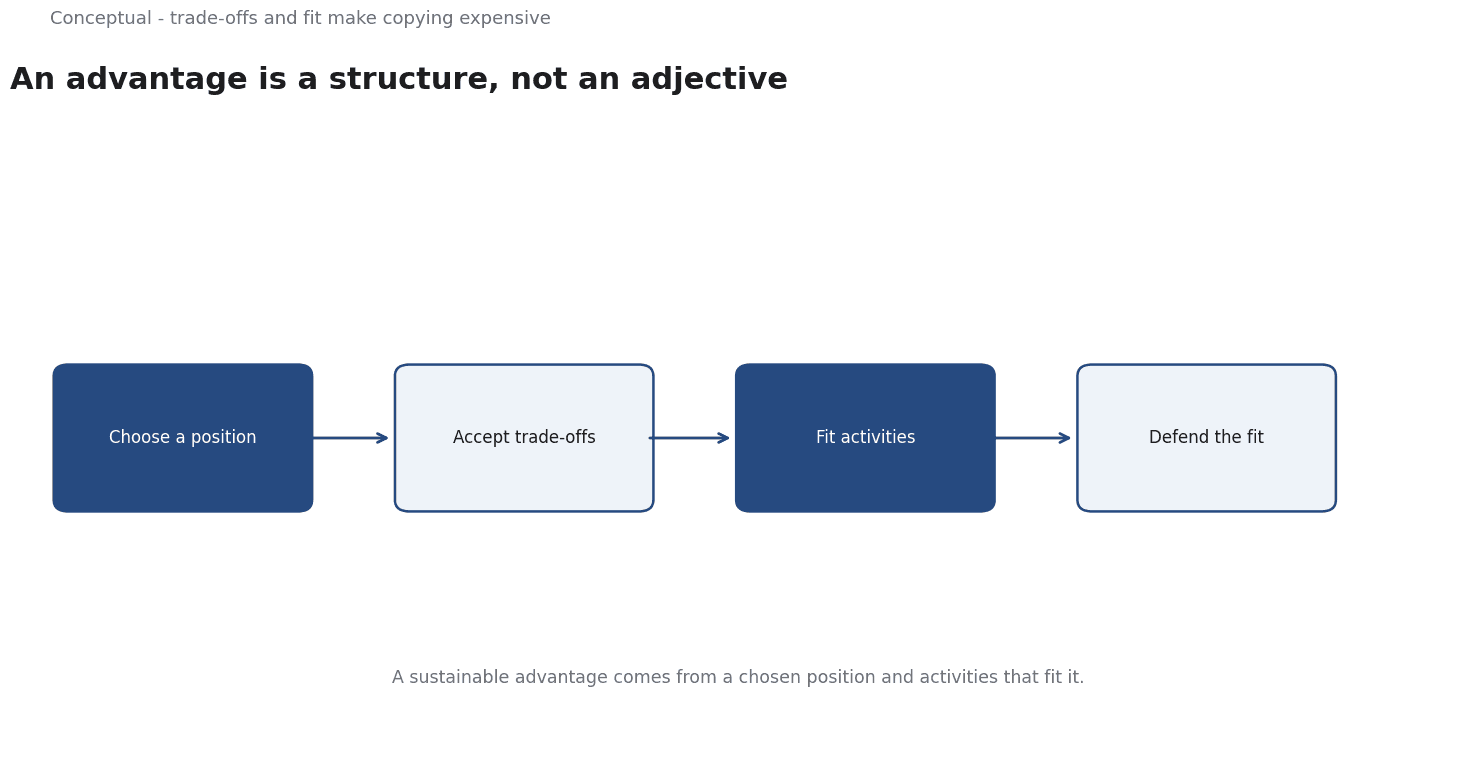
Most companies describe their advantage with adjectives — better product, faster service, stronger team — and then struggle to explain why a competitor with more money cannot copy them. The adjectives are not the advantage. The advantage is a structure that makes copying expensive, and the structure has a specific shape.
Direct answer:
A sustainable competitive advantage comes from a deliberately chosen position and a set of activities that fit it, not from being generally better at everything.
Michael Porter's distinction is decisive: improvements in operational effectiveness are necessary but not sufficient, because they are visible and imitable; a position is defensible only when it involves trade-offs — when more of one thing genuinely necessitates less of another. A company without trade-offs has a set of improvements, not a strategy.
Operational effectiveness is not a strategy
Porter's argument begins with a distinction managers routinely collapse. "What were once believed to be real trade-offs—between defects and costs, for example—turned out to be illusions created by poor operational effectiveness." Once a company fixes the underlying sloppiness, both improve, and "managers have learned to reject such false trade-offs."
That lesson has a trap.
Porter's answer is that this is exactly wrong: operational effectiveness is a different thing from strategy, and confusing the two leaves a company with no position.
The consequences are observable. Two firms in the same industry can converge on the same best practices, the same benchmarks, and the same consulting advice, and end up competing purely on who executes the generic playbook better. That is a real competition, and it is not a strategy, because nothing about the position is protected.
Why trade-offs are the source of durability
The core claim in "What Is Strategy?" is stated without qualification: "A Sustainable Strategic Position Requires Trade-offs. Choosing a unique position, however, is not enough to guarantee a sustainable advantage." And then: "But a strategic position is not sustainable unless there are trade-offs with other positions."
The mechanism is stated just as plainly: "Trade-offs occur when activities are incompatible. Simply put, a trade-off means that more of one thing necessitates less of another." Their function is not to restrict the company but to protect it: "Trade-offs create the need for choice and protect against repositioners and straddlers."
That word — straddlers — is where most strategy failures live. A company that tries to serve both the premium and the budget segment with the same operation ends up with neither: the premium customer sees a compromised product and the budget customer pays for features they do not value. A competitor that has chosen one side can undercut it on the dimension that side cares about. The straddler's problem is not execution; it is that it has no trade-offs, so it has nothing a rival must give up to compete with it.
Porter identifies three sources of trade-offs: "First, sometimes they arise from the preferences of customers... Second, and more important, trade-offs arise from activities themselves... Many trade-offs reflect inflexibilities in machinery, people, or systems." The second and third are the ones managers can actually build. A decision to staff a support function with experts rather than a scripted queue is a trade-off — expensive per case, better on complex cases, and structurally unattractive to a competitor optimised for volume.
Fit is what makes the position hard to copy
A single trade-off can be imitated. What is hard to copy is a system of activities in which each one reinforces the others, because copying one piece without the rest produces a worse outcome, not a better one.
This is the part that generic strategy advice misses. A low-cost position is not just "be cheaper"; it requires a configuration — sourcing, process design, distribution, incentives, and scale — in which all the pieces point the same way. A differentiator chooses a different configuration, and the two configurations are incompatible. A competitor that tries to adopt one piece of yours will find it makes their own system worse, which is the definition of a fit-based advantage.
The practical test is uncomfortable: ask what you would have to stop doing to adopt the competitor's position. If the answer is "nothing", you do not have a position yet. If the answer is a long list of things that are currently working, you have found your strategy and its vulnerabilities.
How to find the position you actually have
Most organisations have a de facto position that was never written down, created by a hundred small decisions about who to serve and what to refuse. Making it explicit is more useful than designing a new one in the abstract.
- List the activities that genuinely differ from your closest competitor's. Not values, not slogans — the things the organisation actually does differently.
- Name the customer you deliberately serve less well. If there is nobody, the position is not chosen.
- Identify the activities that would break if you changed position. Those are your complementarities, and they are where the defence lies.
- Check whether your metrics reinforce the position or erode it. A universal "customer satisfaction" target can quietly push a deliberately low-cost, self-serve business toward expensive service it cannot sustain.
- Refuse at least one plausible opportunity each quarter. Strategy is maintained by saying no to things that would work in isolation; if nothing is ever refused, the trade-offs are not real.
For how the commercial side of a position shows up in retail, see Why Distribution Is Often More Important Than Product Quality, and for the measurement question underneath, see How Marketplace Business Models Actually Work.
A counterargument
A reasonable critic would say the article treats a framework as a law. Porter's own opening concession - that many apparent trade-offs were illusions created by poor operational effectiveness - cuts both ways: if execution keeps dissolving trade-offs, the durability the article promises may be temporary, especially where activities are software and hence easy to copy.
The claim is also close to definitional: a position without trade-offs is declared 'not a strategy,' so any advantage that lacks a visible refusal gets defined away rather than tested.
Porter's third source of trade-offs rests on 'inflexibilities in machinery, people, or systems,' an assumption that fits industrial firms more than asset-light ones. The article cites Damodaran's datasets but never uses them to check whether trade-off-based positions actually persist, so the argument rests on the framework's internal logic rather than evidence that the framework predicts outcomes.
References & Further Reading
- Michael E. Porter, 1996. What Is Strategy? — The differentiation-versus-cost argument behind competitive-advantage analysis.
- Aswath Damodaran, 2026. Damodaran Online: Home Page for Aswath Damodaran — Publicly maintained datasets for industry averages, WACC, and valuation.