Why Distribution Is Often More Important Than Product Quality
A better product does not win if the customer never encounters it. Read how distribution becomes the binding constraint and how to test it.
The story of the superior product losing to the inferior one with better distribution is told so often that it has become a cliché, which is unfortunate, because the underlying mechanism is precise and testable. It has nothing to do with quality being unimportant. It has to do with the fact that a customer can only choose among the options they actually encounter, and distribution determines that set.
Direct answer:
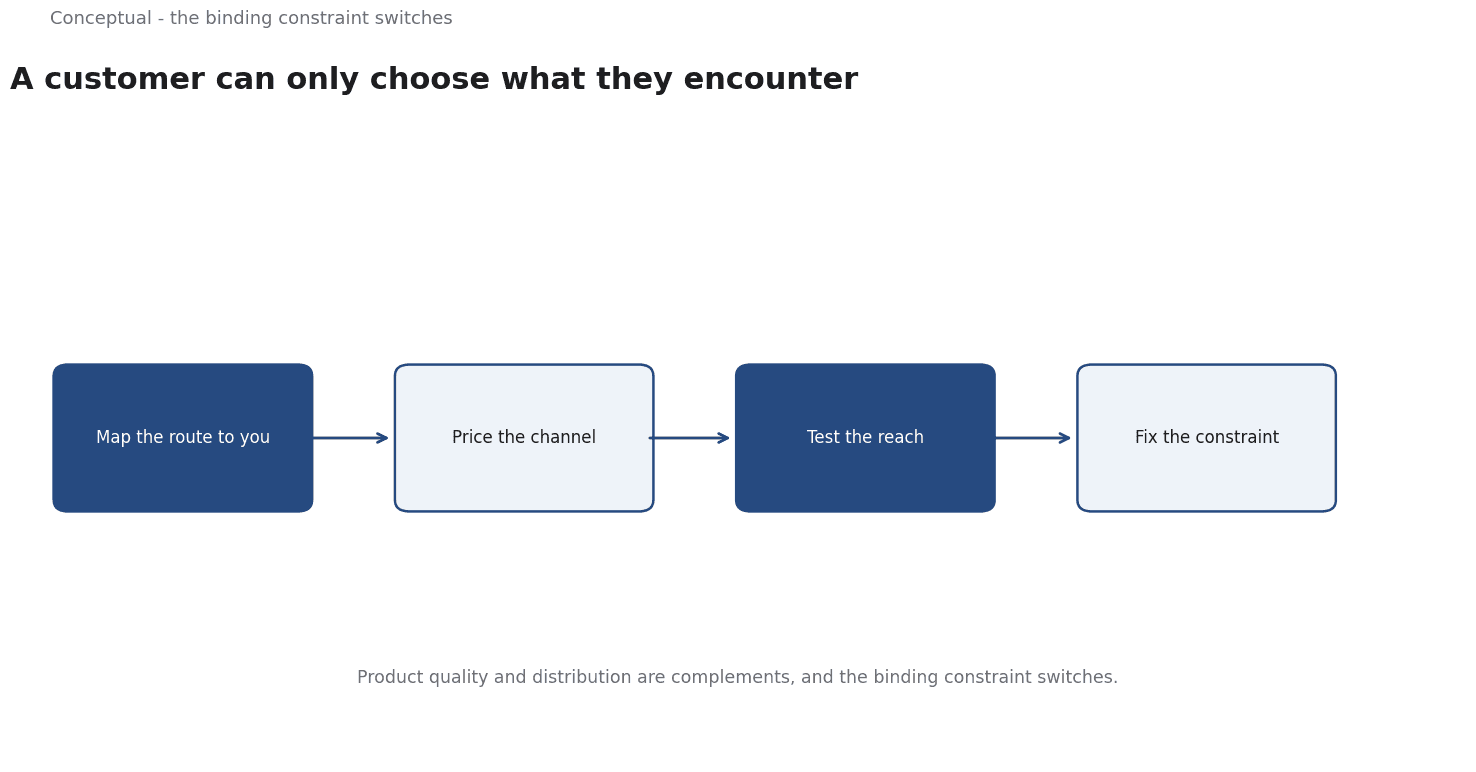
Product quality and distribution are complements, and the binding constraint switches between them as a business grows.
Early on, quality may be the constraint; after a point, the limit is how many relevant customers can encounter the product at the moment they are choosing. Distribution wins those moments because it compounds — each new channel or partner makes every product improvement more valuable — and because it is hard to copy quickly: a competitor can improve a product in a quarter, but it takes years to build the relationships, coverage, and shelf or search presence that put it in front of the buyer.
What distribution actually is
The word is used narrowly to mean logistics, and that is one part of it. The useful definition is broader: the set of things that determine whether the customer encounters, can evaluate, and can obtain the product at the moment of decision.
That includes physical availability, retail placement, online discoverability, marketplace presence, partner channels, and — increasingly — whether an AI system or a search result surfaces the product when someone asks a relevant question. It also includes the less glamorous mechanics: which platforms the customer already trusts, whether the payment method they expect is accepted, and whether the item is in stock.
The mechanism that makes distribution decisive is simple. A purchase requires a choice set, and the choice set is constructed before the customer evaluates quality. If your product is absent from that set, no amount of superiority changes the outcome. This is why the best product can lose without being worse in any meaningful sense — the customer is choosing among the options that were available in that context.
Porter's framing of strategy applies directly. "Trade-offs occur when activities are incompatible — more of one thing necessitates less of another", and choosing a distribution position means refusing others. A brand sold through independent specialists cannot also be the cheapest option in a mass channel without destroying the relationships that made the specialists carry it. That incompatibility is what makes the position defensible, and it is also why distribution choices are among the hardest for a competitor to copy.
The economics of a channel
Distribution is not free, and the right way to understand a channel is as a claim on the value created.
A distributor takes a margin because it performs work: it reduces the customer's search cost, it holds inventory, it provides trust, it handles returns, and it gives visibility to a product the customer would not otherwise have found. The margin is the price of that work. A producer that tries to bypass the channel saves the margin and takes on the work — which is sometimes the right decision and frequently not.
You remove a cost and you remove a capability, and the two were coupled. The test is whether you can perform the channel's work more cheaply than its margin, at the same reach and the same conversion.
Retail data is useful here because it shows where the customer actually buys rather than where a brand would like them to buy. The National Retail Federation publishes the sales and channel figures that make it possible to check whether a distribution bet is aligned with a market that is moving — for instance, whether a category is growing in a channel your brand is not in. A position built on a channel that is structurally shrinking is a position with a limited future, regardless of product quality.
Why the advantage compounds
The reason distribution often dominates over time is that it is multiplicative. A product improvement becomes worth more when it is available in more places where customers are choosing; a new channel becomes worth more when the product is better. Improvements to one reinforce the return on the other.
Quality improvements, by contrast, are often rivalrous and easily matched. A feature launched this quarter can be copied next quarter; a competitor with a decent product and better placement will have sold it many times over before the copying even starts.
And distribution has a memory effect that product does not: relationships, shelf space, marketplace ranking, and default status with a customer all persist. A customer who buys through a particular channel tends to keep buying there. A retailer that has allocated space to your category does not reallocate it every season. That persistence is why a distribution lead taken early can be held with far less ongoing investment than the product lead that created it.
A diagnostic you can run
- List the top three situations in which a customer chooses your category. For each, name the channels in which your product is actually present at that moment.
- Measure the choice set, not your share of it. If your product is absent from a channel where the decision is made, your share there is zero and the product cannot fix it.
- Price each channel's margin against the work it performs. Compare the cost of performing that work yourself at the same reach before cutting it out.
- Check the market direction against your channel mix using published retail data. A growing category in a channel you are not in is a strategic signal.
- Name the refusal your distribution choice implies. If you claim a premium position and are available everywhere, something in the position is already broken.
- Test one new placement with a defined counterfactual. Choose a set of locations or channels, hold the product constant, and measure the incremental purchases. Distribution decisions can beexperimented on like any other variable.
For the positioning logic that determines which channels fit, see Brand Positioning; for the retail-channel context, see Omnichannel Retail.
A worked example
The following is hypothetical and illustrative. A small maker of a well-reviewed coffee grinder sells almost entirely from its own site, where visitors convert at a healthy rate, yet total units have flattened for a year. The constraint is not quality but whether buyers encounter the product at the moment they choose. First, list the three situations in which a customer selects a grinder - a specialty retailer, a marketplace search, and a gift purchase - and check presence in each; suppose the grinder appears in only the first. Second, price the specialty retailer's margin against the work it performs, since under Porter's trade-offs choosing an independent-specialist position means refusing the mass channel and accepting lower volume. Third, set that channel mix against published NRF data to see whether the category is growing in a channel the brand is absent from. The bounded test is one new placement in a single specialty chain, product held constant, measuring incremental purchases. If the margin buys more discovery and trust than self-serve can match at the same reach, the brand gains a channel; if not, the diagnostic says so before more inventory is committed.
A counterargument
A critic could push back that the article stacks the deck by treating quality as copyable features and distribution as inherently defensible. Porter's trade-off argument cuts both ways: a distribution position built on a channel that is structurally shrinking - something the NRF data can reveal - is a liability, not a moat, and channel relationships can be disrupted by the very platform shifts the piece treats as durable. The claim that quality is rivalrous assumes a competitor can copy a feature in a quarter, but Bryar and Carr's working-backwards method implies the product experience itself can compound when it is built from customer insight rather than a feature checklist.
Distribution and quality plausibly alternate as the binding constraint, and the word often hides how much that depends on market structure and direction.
References & Further Reading
- Michael E. Porter, 1996. What Is Strategy? — The differentiation-versus-cost argument behind competitive-advantage analysis.
- National Retail Federation, 2026. NRF Press Releases | Latest Statements & Announcements | NRF — Primary retail-sales and channel data for sell-in versus sell-out definitions.
- Colin Bryar and Bill Carr, 2019. Amazon Company News — Primary company material on how the working-backwards method is applied.