Why Learning How to Learn Is a Competitive Advantage
Learning is a skill with a research base. Read the six strategies, a redesigned study session, and the honest limits the researchers themselves state.
Most people learn by repeating what worked in school: read the material, highlight it, read it again. The procedure feels productive and is often ineffective. The reason learning strategy matters as a competitive advantage is not that some people are naturally better at it — it is that a small set of techniques with empirical support is available to anyone willing to use them deliberately.
Direct answer:
The Learning Scientists publish a "Six Strategies for Effective Learning" resource based on research in cognitive psychology.
The strategies — retrieval practice, spacing, interleaving, elaboration, concrete examples, and dual coding — are methods for making knowledge durable and usable.
The boundary is stated by the researchers themselves: "we cannot guarantee success, and we cannot predict students' grades based on the use of these strategies". They improve the odds; they do not determine the outcome.
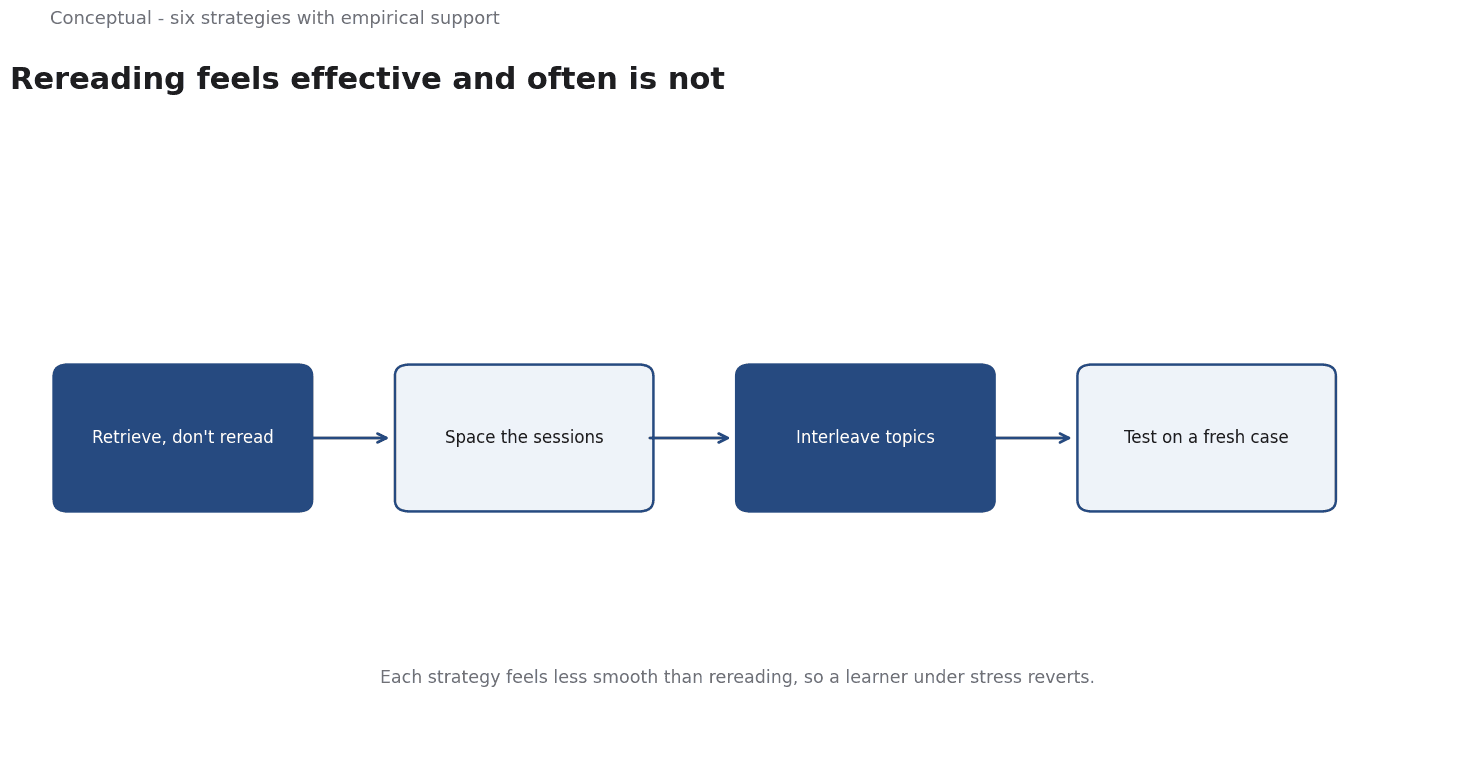
Why rereading feels effective and often is not
Rereading produces familiarity. When the material looks familiar on the second pass, the brain interprets that feeling as knowledge. But recognition is not recall: the cue was present both times.
The distinction matters in practice. A developer who has read a framework's documentation three times may recognise the right answer in a multiple-choice question and still be unable to write the code without looking it up. The knowledge is available with the cue, not without it.
Retrieval practice — attempting to recall information without the source in front of you — tests the thing that matters. It feels harder, which is precisely why people avoid it, and the difficulty is the mechanism: the effort of reconstruction strengthens the memory.
The six strategies
Retrieval practice. Close the book and write down what you remember. Check afterwards. The act of pulling information out is more valuable than another pass over the same text.
Spacing. Spread study over multiple sessions rather than cramming. A day's gap forces reconstruction from a weaker trace, which strengthens it; the effect is robust across many materials.
Interleaving. Mix related but distinct topics in one session instead of blocking them. It feels slower because each switch requires reloading context, and it improves the ability to tell the topics apart — which is what real work requires.
Elaboration. Explain why something is true, or how it connects to something you already know. A fact linked to a structure is easier to retrieve than an isolated fact.
Concrete examples. Anchor an abstract idea in a specific case. A principle illustrated by one worked example becomes usable in a way a definition alone does not.
Dual coding. Combine words with a visual representation where the material supports it. A diagram of a system's data flow encodes relationships that a paragraph expresses linearly.
The six are not a checklist to apply all at once. The useful move is to choose the one that addresses your current failure mode: if you recognise but cannot recall, use retrieval; if you forget between sessions, use spacing.
A worked example of a redesigned session
The following is a hypothetical study plan, not a measured result.
A developer has four hours to learn a new library. The default approach is one four-hour reading session. Redesign it with the strategies:
Session 1 (90 minutes). Read the core concepts for 40 minutes. Close the material and write down the main ideas from memory for 15 minutes. Check and correct. Work one concrete example. Take a 10-minute break, then explain the concepts aloud without notes. These steps use retrieval, concrete examples, and elaboration.
Session 2 (next day, 90 minutes). Begin by recalling yesterday's material before reopening anything. Work a different example that requires choosing between two approaches — interleaving. Sketch the data flow as a diagram — dual coding.
Session 3 (three days later, 60 minutes). Attempt a small task without documentation, then consult it only to fill gaps. The gaps are the curriculum for the next session.
Total: 240 minutes, the same budget as the single reading session, but distributed and active rather than passive.
Two predictions follow from the strategy literature: session 3 will feel harder than rereading would have, and performance on a task without notes will be better. Both are worth checking personally — the honest approach is to try the design and measure your own recall rather than accepting the claim on authority.
The Learning Scientists' own caution applies: the strategies are based on research but "cannot guarantee success". Individual differences, material difficulty, and time constraints all matter.
Applying this at work, not just in study
The strategies transfer directly to professional learning, with one change: the material is encountered in the course of doing the task, so the "study session" has to be designed into the work.
After a code review, reconstruct the reasoning. Instead of applying the suggested change and moving on, write down why the reviewer objected. That is elaboration and retrieval applied to a real artifact, and it converts one person's feedback into durable knowledge.
Keep a short error log. When a tool behaves unexpectedly, record the symptom, the diagnosis, and the fix in your own words. Re-reading that log before a similar task is spaced retrieval with material that is directly relevant to your work.
Alternate related tasks deliberately. If you are learning two systems, work on them in the same week rather than finishing one and then the other. Interleaving makes the boundaries clearer, which matters when you must choose the right tool in practice.
Explain one thing per week to someone else. A paragraph or a short conversation that explains a mechanism without notes is a retrieval test with a real audience, and it reveals gaps that private study hides.
The competitive advantage emerges from the compounding of these small habits. Two developers with the same nominal experience can differ substantially in what they can recall and apply, and the difference is often explained by how they encountered and revisited the material rather than by talent.
What the strategies do not do
Three limits matter.
They do not create understanding of material you cannot parse. Retrieval practice on text you do not comprehend rehearses confusion. Background knowledge is a prerequisite, which is why the strategies are more effective for a learner with some foundation.
They do not replace practice on the real task. Retrieval of a fact is different from performing a skill under time pressure. A developer must still write code; the strategies make the underlying knowledge available when they do.
They are easy to abandon.
Making the schedule explicit — specific times, specific prompts — reduces the need for willpower.
The counterargument that this is all just "study harder" is wrong in a specific way: the strategies change what you do, not just how long.
Spacing and retrieval are structural choices about when and how information is revisited.
A decision test
- Name the failure mode — recognition without recall, forgetting between sessions, or inability to apply.
- Choose one strategy that targets it rather than using all six superficially.
- Schedule the sessions at specific times, with gaps of at least a day where possible.
- Begin each session with retrieval before opening the source.
- Include one concrete example and one explanation in your own words.
- Measure without cues — attempt the task before consulting documentation.
- Keep what works for you and discard what does not, while staying honest about the measurement.
For applying this to technical skills, see How to Start Learning AI; for the career context, see The Future of Work.
References & Further Reading
- Learning Scientists, 2026. The Learning Scientists — Research summaries on retrieval practice, spacing, and durable learning.
- U.S. Department of Labor, 2026. O*NET OnLine — The standard occupational taxonomy used to compare roles across industries.
- Google, 2026. Google re:Work — A large company's published people practices, including hiring and growth frameworks.
- The Learning Scientists, 2026. Downloadable Materials — The Learning Scientists — The Six Strategies for Effective Learning resource and the researchers' explicit caution that success cannot be guaranteed.