Why Many Startups Fail Despite Having Great Products
A good product solves a problem; a business survives on distribution, timing, cash, and a model that works. Read where the gaps appear.
The graveyard of good products is large, and it is not populated by teams that failed to build. It is populated by teams that built something people liked and then discovered that liking is not the same as buying, that buying is not the same as retaining, and that neither pays the salaries of the people who built it.
Direct answer:
Product quality is necessary and insufficient.
A startup fails when one of four things is missing: a route to the people who need the product, a unit economic model that improves with scale, enough cash to survive until the model works, or an organisation that can adapt when the first plan is wrong. Porter's framing applies here — "a strategic position is not sustainable unless there are trade-offs with other positions" — because most failing startups have no position at all: they built something broadly good, refused no one, and therefore gave nobody a strong reason to switch.
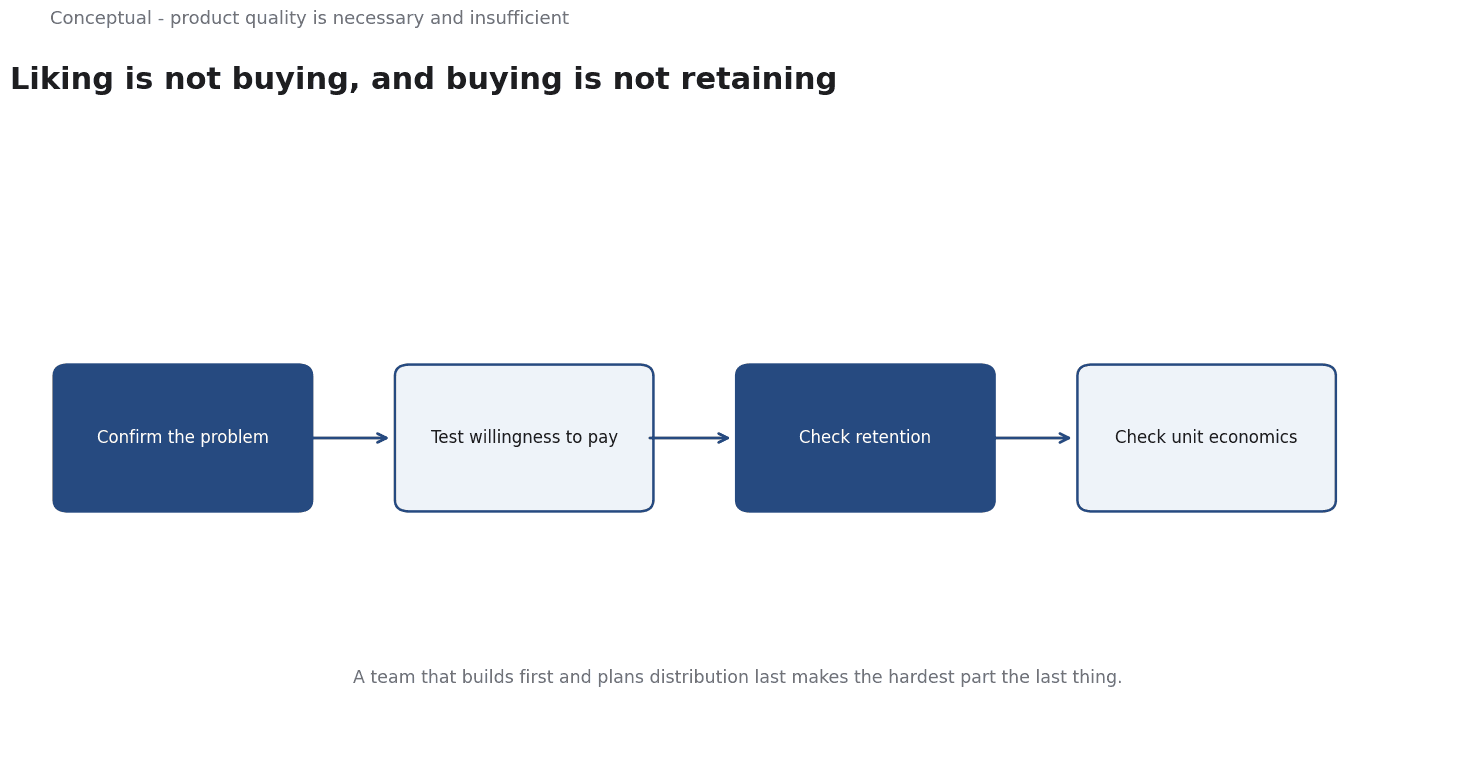
The gap between liking and buying
A product that people praise in conversation can still fail commercially, and the reason is usually that praise is free while adoption has a cost. Switching tools, changing a workflow, and learning an interface are expenses borne by the customer, and they have to be justified by an improvement large enough to overcome them.
This is why distribution is not a later stage of the business. It is the mechanism by which the product reaches a decision point, and it has to be designed alongside the product.
The practical diagnostic is uncomfortable but simple: can the team name the moment when a user decides to switch, and what has to be true at that moment? If not, the product's quality is being measured by the wrong signal. "People liked the demo" is not an answer.
Porter's argument about operational effectiveness versus strategy explains a common variant. A startup can be better than incumbents on several dimensions — faster, cleaner, cheaper — and still have no defensible position, because those improvements are copyable. The incumbent can match them, and the startup's advantage evaporates without ever having been protected.
The unit economics trap
A business can grow and still become less viable with every new customer, and this is the most dangerous failure mode because growth conceals it for a while.
Unit economics answers a narrow question: after fully loaded acquisition cost and serving cost, does one customer contribute enough margin, over a realistic lifetime, to justify the cost of acquiring them? If the answer is no, scaling accelerates the loss.
Three errors are common:
- Counting revenue instead of contribution margin. A customer who buys a low-margin product and generates support tickets is not the same as one who buys a high-margin product and needs nothing.
- Using an average acquisition cost that will not hold at the next scale. Early customers are cheap because the founders sold them personally, and that cost does not stay low when the team has to hire salespeople.
- Assuming retention from enthusiasm. A cohort that signs up eagerly and leaves in month three is a different business from one that stays.
The Small Business Administration's lending guidance is a useful external check on the cost side. Its guaranteed loans are noted as having "rates and fees that are comparable to non-guaranteed loans", and some loans come with "continued support to help you start and run your business". The lesson for a startup is that financing is a real cost with real terms, and a plan that treats capital as free is not a plan.
Timing and the shape of the market
A product can be correct about the problem and wrong about the time. Customers may not yet have the budget, the infrastructure, or the habit that makes the product usable.
Timing is hard to reason about because being early looks identical to being wrong from the inside. The team sees a market that has not arrived, and the temptation is to conclude that the product needs more features. Sometimes it does; sometimes the market needs another two years, and the right move is to survive until then or to find the narrower segment that is ready now.
Market structure matters in the same way. A product entering a market with a few dominant platforms may find that its distribution depends on parties who can change the terms unilaterally. Porter's point about trade-offs is relevant: a position that depends on someone else's platform without a complementary asset of your own is fragile, because you have not chosen what you will refuse.
The organisation is part of the product
The fourth failure is the least discussed in product stories: the company cannot change. The first plan is almost always wrong in some respect, and survival depends on how quickly the team can discover which part and reorganise around the answer.
Signs that the organisation has stopped adapting:
- Decisions require the founder even when the founder is no longer the person with the most information.
- The roadmap is defended rather than revised, because changing it would imply the previous decision was wrong.
- Metrics describe activity rather than outcomes, so the team cannot tell whether it is improving.
- Bad news travels slowly, because the messenger is implicitly blamed for it.
These are not culture problems in the abstract. They are information problems: the organisation has made it expensive for the truth to reach the people who can act on it.
A worked unit-economics example
The arithmetic that decides a startup's fate is short enough to do in a spreadsheet, and doing it early is worth more than any amount of retrospective analysis.
Suppose a product charges 100 per customer per month with a gross margin of 70%, so each customer contributes 70 a month before acquisition and support. Customers stay an average of twelve months, giving a gross contribution of 840. Acquisition costs 600 per customer, and support costs 10 a month, or 120 over the lifetime. The lifetime contribution after those costs is 840 − 600 − 120 = 120, and the acquisition cost is repaid in roughly ten months.
That is a viable but tight model: the company needs enough cash to fund ten months of negative working capital for every new customer, and any deterioration in retention or support cost turns it negative. If churn rises so the average life falls to eight months, contribution becomes 560 − 600 − 96 = −136. Every new customer now destroys value, and growth accelerates the loss.
Two details make the example useful beyond its numbers:
- The acquisition cost is treated as an investment that must be repaid, and the repayment period is a cash question, not an accounting one. A company can be "profitable" on an accrual basis and still run out of cash funding growth.
- The result is sensitive to retention, which is usually the least well-measured input. A small change in average lifetime flips the sign of the entire model, which is why cohort retention deserves more attention than top-line growth.
The honest version of this calculation uses the observed cohort curve rather than an assumed average life, and it states which inputs are measured and which are guesses. A model built entirely from guesses is not a model; it is a wish with arithmetic.
The pivot decision
When the evidence says the current plan is wrong, teams face a decision that is hard to make rigorously: persist or change direction. The difficulty is that both persistence and pivoting have plausible success stories, so the anecdotes cannot decide it.
A workable rule is to separate two questions that are usually conflated:
- Is the problem real and valuable? If customers who use the product get genuine value, the problem is probably real, and the failure may be in distribution, pricing, or the business model.
- Is the current solution the right one? If the same customers get value and still leave, or if only a small subgroup gets value, the solution or the segment may be wrong.
If the problem is real and the solution is wrong, changing the solution while keeping the customer insight is a pivot. If the problem itself was assumed rather than observed, changing the solution is only a new guess, and the team should return to evidence before committing.
In both cases the decision should be dated and written down: what was believed, what was observed, what changed, and what would falsify the new direction. That record is the only defence against repeating the same mistake under a new name.
What to measure before it is too late
A short list of indicators distinguishes a struggling product from a struggling business:
- Time to first value for a new user. If it is long, the product is doing too much of the work for the customer.
- Activation by segment. Who gets value, and who never does? A product that works for one narrow group can be a business; one that works slightly for everyone usually is not.
- Cohort retention, not aggregate growth. New users can mask the fact that old ones are leaving.
- Fully loaded acquisition cost at the current scale, with a stated estimate for the next one.
- Contribution margin per customer, including support and servicing costs.
- Cash runway against the date the model is expected to work, with a specific definition of "work".
- Decision latency — how long a change in understanding takes to become a change in behaviour.
A closing caution
The most difficult aspect of startup failure is that the evidence is ambiguous in real time. The same observation — slow growth, high churn, a narrow group of enthusiasts — can mean "the product needs more time" or "the business will never work", and there is no test that settles it in advance.
What a team can do is make the ambiguity cheaper: measure cohorts rather than impressions, write down the assumptions behind the plan, set a date at which each will be revisited, and change course when the evidence says so rather than when the money runs out.
For the distribution argument, see Why Distribution Is Often More Important Than Product Quality; for the positioning framework, see How Companies Build Competitive Advantages.
A counterargument
A critic could argue the four-factor taxonomy is unfalsifiable after the fact: almost any failure can be narrated as a distribution, unit-economics, timing, or organisation problem, which is the same ambiguity the closing caution admits cannot be settled in real time. The cited sources do not supply the missing discriminant. Bryar and Carr's working-backwards method and Damodaran's valuation datasets are frameworks for thinking clearly, not evidence that these four factors are the actual causes of failure, and NRF channel data speaks to sell-in versus sell-out rather than startup mortality.
The piece mistakes a useful checklist for an explanatory model: it says what to measure but not which factor dominates, and its own worked example shows how sensitive the verdict is to one guessed input.
References & Further Reading
- Colin Bryar and Bill Carr, 2019. Amazon Company News — Primary company material on how the working-backwards method is applied.
- Aswath Damodaran, 2026. Damodaran Online: Home Page for Aswath Damodaran — Publicly maintained datasets for industry averages, WACC, and valuation.
- National Retail Federation, 2026. NRF Press Releases | Latest Statements & Announcements | NRF — Primary retail-sales and channel data for sell-in versus sell-out definitions.