Will AI Replace Jobs or Create an Entirely New Economy?
The evidence shows uneven effects, not a single direction. Read what the adoption and productivity data actually supports about work.
The question is usually asked as a binary, and the binary is the problem. Will AI replace jobs or create new ones? The available evidence does not describe a single wave that lifts or sinks everyone; it describes heterogeneous effects concentrated in particular tasks, with adoption moving faster than any general-purpose technology measured, and realised gains so far modest in aggregate.
Direct answer: The best evidence supports three claims. Adoption has been exceptionally fast — the NBER's nationally representative US surveys found that "nearly 40 percent of the U.S. population age 18-64 uses generative AI" as of late 2024, with work adoption "as fast as the personal computer". Measured productivity effects are uneven: the same research group's customer-support study found 14% average gains with "34% improvement for novice and low-skilled workers but with minimal impact on experienced and highly skilled workers". And aggregate time savings remain small: respondents reported savings "equivalent to 1.4 percent of total work hours". None of this establishes mass unemployment or a new economy of abundance; it establishes a transition whose direction depends on which tasks and which workers you are looking at.
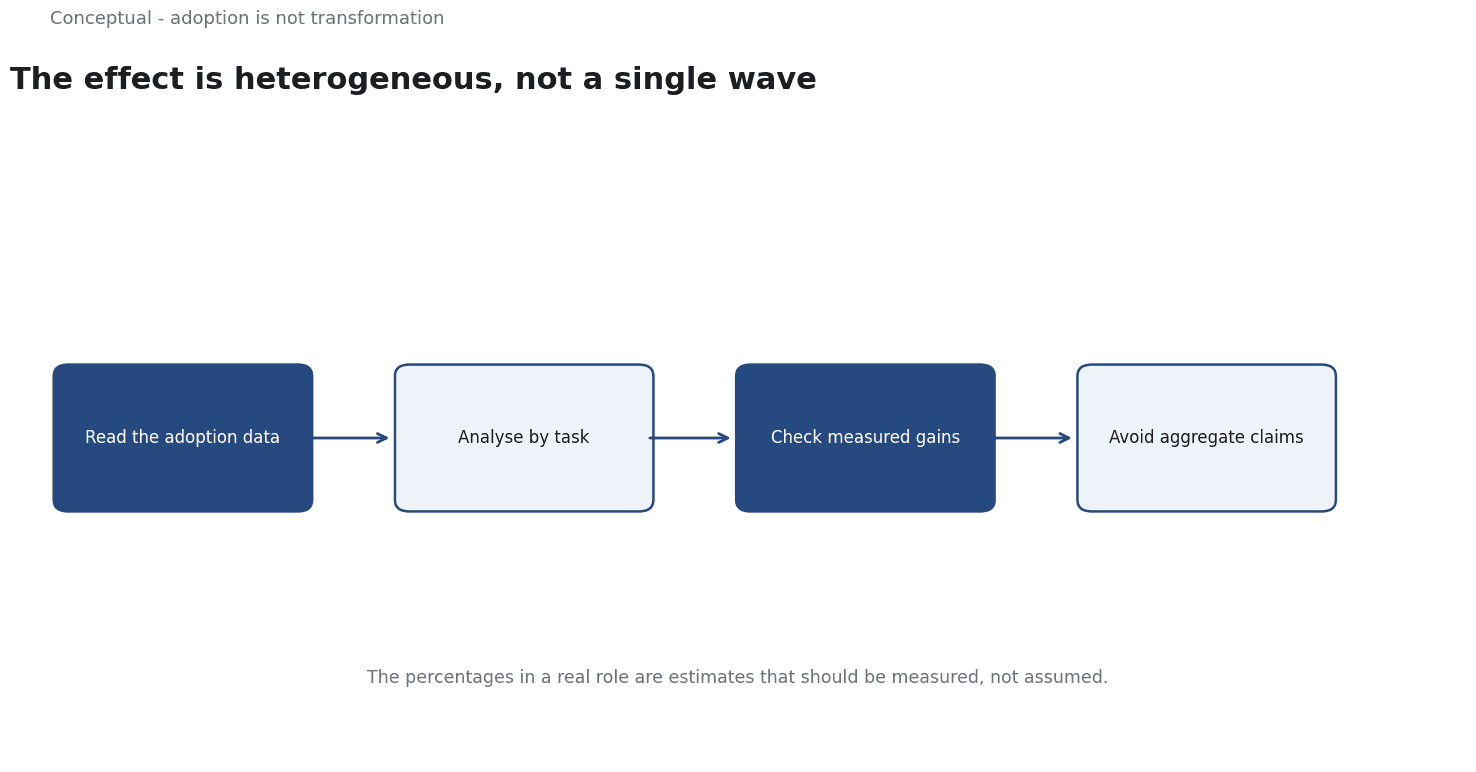
Adoption is not the same as transformation
The speed of adoption is the most robust finding. Brynjolfsson, Li and Raymond report that "23 percent of employed respondents had used generative AI for work at least once in the previous week, and 9 percent used it every work day". Measured against each technology's first mass-market product launch, "work adoption of generative AI has been as fast as the personal computer (PC), and overall adoption has been faster than either PCs or the internet".
The paper also notes that generative AI and PCs show "very similar early adoption patterns by education, occupation, and other characteristics". That last detail matters more than the headline rate. It suggests the diffusion is following the same general-purpose pattern as the PC — concentrated among higher-education, higher-income users first — rather than appearing uniformly across the workforce.
This is why adoption figures can be cited by both sides of the argument. Rapid uptake shows the technology is useful and accessible; it does not show that jobs are disappearing, because the same paper reports that "between 1 and 5 percent of all work hours are currently assisted by generative AI". A technology used occasionally in a small share of work hours has not yet reorganised the economy of work, whatever its trajectory.
The task is the unit of analysis
The research that gets closest to mechanism looks at tasks rather than occupations. The customer-support study of 5,179 agents found that access to an AI assistant "increases productivity, as measured by issues resolved per hour, by 14% on average", with the large variation by experience noted above.
The experience split is the analytically important part. If an assistant supplies knowledge a worker has not yet accumulated, it should help novices most — which is what the data shows. If a worker already knows the answer, the tool adds a verification cost and may slow them down. This interpretation is consistent with METR's finding that experienced open-source developers took "19% longer to complete issues" when allowed AI tools, in a randomised study of sixteen developers completing 246 tasks.
Two caveats belong with that result. METR's own note is that "You only had 16 developers, so these results will not generalize/replicate." And the NBER and METR studies look at different tasks with different populations, so they are not in conflict. Together they support a narrower claim than either headline:
AI assistance is most valuable where the user lacks the knowledge, and least valuable — possibly negative — where they already hold a strong prior.
For the labour-market question, that means a job is not simply "exposed" or "safe". A job contains tasks, some of which fit the tool and some of which do not, and the tool's effect depends on the worker's experience with the specific task.
What the aggregate number does not show
A 1.4% saving in total work hours is a real number and a small one. The authors read it as suggesting "that substantial productivity gains from generative AI are possible" — note the tense. It is a statement about potential, not about realised transformation.
Three reasons the aggregate can stay small even while individuals benefit:
- Assistance is intermittent. If only 1–5% of hours are assisted, even a large per-hour gain produces a modest aggregate effect.
- Verification absorbs the saving. A tool that drafts in seconds and requires careful checking may save little total time, particularly for expert users.
- Gains are unevenly distributed. A 34% gain for one group and near-zero for another average out to something modest across the workforce.
This is why an organisation planning AI adoption should not use the aggregate figure as its business case, and why a worker should not use it to conclude nothing is happening. Both are looking at the wrong level of analysis.
A worked example of task-level exposure
The difference between "job exposed" and "tasks exposed" is easy to see with a concrete decomposition. Consider a support role whose week consists of:
- 30% drafting routine replies from a knowledge base
- 25% investigating unusual customer problems across systems
- 20% handling angry or distressed customers
- 15% updating internal documentation and escalating patterns
- 10% coaching new colleagues
A naive analysis marks the role "highly exposed" because drafting is automatable. A task-level analysis reaches a different conclusion. The drafting portion has a verifiable output and a knowledge base the tool can use, so it is a candidate for assistance — and the NBER study found exactly this kind of support work produced 14% average gains. The investigation portion requires cross-system judgement and may benefit when the tool retrieves context. The emotionally demanding portion is defined by the need for a human to be accountable, and the coaching portion depends on experience — which is where the tool may help novices but add little for the expert doing the coaching.
The arithmetic of exposure is therefore not "30% automated". It is a set of partial effects: some tasks faster, some unchanged, some slower if verification costs dominate, and some that should not be automated at all. A role whose tasks change in this pattern is not replaced; it is reshaped, and the reshaping depends on which parts the worker was already good at.
Two cautions apply.
And the tool's capability changes, so a decomposition that is right this year will need revisiting. That is why this is a recurring exercise rather than a one-time classification.
What the evidence does not support
Three popular claims go beyond what the research establishes.
"AI will eliminate most jobs." The studies show task-level and worker-level heterogeneity, with modest aggregate time savings so far. They do not establish a displacement rate, and extrapolating from 1.4% saved hours to mass unemployment is a forecast dressed as a finding.
"AI will create more jobs than it destroys." The same caution applies in reverse. New categories of work may appear, and the capital-intensive nature of the capability means the returns may concentrate. The OECD's cross-country measurement programme exists partly because these outcomes differ by institution and policy, and cannot be assumed.
"The effects are already visible in employment statistics." The surveys measure use and self-reported time savings; they do not measure hiring or unemployment. A transition can be underway in tasks without yet appearing in aggregate employment figures, and a change in those figures can have many causes.
The honest conclusion is that the evidence supports a mechanism and a direction of travel, not a forecast. It tells researchers where to look — tasks, experience levels, verification costs — and it tells organisations what to measure in their own workflows.
The complementary frame: capital and energy
The capability is capital-intensive, and that shape matters for employment. If the returns accrue to owners of infrastructure and complementary assets, the distribution of gains differs from what productivity numbers alone suggest. The investment and electricity figures behind that claim are treated in The Economics of AI; the point here is only that "who captures the value?" is a separate question from "does the technology work?".
A decision frame for workers and organisations
For an individual, the useful questions are task-level:
- Which of my recurrent tasks have a verifiable output, where a tool's draft can be checked quickly?
- Which tasks depend on judgement I have accumulated, where verification would cost more than generation saves?
- Can I use the tool to acquire the knowledge that currently makes me slow, rather than only to automate what I already know?
For an organisation:
- Segment by prior experience, because the gains differ sharply.
- Measure the whole workflow, not the assisted step. The time saved on a draft can be lost in review.
- Use dated primary sources for adoption claims. The NBER survey and the IEA report are primary; a headline about "AI replacing jobs" usually is not.
- Record the counterfactual. A reported saving is only meaningful against a defined baseline.
- Plan for heterogeneity. One rollout policy for all users will over-serve some and under-serve others.
For the adoption mechanics, see Why AI Adoption Is Harder Than Building an AI Model; for the economics, see The Economics of AI.
A counterargument
The article's restraint fits the studies it cites, but that restraint can be read as an argument against itself. Every source here measures the present state of a capability the article says is still changing: adoption rates, self-reported time savings, and task-level gains are snapshots of today's tools, not estimates of what follows once organisations reorganise around them.
The finding that novices gain 34% while experts gain almost nothing cuts both ways; if the tasks that make a novice faster are the ones most easily automated, the gain may describe a training ladder being removed rather than a worker empowered.
The OECD's cross-country programme exists partly because outcomes differ by institution and policy, which is another way of saying task data cannot settle the labour-market question alone.
References & Further Reading
- Erik Brynjolfsson, Danielle Li, and Lindsey R. Raymond, 2024. The Rapid Adoption of Generative AI — Workforce-level adoption data and the productivity-gap evidence.
- OECD, 2026. The AI Wonk - oecd.ai — Cross-country measurement and policy data for AI adoption.