Why Subscription Businesses Are So Attractive
Subscription models promise recurring revenue and predictable cash flow. Learn why they appeal to investors and operators, and where the economics break down.
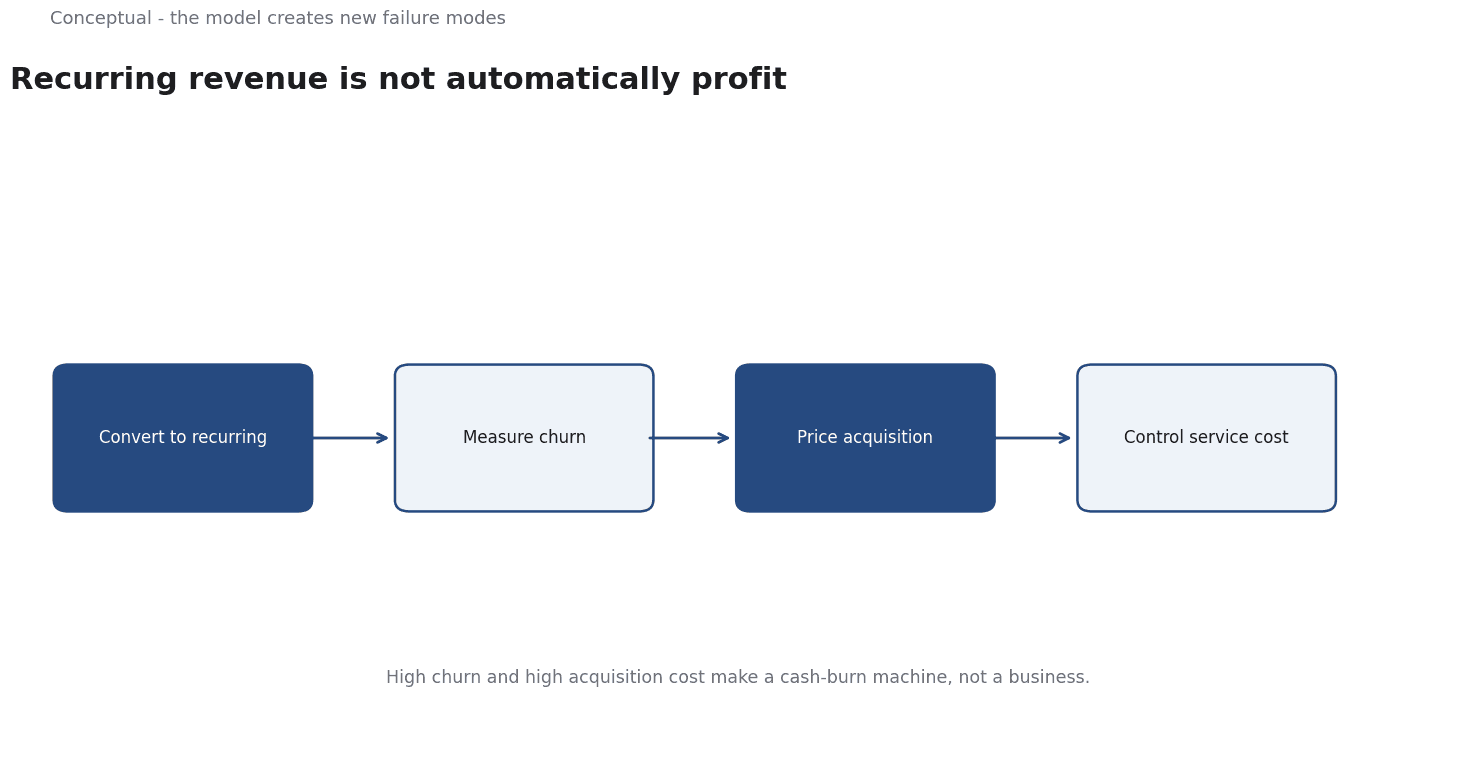
Recurring revenue changes how a business is valued and run. It also creates new failure modes.
Direct answer: Subscription businesses are attractive because they convert one-time sales into recurring revenue, creating predictable cash flow, higher customer lifetime value, and easier investment in customer acquisition. But the model is not automatically profitable: churn, customer acquisition cost, and service costs can destroy the economics just as easily as in any other business.
Why the subscription model appeals
Predictable revenue. A subscriber who pays monthly creates a known revenue stream. This makes forecasting, hiring, and investment planning more reliable than in transactional businesses where each month starts from zero.
Higher LTV. A customer who pays $50/month for three years is worth $1,800, versus a one-time $100 purchase. Higher lifetime value justifies higher acquisition spending.
Customer relationships. Subscriptions create ongoing interaction. The company learns usage patterns, preferences, and pain points over time, which improves retention and upsell opportunities.
Easier fundraising. Investors value recurring revenue more highly than lumpy transaction revenue because it is more predictable and scales with the customer base, not with constant new sales efforts.
These advantages explain why software, media, retail, and even hardware companies have moved to subscription models.
Where the economics break down
Churn is the silent killer. A 5 % monthly churn rate means the average customer stays 20 months. If your CAC is $400 and your monthly contribution margin is $30, you need 14 months just to break even. At 5 % churn, you make $420 over 20 months—barely covering acquisition. Small changes in churn dramatically change outcomes.
CAC can exceed LTV. Acquiring a subscriber through paid channels can cost more than the subscriber ever pays.
Service obligations never end. A one-time product sale ends when the product ships. A subscription creates an ongoing obligation to deliver value—content, software updates, support, inventory. If the value stops, the subscription cancels.
Price sensitivity is higher. Subscribers evaluate value every billing cycle. A price increase, a service outage, or a better competitor can trigger mass cancellations that a one-time buyer would not reverse.
Cohort behavior varies. The customers who sign up in month one are not the same as those who sign up in month twelve. Early adopters may be more tolerant; later customers may be more price-sensitive. Cohort analysis is required to understand true economics.
The metrics that matter
Before launching or evaluating a subscription business, track:
- Monthly churn rate. The percentage of subscribers who cancel each month.
- Customer lifetime value (LTV). Average revenue per subscriber × margin × expected lifespan.
- Customer acquisition cost (CAC). All sales and marketing spend divided by new subscribers.
- LTV:CAC ratio. A commonly cited benchmark is 3:1, but it is context-dependent.
- Payback period. How many months of margin it takes to recover CAC.
- Net revenue retention. Revenue from the same cohort over time, including expansions and contractions.
If LTV:CAC is below 1, each new subscriber destroys value. If payback period exceeds 12–18 months, the business needs significant capital to grow.
When subscription fits and when it does not
Subscription fits when:
- The service delivers ongoing value (content, software, supply replenishment).
- Customers have a recurring need.
- The cost of serving each additional subscriber is low relative to price.
- Churn can be kept low through genuine value.
Subscription does not fit when:
- The product is purchased once and used for years.
- Customer needs are episodic, not continuous.
- Service costs scale linearly with subscribers and erode margins.
- Customers resent being locked into recurring payments.
For the related question of how unit economics interact with subscription models, see Understanding Unit Economics: CAC, LTV, Churn, and Contribution Margin and Why Distribution Is Often More Important Than Product Quality.
A worked example
The following is hypothetical and illustrative. A subscriber paying $50 a month for three years is worth $1,800, compared with a single $100 purchase. That gap is the whole appeal of the model, and it is why higher lifetime value can justify higher acquisition spending. But the comparison only holds if the subscription actually lasts.
Take the figures already discussed. At 5 % monthly churn the average customer stays 20 months. With a $400 acquisition cost and $30 monthly contribution margin, roughly 14 months go to breaking even, leaving about $420 of contribution across the full relationship. The business is barely ahead, and a small rise in churn or acquisition cost pushes it underwater.
That is why the LTV:CAC ratio and payback period matter more than the headline recurring revenue. A commonly cited ratio is 3:1, and a payback window beyond 12 to 18 months demands significant capital to grow. Below a ratio of 1, each new subscriber destroys value however impressive the top-line growth looks.
Where the reasoning breaks down
The model also assumes the value keeps arriving. A subscription creates an ongoing obligation to deliver content, software updates, support, or inventory; when that stops, the subscriber cancels. The activation and engagement loop that product-led teams use, described in the Product-Led Growth material, is really a retention mechanism: a customer who never reaches value will not stay to be renewed.
Cohorts complicate the picture further. Customers who join in month one are not those who join in month twelve; early adopters tolerate rough edges that later, more price-sensitive buyers will not. Valuation benchmarks of the kind Damodaran maintains can frame what recurring revenue is worth, but the investor-protection perspective from Investor.gov is a reminder that predictability is not the same as safety. A model with high churn and high acquisition cost is a cash-burn machine.
The practical test is fit.
Subscription works when the need recurs, the service delivers ongoing value, and marginal serving cost stays low relative to price.
It fails when the product is bought once and used for years, when needs are episodic, or when subscribers resent the commitment.
The model changes when revenue is recognized, not whether the value exists.
A counterargument
A critic could object that the appeal and breakdown sections cancel each other, leaving no net claim, and that the worked example is stacked toward the breakdown. The fifty-dollar-a-month, three-year comparison assumes the subscription lasts, an assumption the piece then spends two sections undermining. Its sources do not settle the balance: Damodaran's datasets frame what recurring revenue is worth, and Investor.gov is a reminder that predictability is not safety, so neither shows that subscriptions create value rather than re-time it. A reasonable pushback is that the advantage is mainly accounting and valuation - when revenue is recognized and how it is discounted - not an improvement in the underlying business, which the closing line itself concedes. The framing works as a fit test, not as proof that attractiveness is a property of the model.
References & Further Reading
- Aswath Damodaran, 2026. Damodaran Online: Home Page for Aswath Damodaran — Publicly maintained datasets for industry averages, WACC, and valuation.
- U.S. Securities and Exchange Commission (Investor.gov), 2026. Introduction to Investing — Primary regulator guidance on market mechanics and investor protection.
- Wes Bush, 2026. Product-Led Growth — The activation and engagement loop definition that PLG teams actually use.