Lifecycle Messaging Explained
Lifecycle messaging follows the customer's stage, not a calendar. Read how it works, a worked example, and why more messages can mean less attention.
Lifecycle messaging is often described as sending the right message at the right time, which sounds simple until you define "right". The marketing-automation entry describes triggered messages, as the demand-generation entry covers the stages a customer moves through, as Lifecycle Email: Triggered Messages Across the Customer Journey treats triggered sequences, as Lifecycle Email: Triggered Messages Across the Customer Journey advises for evidence from real people, as the email-metrics article warns about activity measures.
Direct answer: Base messages on a customer's stage and behaviour, with a defined trigger and a measure of whether the message changed anything. Wikipedia's marketing-automation entry provides the mechanism, and demand generation covers the stages. The boundary: automation does not create relevance, which the value-proposition article treats as prior, as the privacy article makes obligations jurisdiction-specific, as the publication standard forbids guaranteed outcomes.
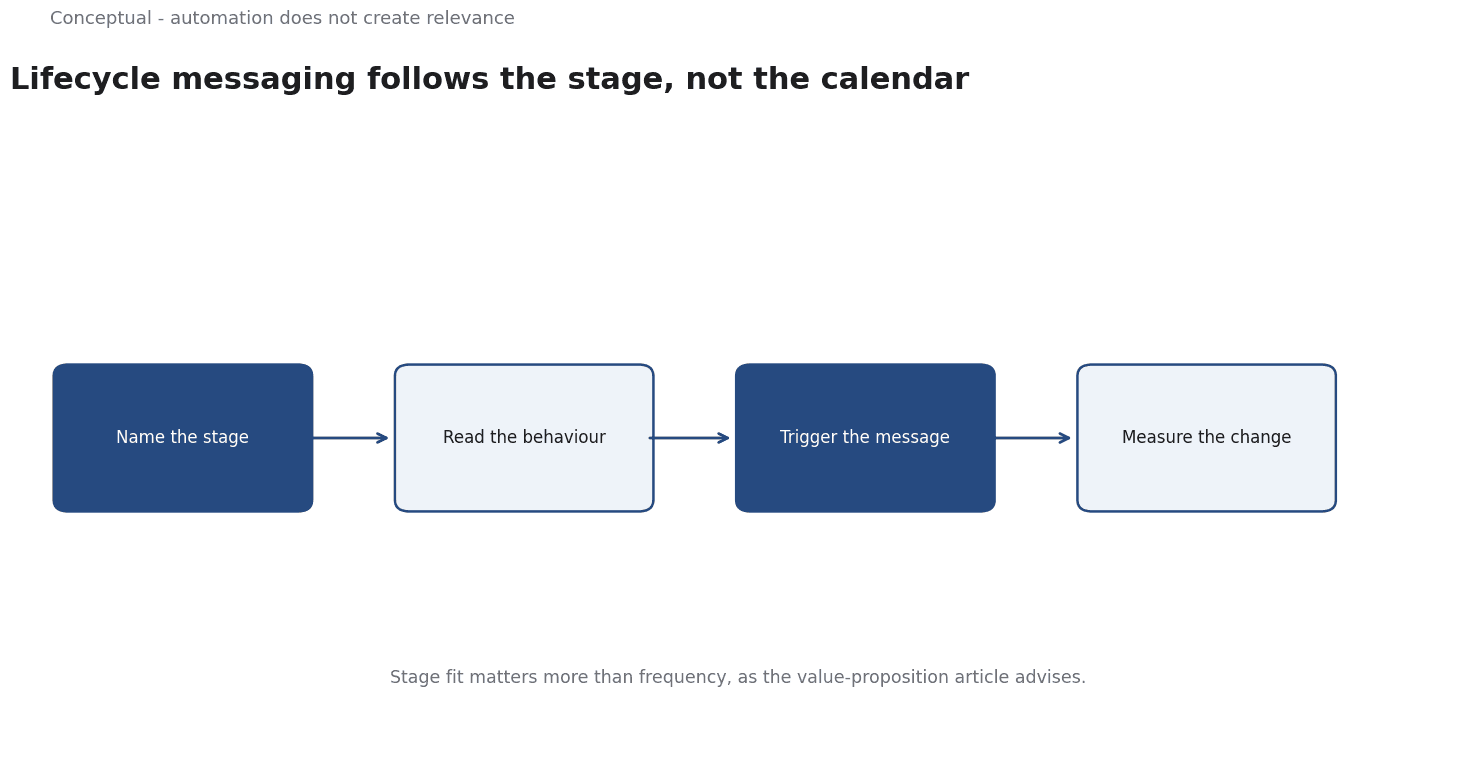
How it works
Define the stages. What states does a customer move through, which the demand-generation entry describes, as Lifecycle Email: Triggered Messages Across the Customer Journey advises, as the funnel article treats stage measures, as the rubric article requires concrete criteria, as the data-governance article requires a dated definition.
Attach a trigger. What event moves a customer to the next message, which the marketing-automation entry describes, as Lifecycle Email: Triggered Messages Across the Customer Journey treats triggered sequences, as the analytics article recommends for observed behaviour, as the decision-memo article requires for a recorded rule, as the monitoring article advises for review.
Write for the stage. The message should fit what the customer needs now, which the value-proposition article argues, as the content-marketing article advises for value before the ask, as the customer-experience article treats the outcome, as the rubric article requires concrete criteria, as the risk article requires residual risk.
Measure the change. Did the message change behaviour, which the email-metrics article treats, as the dashboard article argues for metrics tied to decisions, as the attribution article warns about credit rules, as the experiment guidance recommends for comparisons, as the decision-memo article requires for a record.
Three consequences follow. The stage comes before the message, as the demand-generation and value-proposition articles advise, as the rubric article requires, as the decision-memo article requires a question, as the data-governance article requires dated definitions, as the monitoring article advises for review, as the privacy article makes obligations jurisdiction-specific, as the risk article requires residual risk, as the attribution article warns about credit rules.
A worked example
The following is hypothetical and illustrative. A product sends a welcome series, a usage tip, and a re-engagement email on fixed days after signup.
Three checks decide. First, are the triggers tied to behaviour or just to elapsed time, as the marketing-automation entry and lifecycle-email article advise, with observed signals, as the analytics article recommends? Second, does each message fit the customer's stage, as the value-proposition and content-marketing articles advise, with a concrete criterion, as the rubric article requires? Third, did any message change behaviour, as the email-metrics and dashboard articles advise, with a comparison, as the experiment guidance recommends, as the attribution article warns?
Three conclusions follow.
Stage fit matters more than frequency, as the value-proposition article advises.
And the decision should be recorded, as the decision-memo article requires.
What lifecycle messaging cannot do
It cannot create a value proposition, which the value-proposition and positioning articles treat as prior, as the publication standard forbids guaranteed outcomes, as the risk article requires residual risk. It does not remove privacy duties, which the privacy article makes jurisdiction-specific, as the consent article advises, as the data-governance article requires provenance, as the governance checklist requires an owner. And it cannot prove causation from a click, which the attribution article treats as a credit rule, as the experiment guidance recommends for comparisons, as the causal-inference article warns, as the decision-memo article requires for a judgement.
The counterargument that more messages mean more engagement is fair for reach and incomplete for attention, which the worked example shows, as the email-metrics and dashboard articles advise, as the value-proposition article argues for relevance, as the risk article requires residual risk.
A decision test
- Define the stages, as the demand-generation entry advises.
- Attach triggers to behaviour, as the marketing-automation entry advises.
- Write for the stage, as the value-proposition article argues.
- Measure behaviour change, as the dashboard article advises.
- Use comparisons for claims, as the experiment guidance recommends.
- Check privacy obligations, as the privacy article requires.
- Record the decision and review, as the decision-memo article requires.
For the sequences, see Lifecycle Email; for the measurement, see Email Marketing Metrics.
References & Further Reading
- Wikipedia contributors, 2026. Marketing automation - Wikipedia — Automated messaging across the customer lifecycle.
- Wikipedia contributors, 2026. Demand generation - Wikipedia — An overview of demand generation as a marketing discipline distinct from lead generation; secondary reference used with the lead-generation entry.