Referral Programs without the Hype
Referrals work when the product is worth talking about and the reward fits. Read the mechanics, a worked example, and the fraud controls.
Referral marketing is often described as the cheapest acquisition channel, which is true only under conditions that are rarely stated. A friend's recommendation is credible because it comes from a person, not because a reward was offered, and a programme that ignores that distinction pays for transactions without earning advocacy.
Direct answer: Referrals grow when customers have a reason to talk about the product and the reward is proportional to the value of the referred customer. The referral-marketing overview provides the channel context, and geo-experiment guidance offers a design for testing whether the programme caused the growth. The boundary: a credited referral is not an incremental customer — the loyalty article's holdout logic applies here — and fraud is a design problem, which the fraud controls in the security checklist require.
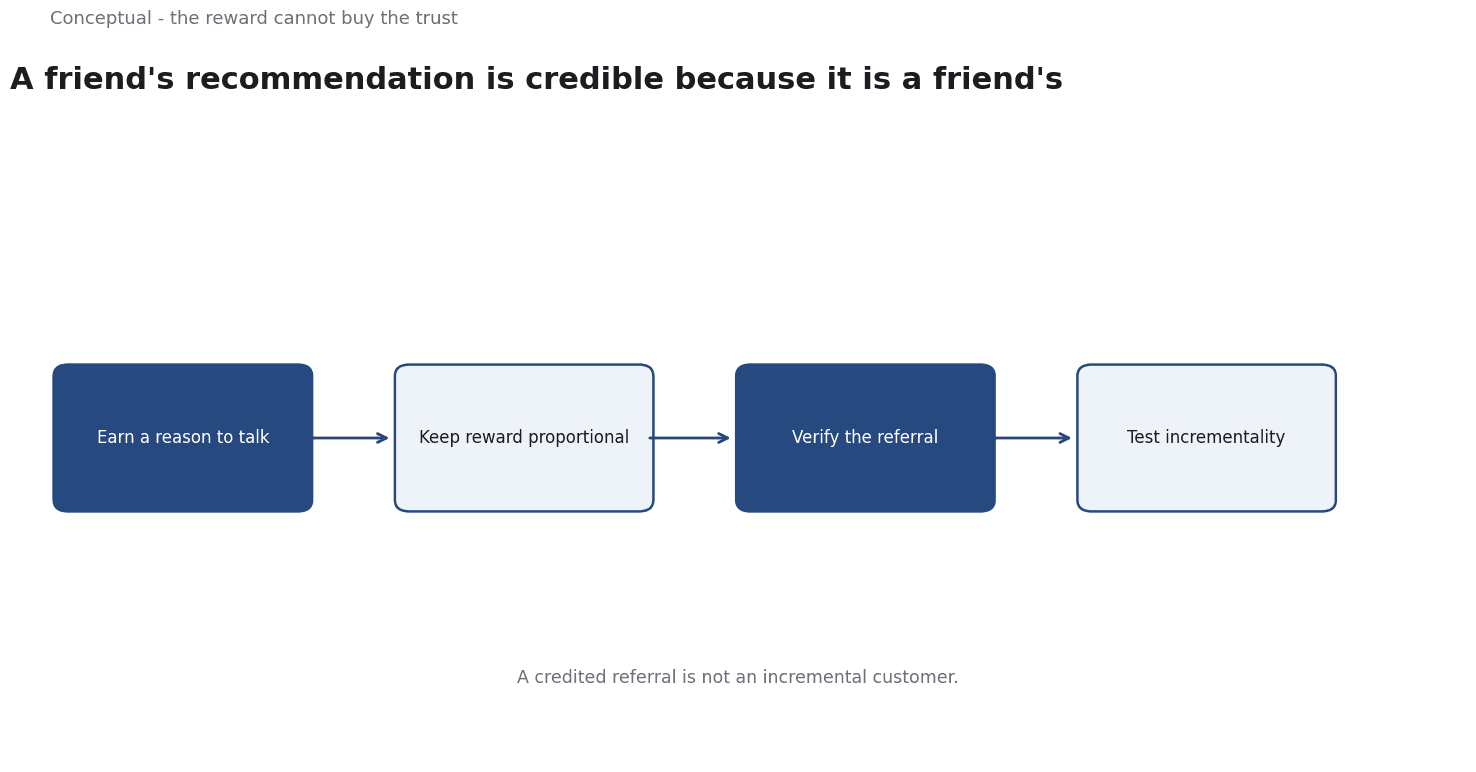
The trust the reward cannot buy
A referral is credible because the recommender has nothing to gain beyond the reward, and even that is small relative to the relationship they risk by recommending something poor.
A programme that makes the reward the reason for the referral removes the very signal that made it valuable, which the advocacy article treats as the difference between genuine and manufactured voices.
The design question is therefore how to thank a customer without turning the thank-you into the motive.
This is why the product must come first. A customer who has solved a real problem will mention the tool in a conversation without being prompted, as the community-led-growth article describes for peer value. A reward then converts an existing behaviour into a measurable event, rather than creating a behaviour that the market will discount, as the online-reviews article warns about incentives that distort public evidence.
The measurement should respect the same logic. A credited referral is a transaction with a rule attached, which the attribution article explains as credit rather than causation. A holdout estimates how many referred customers were incremental, which the loyalty article applies to points, and that estimate is the basis for deciding whether the reward was worth paying, as the unit-economics article requires for contribution margin.
What makes a referral work
A reason to talk. The customer must have experienced something worth passing on, which the advocacy article treats as a precondition. A reward can prompt the ask, but it cannot manufacture the experience.
A proportional reward. Cash, credit, or a feature unlock each attracts different behaviour, as the discount-strategy article explains for incentives.
A verified trigger. Reward after a retained purchase rather than a signup, which the loyalty article recommends for measured behaviour. The trigger should match the value the business keeps, as the unit-economics article explains for contribution margin.
A worked example
The following is hypothetical and illustrative. A product pays 20 credit when a referred friend completes a paid month. Over a quarter, 1,000 referrals trigger a reward; 80 are blocked for duplicate-payment signals, which the fraud controls in the security checklist support.
A holdout of similar non-referred prospects shows that 30% of the credited purchases would have occurred anyway, as the geo-experiment guidance recommends for comparison. The naive view credits 1,000 customers; the incremental estimate is closer to 644. Three checks decide whether the programme is worth keeping. First, does the reward fit the margin, as the unit-economics article requires? Second, do referred customers retain, which the retention article measures by cohort? Third, are the fraud controls working, as the anomaly-detection article treats false positives and negatives?
Three conclusions follow. The holdout matters more than the redemption count, which the attribution article explains for credit rules. The controls belong at the trigger, as the security checklist recommends for consequential actions. And the result should be recorded with the reasoning, as the decision-memo article requires.
What referrals cannot do
They cannot create preference. A recommendation amplifies the truth about a product, which the demand-generation article argues for building preference before capture. They cannot be measured by signups alone, which the funnel article treats as an early-stage signal. And they cannot run without trust — a programme that rewards spam damages the brand, as the online-reviews article warns about reputation as a public record.
The counterargument that referrals are free misses the cost of the reward and of fraud, which the cost estimator treats as real expenses on any channel.
A decision test
- Confirm customers have a genuine reason to talk, as Customer Advocacy and User-Generated Content advises.
- Set the trigger at a verified, retained outcome, as the loyalty article recommends.
- Price the reward against contribution margin, as the unit-economics article requires.
- Add fraud controls at the trigger, with a cap per customer.
- Measure incrementality with a holdout, as the geo-experiment guidance suggests.
- Track retention of referred customers by cohort, as the retention article advises.
- Review the programme after a change in product or reward, as the monitoring article recommends.
For the channel frame, see Demand Generation vs Lead Generation; for advocacy, see Customer Advocacy.
References & Further Reading
- Wikipedia contributors, 2026. Referral marketing - Wikipedia — The mechanisms and incentives of referral marketing programmes.
- Brian Vaver and Koehler, 2011. Measuring Ad Effectiveness Using Geo Experiments — Geo experiments for incrementality, the cleanest way to attribute marketing spend.