AI for Sales: Research, Personalization, and Follow-Up
Sales AI works on preparation and consistency, not on persuasion. Read the three uses, a worked workflow, and where accuracy matters.
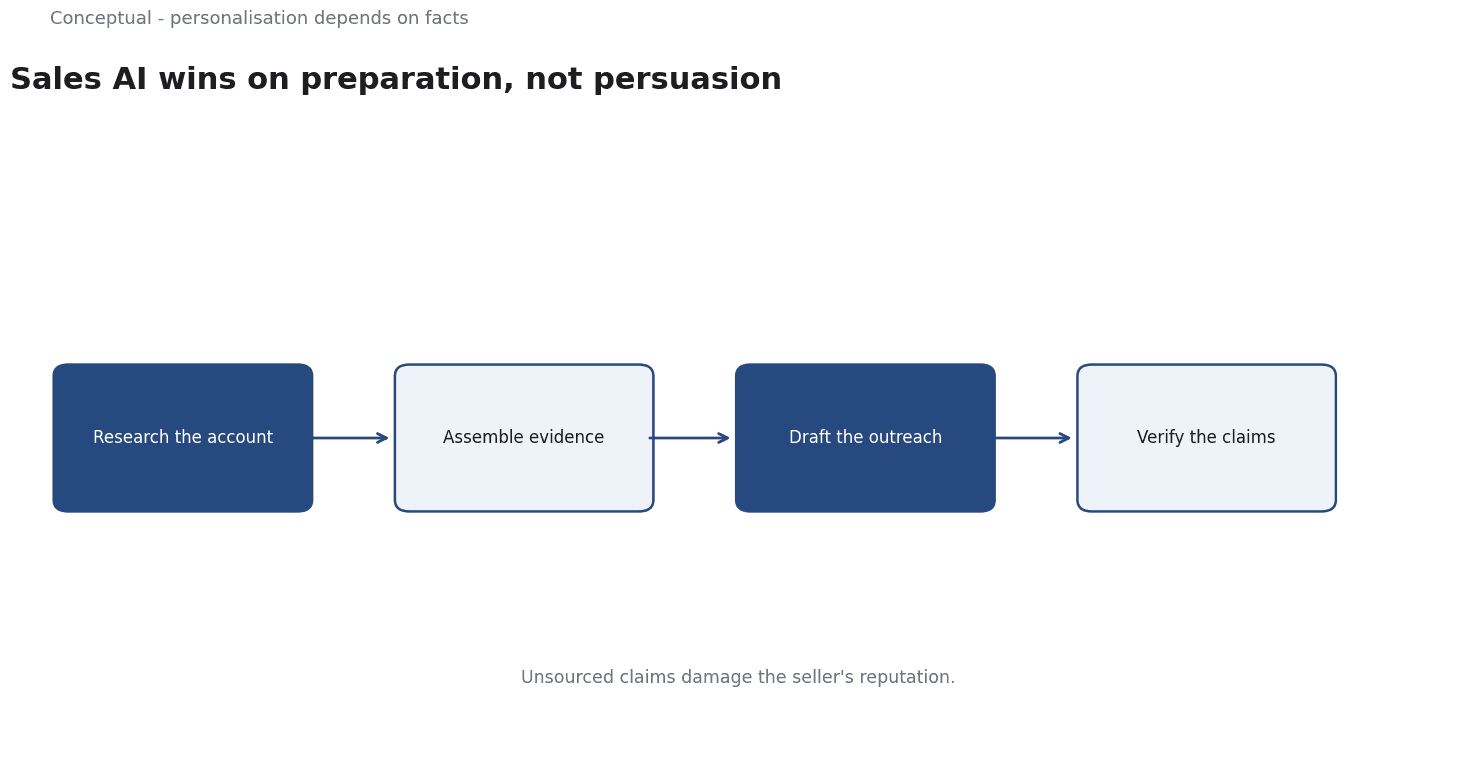
The promise of AI in sales is often framed as automated persuasion, which is both unappealing and a weak description of what the technology does well. The real value is in preparation — researching an account, assembling relevant evidence, and keeping follow-up consistent. Those are tasks where a seller's time is scarce and the output can be checked.
Direct answer: Use AI to summarise account research, personalise outreach with verifiable facts, and maintain follow-up cadence — not to invent claims or pressure prospects. Anthropic's use-case guides cover research and content patterns, and the O*NET task descriptions identify what sales work involves. The boundary: a personalised message with a wrong fact damages credibility, so every generated claim needs a source, as How to Reduce Hallucinations in LLM Applications explains.
Three uses
Account research. Summarise public information — filings, news, job postings — into a short brief with sources. The value is time saved, not a claim the model could not find elsewhere, as the financial-statement article explains for primary sources.
Personalisation. Draft an opening that references a verifiable fact about the recipient's situation. A fact with a source is useful; an invented detail is a credibility failure, which the reduce-hallucinations article covers.
Follow-up. Keep a consistent cadence across a pipeline and draft reminders tied to the last interaction. This is a workflow-automation task, as the workflow article describes, not a creative one.
A worked workflow
The following is hypothetical and illustrative.
A seller prepares for 20 account meetings a week. The AI workflow:
- Gathers public sources for each account and produces a one-page brief with citations.
- Drafts three personalisation points, each linked to a source, for the seller to verify.
- Schedules follow-up drafts tied to the meeting outcome.
Three checks decide whether it works:
- Citation accuracy — does the cited source actually support the generated point? A wrong citation is worse than no personalisation, as How to Reduce Hallucinations in LLM Applications argues.
- Time saved — measure preparation time before and after, net of verification. A brief that takes ten minutes to check may not save much, which the email-metrics article explains for intermediate metrics.
- Reply quality — do personalised messages get more substantive replies, or merely more opens? The attribution article warns against treating a proxy as a result.
Three conclusions follow:
- The seller verifies every fact, as the human-in-the-loop design requires.
- Consistency of follow-up is a reliable gain, while personalisation quality is empirical, which the demand-generation article distinguishes from capture mechanics.
- The tool is a preparation assistant, not an autonomous sender, which the security checklist recommends for actions with consequences.
Keeping a source of truth
Personalisation is only as good as the facts behind it.
Three practices keep the process defensible:
One research record per account. Store the brief, the sources, and the date in a single place so a seller can see what is current and what has been superseded, as the data-governance article recommends for any relied-upon record.
Expire stale facts. A job posting or funding round mentioned in outreach loses relevance quickly. A date on each fact and a rule for when it is too old prevents a personalised message from referencing news that is a year old, which the monitoring article covers as drift.
Separate verified from inferred. A fact with a source is different from an inference about a prospect's priorities. Label them separately so the seller knows which claims can be stated directly and which are hypotheses to test in conversation, as the evaluation-rubric article argues for distinguishing evidence from interpretation.
These habits turn personalisation from a copywriting trick into a research discipline that a seller can stand behind.
What sales AI cannot do
It cannot create trust. A message that references a fact accurately is still a cold outreach; the relationship develops through conversation, which the content-marketing article explains as preference building.
It cannot replace qualification. An account that fits a research profile may not have a need or budget, which the funnel article covers as a stage distinction.
It cannot invent credibility.
The counterargument — that buyers can tell when outreach is AI-generated — is an argument for using AI to prepare better material, not for avoiding it.
A well-sourced brief and a thoughtful message are indistinguishable in quality from one written by hand, which is the point.
A decision test
- Use AI for research and preparation, not automated persuasion.
- Cite a source for every personalisation point.
- Have the seller verify facts before sending.
- Automate follow-up cadence with drafts tied to prior interactions.
- Measure preparation time net of verification.
- Score reply quality, not opens or sends.
- Keep the seller accountable for every message, as the governance checklist requires.
For the outreach context, see Demand Generation vs Lead Generation; for the grounding method, see How to Reduce Hallucinations.
References & Further Reading
- Anthropic, 2026. Guides to common use cases - Claude Platform Docs — Production use-case guides for ticket routing, customer support agents, content moderation, legal summarization and commerce agents.
- U.S. Department of Labor, 2026. O*NET OnLine — The standard occupational taxonomy used to compare roles across industries.