Demand Generation vs Lead Generation: Where the Funnel Breaks
One builds a market, the other captures a name. Read the measurement differences, a worked funnel example, and why conflating them breaks the budget.
A marketing team can hit its lead target and still fail: the form fills arrive, sales rejects most of them, and the pipeline does not grow. The likely cause is a confusion between two activities that are often listed on the same slide. Demand generation creates the conditions for a purchase; lead generation captures a person who might make one. They have different jobs, different time horizons, and different metrics.
Direct answer: Demand generation builds awareness and preference in a market before anyone is ready to buy; lead generation converts interest into a identified contact for follow-up. Wikipedia's overview of demand generation treats it as a distinct marketing discipline, while lead generation covers the mechanisms — forms, content, inbound and outbound methods — that collect contact details. The boundary: a lead captured before demand exists is usually a name with no intent, and demand created with no capture mechanism often leaves the resulting interest unconverted.
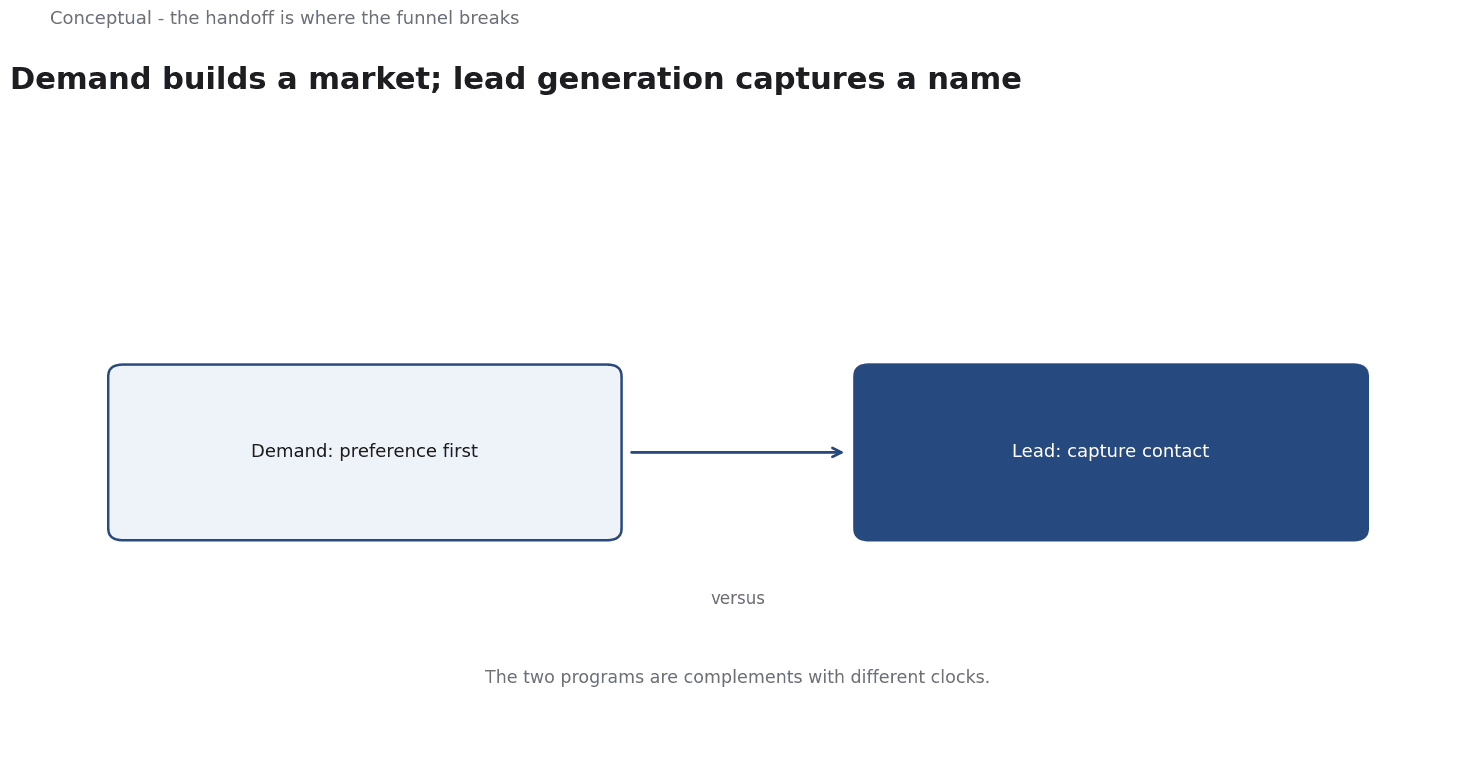
Two different jobs
Demand generation works on people who are not yet looking. It builds familiarity, category understanding, and preference through content, education, and presence in the channels where the audience pays attention. Its output is a market that is more likely to consider you when a need arises.
Lead generation works on people who have shown some interest. It offers a reason to identify themselves — a guide, a trial, a webinar — and passes the resulting contact to sales or an automated sequence.
Three consequences follow:
- Time horizon differs. Demand work may pay off months later, when a need appears. Lead work is measured in days or weeks.
- The unit differs. Demand is measured in audience, engagement, branded search, and eventually pipeline. Lead is measured in contacts, cost per lead, and conversion to opportunity.
- Failure modes differ. Demand fails by being invisible at the moment of need. Lead fails by collecting contacts nobody wants to call.
Wikipedia's lead-generation entry describes inbound and outbound methods and the role of content and forms; those are the mechanisms of capture, not the work of building a market.
The handoff is where it breaks
The two activities connect at a specific point: a person who developed preference through demand work becomes a lead when they identify themselves. Three things go wrong at that point:
Capture too early.
The visitor gives a name to get something they would have used anyway, and the lead quality is low.
No capture at all. Educational content that generates genuine interest but offers no next step leaves the audience anonymous. The demand worked; the pipeline did not.
No shared definition. Marketing counts a lead; sales defines a qualified opportunity by different criteria. Both teams report success while the pipeline stalls.
The practical remedy is a written definition of what counts as a lead and what sales will accept, agreed by both teams, with a feedback loop from opportunity back to the content that produced it.
A worked example of funnel arithmetic
The following numbers are hypothetical and illustrative.
A company runs both programs for a quarter:
- Demand program: 200,000 people reached, 4% engagement, 10% of engaged visitors reach a product page — 800 product-page visitors.
- Lead program: 1,000 form fills from those visitors and other sources, at a cost of 80 per lead — 80,000 spend.
- Sales accepts 20% of leads as qualified: 200. Of those, 10% become customers: 20 customers.
Three changes alter the picture:
- Improve lead quality, not lead count. If better qualification raises sales acceptance from 20% to 30% without changing cost, qualified leads rise from 200 to 300 and customers to 30 — a 50% increase at the same spend. The metric that mattered was acceptance rate, not lead volume.
- Add a capture step to demand content. If 2% of the 8,000 engaged people identify themselves before reaching a product page, that is 160 additional leads at low marginal cost. This is the handoff working.
- Cut the demand program. If the 200,000 reach is removed, lead volume initially holds from existing intent, then decays as the audience that would have considered you shrinks. The damage appears in a later quarter, which is why demand is easy to cut and hard to rebuild.
The lesson is that the two programs are complements with different clocks.
Optimising the lead metric alone can hide a demand problem that will surface after the budget cycle.
Measurement that respects the difference
Measure demand with leading and lagging signals together. Reach and engagement are leading signals; branded search volume, direct traffic, and the share of inbound leads that mention your content are lagging ones. No single number captures the effect.
Measure leads by what happens next. Cost per lead is a vanity number if sales rejects the leads. The useful metrics are acceptance rate, conversion to opportunity, and cycle time.
Use experiments for incrementality where possible. Geo holdouts and matched tests are more reliable than attribution models for deciding whether a program caused the pipeline. Attribution allocates credit by a rule; it does not measure what would have happened without the spend.
A vendor's platform report is evidence of what the platform observed, not of incremental lift. Treat it as one input.
Budgeting the two clocks
A practical budgeting rule is to fund both programs on their own horizons and review them on different schedules.
Lead programs can be reviewed monthly. Cost per accepted lead, acceptance rate, and opportunity conversion respond quickly to changes in targeting and offer. A monthly review can kill a weak campaign before it consumes a quarter's budget.
Demand programs need a longer window. Reach, branded search, and direct traffic move slowly, and the pipeline effect appears when buyers decide, not when they first saw your content. Reviewing demand monthly encourages exactly the cuts that cause a pipeline problem two quarters later.
The two budgets should also be defended with different evidence. A demand program that produces no form fills in a month has not failed; one that produces no change in branded search or engaged audience over two quarters has a question to answer. A lead program that produces many fills and few accepted opportunities has failed now, regardless of what the demand program is doing.
This is why a single "marketing ROI" number is misleading. It merges two activities with different clocks into one ratio and then invites a decision based on the wrong one.
What the distinction cannot settle
Some activities sit in both. A webinar can educate a market and capture a lead. The useful question is which job the budget line is meant to do, not which bucket it is labelled with.
Attribution remains imperfect. Even with good definitions, the path from awareness to purchase crosses channels and months. Directional evidence plus experiments is more honest than a precise-looking model.
Sales capacity is a constraint. More qualified leads than sales can contact produce no more customers. The funnel breaks at the handoff for organisational reasons as often as for marketing ones.
The counterargument — that the distinction is academic and teams should just "do both" — misses the budgeting point.
If nobody decides which job a spend is doing, it will be judged by the wrong metric, and the wrong program will be cut.
A decision test
- Label each program by the job it does — build demand or capture a lead.
- Agree with sales on what counts as an accepted lead.
- Measure leads by acceptance and conversion, not by count.
- Measure demand with both leading and lagging signals.
- Check the handoff — is there a next step for interested people who are not ready to convert?
- Use holdouts or matched tests for incrementality claims.
- Review on the right clock — demand on a longer horizon than lead.
For the measurement side, see Marketing Attribution; for the strategic frame, see Content Marketing.
References & Further Reading
- Wikipedia contributors, 2026. Demand generation - Wikipedia — An overview of demand generation as a marketing discipline distinct from lead generation; secondary reference used with the lead-generation entry.
- Wikipedia contributors, 2026. Lead generation - Wikipedia — The definition of lead generation, inbound versus outbound methods, and the role of content and forms; secondary reference.