Async Work Metrics that Matter
Async work is measured by decisions and handoffs, not by hours online. Read the metrics, a worked example, and why a fast reply can be a poor signal.
Asynchronous work is often measured with presence signals that belong to synchronous work. The remote-work entry describes distributed ways of working, and the decision-making entry covers the structure of a choice. The useful question is whether work moved forward without a meeting.
Direct answer: Measure async work by decision latency, handoff clarity, and unresolved questions — not by response speed. The sources define the context; the metric set is a synthesis.
Delta: This article adds a claim-status table and a worked example, separating what the sources describe from the locally chosen measurement rules.
The mechanism
Three properties of async work shape the metrics:
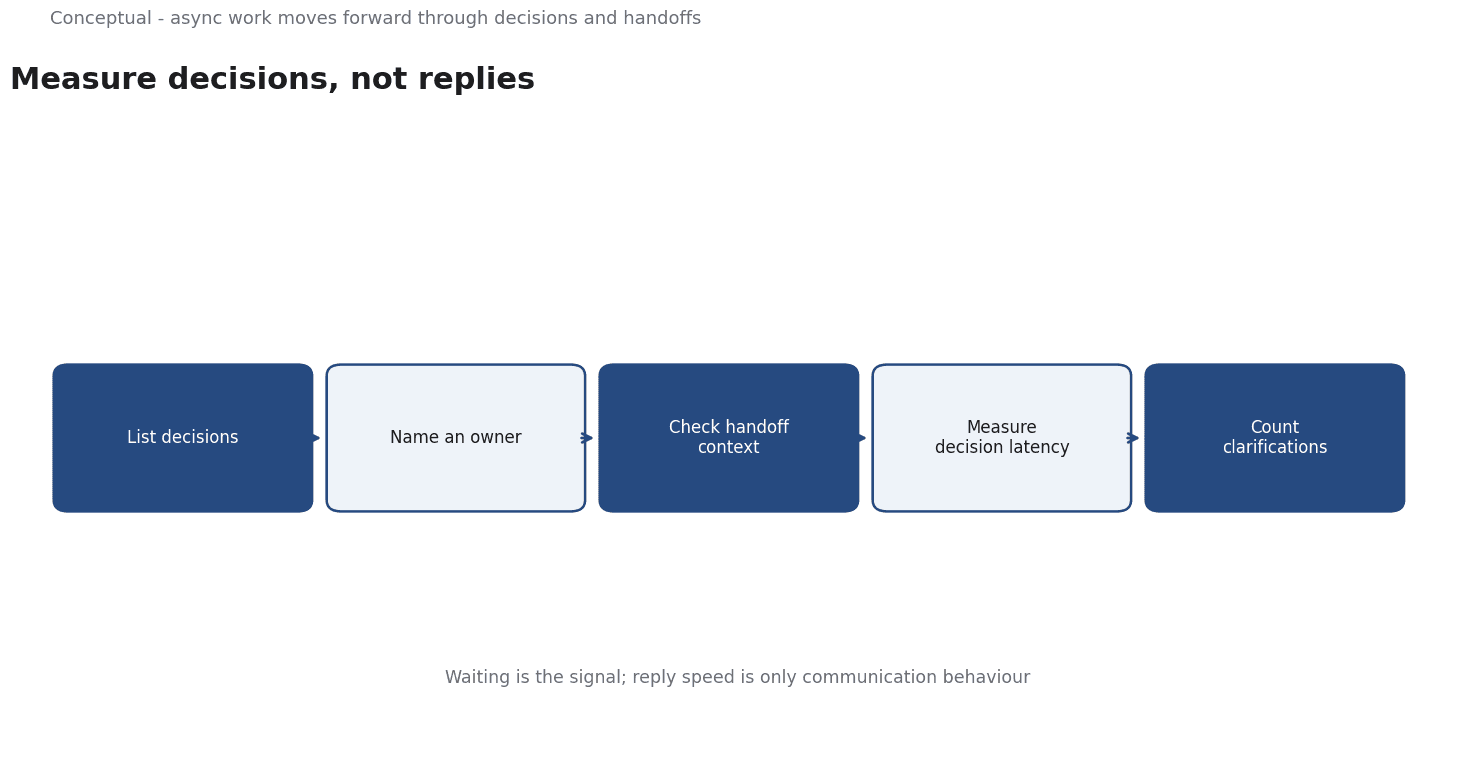
- Decisions replace meetings. The decision-making entry describes a choice with an owner and evidence. In async work, the written decision is the artefact others act on.
- Handoffs need context. A message that omits context forces a follow-up. The cost appears as a second round of questions rather than as a slow reply.
- Delay is not idleness. A response after several hours may be correct if the work is asynchronous. Speed of reply is a poor proxy for progress.
The sequence is: list the decisions a team must make, identify the waiting points, then measure how long each decision remains unresolved.
Choosing the decisions is local judgement, so it is inferred; the structure of a decision is source-reported.
A worked example
Illustrative. A distributed team reports that projects stall between review and approval.
Three checks decide. First, which decision is waiting, and who owns it? Second, does the handoff include the evidence the owner needs, or does it require a clarifying round? Third, how long does the decision remain unresolved, and is the delay due to missing information or to an absent owner?
The outcome is a specific change to the handoff or to the ownership rule. The numbers are hypothetical; the diagnostic sequence is the contribution.
Why waiting is the signal
In synchronous work, presence is visible. In asynchronous work, the visible signal is a message arriving, which is why teams often measure reply time.
Waiting is the state that actually matters. A decision that waits for an owner cannot be completed, regardless of how quickly people answer messages. Measuring how long a decision stays open identifies the constraint directly. It also distinguishes two causes that look identical from reply times: a missing owner and missing information.
The handoff is the place to look first. A complete handoff states the decision, the relevant evidence, and the owner. When any of those are absent, the recipient must reconstruct them, which produces questions. Counting clarification rounds is therefore a leading indicator of future delay. A team can reduce those rounds with a template, which is a cheaper intervention than asking everyone to respond faster.
Time zones and working hours explain some delay and not all of it. A decision that waits three days because the owner was never identified is different from one that waits three days because the owner was offline. Recording the reason makes the two distinguishable, and only the first has a process fix.
None of this argues against quick replies. It argues that reply speed is a measure of communication behaviour, while decision latency is a measure of work. Keeping them separate lets a team improve one without confusing it with the other.
Evidence status
| Claim | Status | Source | Verified | Recheck when |
|---|---|---|---|---|
| Remote work includes distributed and asynchronous modes | source-reported | Wikipedia, Remote work | 2026-11-18 | Definition revised |
| Decisions can be described by owner and evidence | source-reported | Wikipedia, Decision making | 2026-11-18 | Source revised |
| Measure decision latency rather than reply speed | inferred | Derived from the two sources | 2026-11-18 | Workflow changes |
Why reply speed misleads
A quick reply can be a question that creates more work. A slow reply can be a decision reached after reading the material carefully. Neither tells you whether the team is blocked. Decision latency does, because it measures the state that matters rather than the behaviour that is easiest to observe.
Handoff quality is the upstream cause. When a message omits context, the owner must ask for it, and the waiting time grows by a full round trip. Counting clarification rounds is often more actionable than counting delays, because the fix is a template or a checklist rather than a change in working hours.
What it cannot do
It cannot replace a shared goal, which the value-proposition literature treats as prior. It does not remove the need for occasional synchronous conversation. And it cannot guarantee that a decision is good, only that it is not stuck.
The counterargument that fast replies indicate responsiveness is fair for customer-facing work and incomplete for internal decisions.
A decision test
- List the recurring decisions.
- Name an owner for each.
- Define what a complete handoff contains.
- Measure decision latency.
- Count clarification rounds.
- Change the handoff or the owner rule.
- Record the decision and the recheck condition.
For the management context, see Time Management for Small Teams.
References & Further Reading
- Wikipedia contributors, 2026. Remote work - Wikipedia — Distributed and asynchronous ways of working.
- Wikipedia contributors, 2026. Decision-making - Wikipedia — Overview of decision processes, trade-offs and the distinction between the decision and its outcome; secondary reference.