B2B Demand Generation at Scale
How to scale B2B demand generation with defined accounts, stage-based measurement and a clean CRM, and why more leads can hide a failing funnel.
B2B demand generation is often scaled by adding channels and volume, but more traffic does not fix a vague definition of who the buyer is. The demand generation entry describes marketing activity that builds awareness and intent, while the customer relationship management entry covers how organisations manage interactions with current and potential customers. The practical problem is making scale produce qualified pipeline rather than a larger pile of unqualified contacts that sales cannot use.
Direct answer: Scale demand generation by defining the target account, tying each channel to a measurable stage, and keeping the CRM as the single record of what happened. Add volume only after the qualification rule and the handoff to sales are stable. The test is incremental qualified pipeline, not raw lead count.
Delta: This article adds a claim-status table and a worked example beyond the sources: it maps the demand-creation concept and the CRM record-keeping role to a channel-scaling decision, with claim status made explicit.
The mechanism
Demand generation is a set of marketing activities that create awareness and interest in a product, with the aim of producing an audience ready to buy.
The practical consequence is that a channel should be judged by how well it moves a defined audience toward readiness, not by the volume of activity it generates.
Defining the audience comes first. If the target account and buyer are vague, every channel will look productive because any contact can be counted as a result, and scale will magnify the vagueness rather than resolve it.
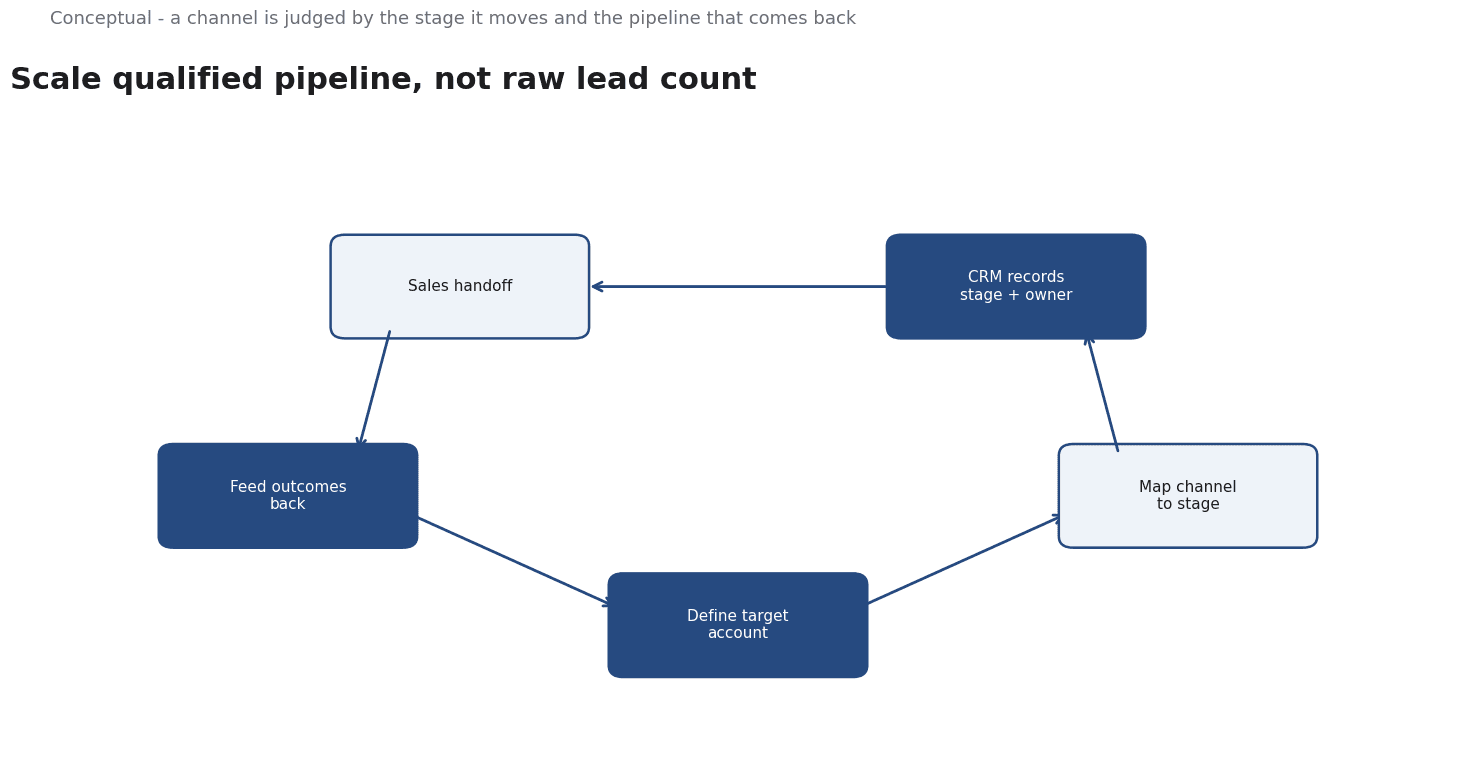
Customer relationship management covers the systems and processes an organisation uses to manage interactions with current and potential customers, including contact history, stage and ownership. The consequence is that the CRM is where a lead becomes a measurable pipeline stage. Without a consistent record, a team cannot tell which channel produced a good customer, because the link between the first touch and the eventual outcome was never stored. Data hygiene is therefore part of demand generation itself, not a back-office chore that can be fixed later.
Stage-based measurement is the bridge between the two ideas. Mapping channels to stages such as awareness, consideration and decision lets a team see where volume is being wasted. The consequence is direct: if a channel generates many early-stage contacts and none reach later stages, adding more of it makes efficiency worse, not better. Measuring at the stage where the decision is made gives a sharper signal than counting top-of-funnel activity, because it reflects the outcome the business actually needs rather than the activity that is easiest to count.
The handoff between marketing and sales is where value leaks. A lead passed without context, or a stage that each team defines differently, corrupts both sides' numbers. The consequence is that both teams can report success while the pipeline does not grow. Agreeing on definitions across teams and feeding outcomes back into channel decisions closes the loop. Scale only the channels whose downstream outcomes you can see, because a channel with invisible outcomes cannot be improved and cannot be reliably cut.
A worked example
The following is hypothetical and illustrative. A B2B company wants to increase demand by adding two new channels and doubling spend on an existing one. Three checks come before the budget move. First, is the target account and buyer defined tightly enough that a lead can be judged qualified? Second, does the CRM hold a consistent stage and owner for each lead, so the team can trace a channel to a closed outcome? Third, which stage does each channel actually influence, and are downstream outcomes visible at that stage? The outcome is a limited increase on the channel with visible downstream pipeline and a pause on the others. The figures are illustrative; the sequence is the contribution.
Evidence status
| Claim | Status | Source | Verified | Recheck when |
|---|---|---|---|---|
| Demand generation builds awareness and intent for a product | source-reported | Wikipedia, Demand generation | 2026-11-18 | Definition or scope revised |
| CRM systems manage interactions with current and potential customers | source-reported | Wikipedia, Customer relationship management | 2026-11-18 | Source revised or system scope changed |
| Scale spend on channels whose downstream pipeline is measurable | inferred | Derived from the sources | 2026-11-18 | Attribution model or data quality changes |
Two rows report what the sources describe: the purpose of demand generation and the role of CRM systems in managing customer interactions. The third row is a local rule, inferred rather than reported, that spending should follow channels with visible downstream outcomes. It should be revisited when the attribution model or the quality of the CRM data changes.
What it cannot do
Demand generation cannot create demand where none exists. It amplifies a value proposition that already resonates with a defined buyer. If the product does not solve a problem the buyer recognises, more spend simply exposes more people to an offer they do not want, and the cost of that exposure is real. The honest boundary is that demand generation works on an existing fit between problem and product; it does not manufacture that fit. Treating it as a substitute for a weak value proposition wastes budget faster, because scale removes the small-sample excuse that once hid the problem.
There is a hidden cost in scaling. More channels mean more integrations, more data cleaning and more coordination between marketing and sales. The marginal cost is often underestimated because per-lead figures exclude the overhead of maintaining the systems that produce and track those leads. A channel that looks cheap per lead can be expensive after the CRM work and the team time are included. Any decision to add volume should count the full cost of the extra complexity, not just the media price, or the apparent efficiency gain will disappear once the bill arrives.
Attribution error is the characteristic failure mode. When a buyer touches several channels, it is hard to credit each one correctly, and last-click reporting tends to over-credit the final touch while ignoring earlier work.
The consequence can be a slow erosion of the top of the funnel that only appears much later as a pipeline shortfall. Recognising the limit of attribution does not solve it, but it does argue for treating the numbers as signals rather than exact accounts.
There are boundaries where this approach should not lead. In long, relationship-driven sales cycles, demand generation metrics can encourage short-term lead counting that misrepresents real progress. Not every market behaves like high-volume inbound, and some require account-based, relationship-led work whose results resist a simple funnel measure. Applying a volume metric in that setting rewards the wrong behaviour and can push a team to abandon a slow but sound approach. The metric should fit the sales motion rather than dictate it, and that fit is a decision to make explicitly.
Finally, the approach needs review because channels, buyer behaviour and data quality all change. A channel that produced qualified pipeline last quarter can degrade when an audience saturates or a platform changes its rules. Set a scheduled recheck of the qualification rule, the stage definitions and the attribution method, and give someone ownership of the CRM data behind them. Without that review, a once-good channel keeps spending on momentum, and the team loses the ability to tell a durable result from a temporary one.
The counterargument that more leads are always better is fair when conversion is stable and incomplete when the extra leads are unqualified.
A decision test
- Define the target account and the buyer.
- Agree stage definitions with sales.
- Verify that CRM records are complete and consistent.
- Map each channel to a specific stage.
- Measure qualified pipeline, not raw lead count.
- Increase spend only where downstream outcomes are visible.
- Recheck attribution and data quality on a schedule.
The test keeps the question of scale tied to evidence. It asks first whether the measurement is trustworthy and only then whether more volume is justified. That order matters: scaling a poorly measured funnel produces a bigger number and the same uncertainty, while scaling a measured one produces a result that can be repeated or reversed with confidence.
For further reading, see Marketing Dashboards Without the Hype.
References & Further Reading
- Wikipedia contributors, 2026. Demand generation - Wikipedia — An overview of demand generation as a marketing discipline distinct from lead generation; secondary reference used with the lead-generation entry.
- Wikipedia contributors, 2026. Customer relationship management - Wikipedia — Systems for managing customer relationships.