Balance Sheet Analysis for Beginners
A balance sheet is a snapshot with a structure. Read how to begin, a worked example, and why a healthy total can hide a weak position.
A balance sheet is often read as a list of totals, which hides the relationships that matter. The Wikipedia entry describes the structure of assets and liabilities, and the working-capital entry covers short-term obligations. The beginning is learning what the snapshot can and cannot say.
Direct answer: Read a balance sheet by grouping assets and liabilities by maturity, then check the relationships between them. The sources describe the structure; the method is a synthesis.
Delta: This article adds a claim-status table and a worked example, separating documented accounting structure from local judgements about liquidity.
The mechanism
The first point is that a balance sheet is a snapshot. The Wikipedia entry describes what it records at a point in time. A single date can be unrepresentative, which is why several periods are more informative than one, especially for a seasonal business.
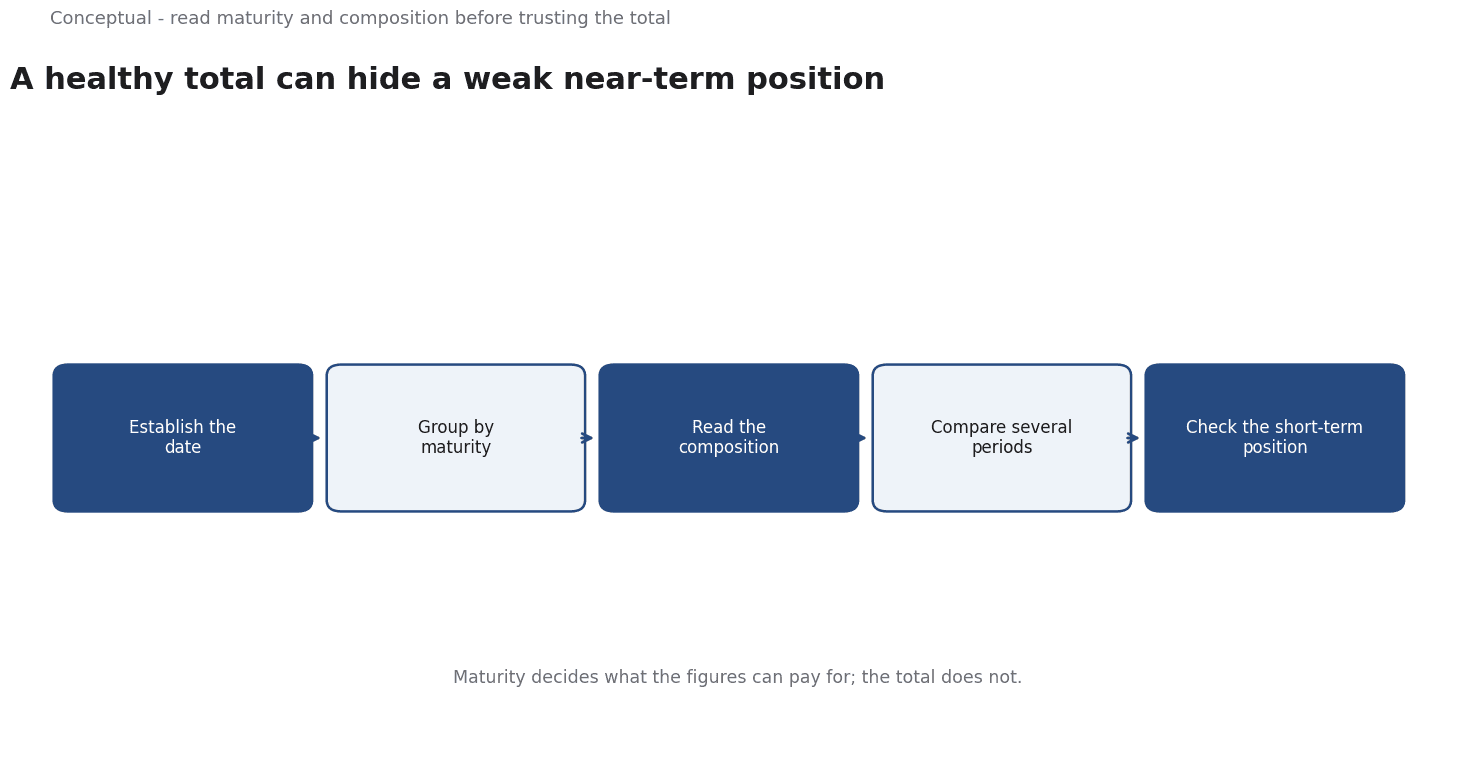
The second point is maturity. The working-capital entry describes current assets and obligations, which are the short-term part of the picture. An asset that cannot be converted to cash quickly does not cover a liability due soon, even if the totals look balanced.
The third point is composition. Two companies with the same total assets can have very different risk, depending on what those assets are and how they were financed.
The sequence is: establish the date, group by maturity, read the composition, then compare across periods. The comparisons are local, so the conclusions are inferred; the structure is source-reported.
A worked example
Illustrative. A company reports assets that exceed liabilities and still struggles to pay bills.
Three checks decide. First, are the assets cash or illiquid holdings? Second, which liabilities are due within the year, and what covers them? Third, has the pattern changed across several periods, or is this a one-off snapshot?
The outcome is a qualified reading of the statement. The scenario is hypothetical; the method is the contribution.
Evidence status
| Claim | Status | Source | Verified | Recheck when |
|---|---|---|---|---|
| A balance sheet records assets and liabilities | source-reported | Wikipedia, Balance sheet | 2026-11-18 | Standards change |
| Working capital concerns short-term items | source-reported | Wikipedia, Working capital | 2026-11-18 | Definition changes |
| Group by maturity before judging totals | inferred | Derived from the structure | 2026-11-18 | Business changes |
Why a healthy total can mislead
A total can be healthy while the near-term position is weak. A company can own valuable assets that cannot be sold quickly enough to meet obligations, which is a liquidity problem that the total does not reveal.
A further point is that accounting values are not market values. An asset recorded at historical cost may be worth more or less today, and a balance sheet does not claim otherwise. Knowing the basis of the figures is part of reading them, which is why the notes matter as much as the statement.
The snapshot also omits things that matter. A committed contract, a pending legal claim, or a dependent customer relationship may not appear until it becomes an obligation or an asset. Reading a balance sheet alongside the notes and the narrative is the only way to approach a complete view.
For a beginner, the most useful habit is to ask what a number would need to look like for the conclusion to change. That question turns a static statement into a set of testable claims, which is what analysis means.
A single snapshot cannot show a trend, which is why several periods belong in any serious reading.
The notes explain the basis of the figures, and reading them is part of reading the statement.
A healthy total does not guarantee that near-term obligations can be met.
Composition matters more than totals, because maturity determines what the figures can pay for.
A beginner should read the statement at several dates, since a single snapshot invites conclusions the data cannot support.
The analysis should record which figures were used, so a later reader can reproduce the conclusion.
What it cannot do
It cannot show value that was not recorded. It does not predict the future. And it cannot replace a cash-flow view.
The counterargument that the totals settle the question is fair for a quick screen and incomplete for a decision.
A decision test
- Establish the reporting date.
- Group assets and liabilities by maturity.
- Read the composition.
- Compare several periods.
- Check the short-term position.
- Record the assessment and recheck condition.
For the short-term view, see Working Capital.
References & Further Reading
- Wikipedia contributors, 2026. Balance sheet - Wikipedia — The structure of assets, liabilities and equity, and the accounting equation that must balance.
- Wikipedia contributors, 2026. Working capital - Wikipedia — Current assets minus current liabilities, and why a growing business can be cash-constrained; secondary reference.