B2B Marketing: ABM, Lead Scoring, and Sales Enablement
B2B marketing is a system for getting the right accounts into a conversation. Read how scoring, targeting, and enablement connect.
B2B marketing is often described as a funnel from lead to customer, and the metaphor breaks down immediately in any organisation where the buying decision involves several people, a procurement process, and a timeline measured in months. What actually has to happen is narrower and harder: the right accounts have to become aware of a solution at the moment a need is forming, and the people in those accounts need enough evidence to carry the decision internally.
Direct answer: In B2B, the unit of work is the account rather than the individual lead, because the buying decision is distributed. Account-based marketing targets a defined set of accounts with coordinated messaging; lead scoring ranks individuals within them by observed intent and fit; sales enablement gives the seller the evidence to move the conversation forward. The three only work when they share a definition of a qualified opportunity — and the most common failure is that marketing's definition of a lead and sales' definition of an opportunity are different things.
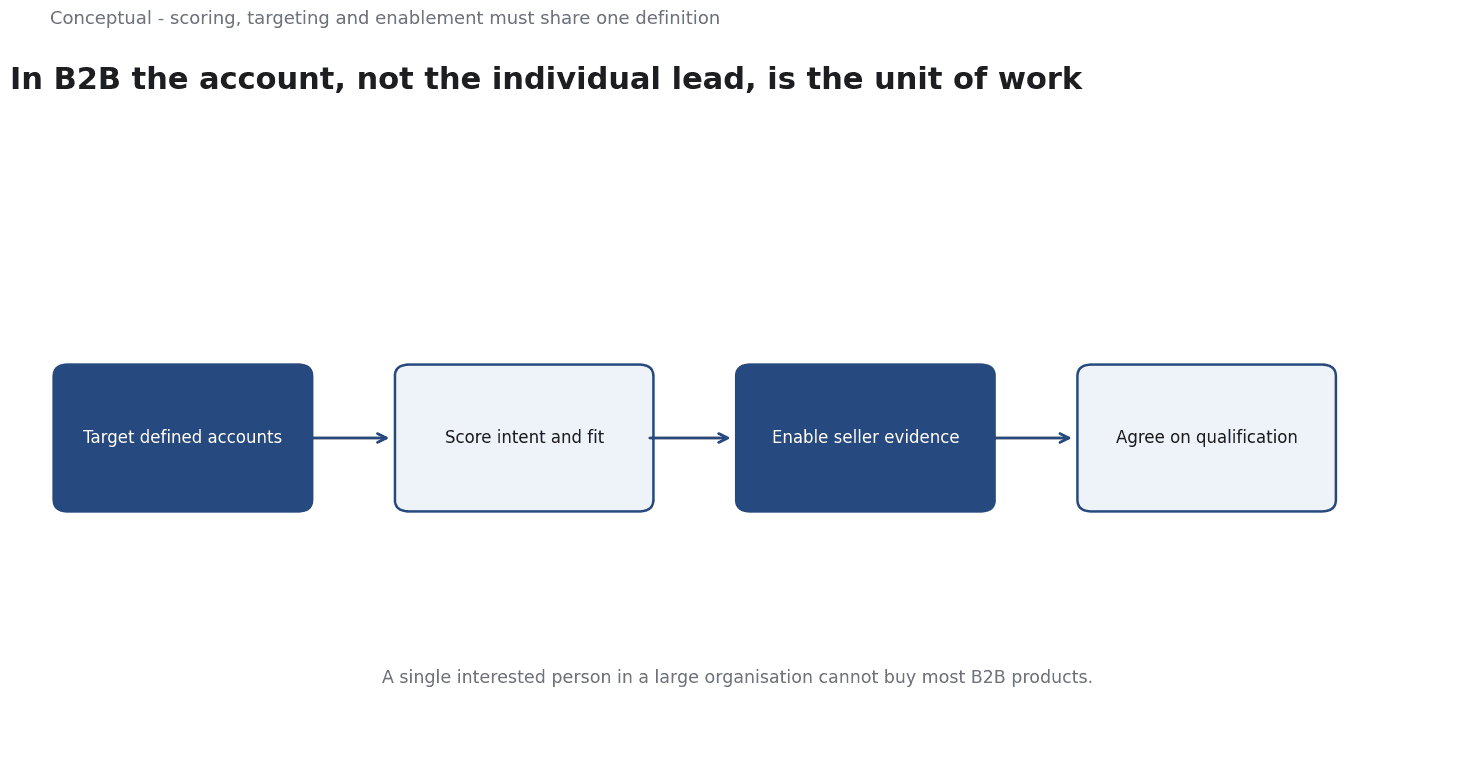
Why the account is the unit
A single interested person in a large organisation cannot buy most B2B products.
There is a budget holder, a technical evaluator, a procurement process, and often a risk or legal reviewer. An interested champion who cannot navigate those functions is a lead, not an opportunity.
This is why account-based approaches start from a list of target accounts chosen on fit — company size, sector, technology, trigger events — and coordinate activity across the buying group. The discipline is about focus: a finite list of accounts justifies research, tailored messaging, and multiple contacts, where a broad lead-generation programme does not.
The trade-off is explicit. ABM deliberately ignores most of the market, which is exactly why Porter's framing applies: "a strategic position is not sustainable unless there are trade-offs with other positions." A programme that claims to do ABM while also nurturing every inbound lead has not chosen a position and will under-invest in both.
Scoring is a model of intent, not a truth
Lead scoring assigns points to observed behaviours and attributes — a page visit, a download, a job title — and ranks the result. It is useful because a sales team cannot call everyone, and it is dangerous because the points are a model, not a measurement.
Two failure modes dominate. The first is scoring activity that is easy to observe rather than activity that predicts a purchase; a whitepaper download may indicate interest or idle curiosity, and the historic data should decide. The second is never recalibrating. A score built from last year's customers can systematically rank this year's buyers badly when the product or the market changes.
The practical fix is to treat the score as a hypothesis with an outcome: fit a model to the accounts that actually became opportunities, check its accuracy on a holdout, and rebuild it on a schedule. This is ordinary ML evaluation applied to a marketing problem, with the same need for a clean split and a business-relevant metric. If the score is not better than a simple rule, use the rule.
A useful distinction to keep in the CRM is between fit — does this account look like our customers? — and timing — is this person showing intent now? They are different questions, and a single blended score hides which one is driving the ranking.
Enablement is where most of the value leaks
Marketing can identify the right account and score the right contact, and the process still fails when the seller has nothing credible to say in the conversation. Sales enablement is the discipline of making the evidence available at that moment: the case study relevant to the prospect's sector, the answer to the security questionnaire, the comparison that addresses the competitor they are evaluating.
A repository of five hundred documents is not enablement, because the seller cannot find the right one under time pressure. What works is a small set of artefacts mapped to the specific objections that occur in live deals — which is exactly what a well-built battlecard does — and the sources behind them, so the seller can adapt rather than recite.
Win/loss analysis closes the loop. If the same objection appears in three lost deals and the enablement material does not address it, the material is the problem, and a new campaign will not fix it.
The measurement question
Attribution tells you which interaction received credit — Google Ads describes attribution models as a way to "choose how much credit each ad interaction gets for your conversions" — but it does not tell you whether the programme created the opportunity. For that, a holdout or a geo-level design is required, with the same discipline as any other experiment.
The operational metrics that actually improve the programme are simpler: the proportion of target accounts in which a buying-group conversation started, the time from first contact to a qualified opportunity, and the win rate within the target list. A large volume of leads outside the target list is a signal that the strategy is not being followed.
A sequence that works
- Define the target account list on fit and timing, and write the criteria down.
- Map the buying group — who is involved, what each person needs to believe.
- Build one score for fit and one for timing, and validate both against actual opportunities.
- Create the three or four artefacts that answer the recurring objections, not a library.
- Agree a single definition of a qualified opportunity across marketing and sales.
- Measure account coverage and conversion inside the target list, not lead volume.
- Run win/loss interviews and feed the recurring objections back into enablement.
For the sales process these inputs feed, see Sales Operations; for the intelligence that makes enablement credible, see Competitive Intelligence.
A worked example
The following is hypothetical and illustrative. A hypothetical mid-market software firm tries to focus its marketing on a target account list while still receiving inbound leads. Three checks keep the programme honest. First, do marketing and sales share one definition of a qualified opportunity? If the list is chosen on fit and timing but sales counts any inbound demo as an opportunity, the two functions are measuring different things, and the focus the account approach requires is lost. Second, are the scores validated rather than assumed? The team keeps fit and timing as separate scores, fits them to accounts that became opportunities, checks accuracy on a holdout, and rebuilds on a schedule, so a score built from last year's buyers cannot quietly misrank this year's. Third, does measurement separate credit from incrementality? Google Ads documentation describes how attribution assigns credit among interactions (Google Ads Help), but a holdout or geo design (Vaver and Koehler) is needed to ask whether the programme created the opportunity. The outcome is bounded: success is account coverage, time to qualified opportunity, and win rate inside the target list, not lead volume outside it.
A counterargument
A reasonable critic could object that the article's "the account is the unit" framing, justified by Porter's trade-offs, overcommits to a deliberately-ignore strategy that suits only a narrow slice of B2B. Porter's line about strategic positions requiring trade-offs concerns competitive positioning, not whether a mid-market company can afford to ignore inbound demand while building a target-account list; the article transfers the quote without that bridge. Google Ads' documentation is cited for what attribution models do - assign credit - while the call for a geo design draws on Vaver and Koehler's work, which assumes a measurement budget most teams lack.
The advice to validate lead scores against actual opportunities also creates a cold-start problem: an account list chosen on fit is drawn from the same historical customers used to build the score.
References & Further Reading
- Google Ads Help, 2026. About attribution models - Google Ads Help — First-party documentation of attribution models and their limits.
- Brian Vaver and Koehler, 2011. Measuring Ad Effectiveness Using Geo Experiments — Geo experiments for incrementality, the cleanest way to attribute marketing spend.