Behavioral Finance: Cognitive Biases in Investing and Spending
Market anomalies are not random noise. Read how documented biases shape decisions and why knowing them does not make you immune.
Behavioural finance is often presented as a catalogue of biases — anchoring, loss aversion, herd behaviour, overconfidence — and the catalogue is long enough to be paralysing. The useful version is much smaller: there are a few robust patterns in how people judge risk and value, they show up in identifiable ways in investing and spending, and the right response is not to try to eliminate them but to design decisions that survive them.
Direct answer: The core findings are that people evaluate outcomes relative to a reference point rather than in absolute terms, that losses loom larger than equivalent gains, and that heuristics which work in ordinary life produce systematic errors in financial decisions. Kahneman's Nobel lecture is the primary source for the judgment-and-decision research behind these claims. The practical implication is not "avoid bias" — you cannot — but "build a process that catches it", which in investing means pre-commitment, written rules, and a decision record.
The reference point is the mechanism
The single most useful idea in the field is that people evaluate changes relative to a reference point, not final states. A price you bought at becomes a reference, and a fall below it is experienced as a loss even when the asset is still worth more than alternatives. A target you set becomes a reference, and falling short of it feels worse than the same shortfall would have felt had the target never existed.
This explains a cluster of familiar behaviours. Investors hold losing positions too long because selling makes the loss real, and sell winning positions too early because the gain feels worth protecting. Spending decisions get framed relative to what others paid, what was paid last year, or what was budgeted, rather than against the value received.
The Nobel Prize in Economic Sciences was awarded to Daniel Kahneman in 2002 for work on judgment and decision-making under uncertainty, and the prize lecture is the primary source for the framing. The point for a practitioner is that the reference point is often arbitrary — it is whatever number happened to be salient — and that choosing it deliberately is more effective than trying to feel differently about the one you have.
The biases that matter most in money decisions
A few patterns carry most of the practical weight.
Loss aversion — the asymmetric response to gains and losses — explains why a portfolio is treated differently from a fresh sum of the same size, and why insurance against small losses can be attractive while obvious large risks are ignored.
Overconfidence explains why active trading, concentrated positions, and precise forecasts are more common than the evidence supports. The feeling of certainty is not evidence of accuracy, and the market is unforgiving of the difference.
Anchoring explains why the first number in a negotiation, a valuation, or a price comparison shapes the final decision even when everyone agrees it is arbitrary. This is why the order of information matters in a sales conversation and why a "was" price is so powerful.
Herd behaviour explains why assets become overpriced and why crowded trades unwind violently. It is not irrational to update on others' information; it becomes a problem when the information content is small and the imitation is large.
Mental accounting explains why the same money is treated differently depending on which "bucket" it is in — a tax refund spent freely, a bonus invested cautiously, a windfall treated differently from salary.
None of these operate only in financial markets; they operate in every decision involving money, from pricing to procurement to personal saving. The relevance to this publication's wider subjects is that a data strategy or a pricing rule is also a decision environment in which someone's bias will be applied.
What the evidence does not support
Two cautions belong alongside the catalogue.
First, a bias label is not an explanation. Saying "that decision was anchoring" describes the pattern after the fact; it does not establish what the person believed, what information they had, or whether the outcome was actually worse. The best work in the field uses controlled experiments that vary one thing at a time, and much of the popular literature does not.
Second, knowing about biases does not remove them. This is the "bias blind spot" and it is exactly what you would expect from a system that operates automatically.
The response has to be structural.
Building a process that survives your own judgment
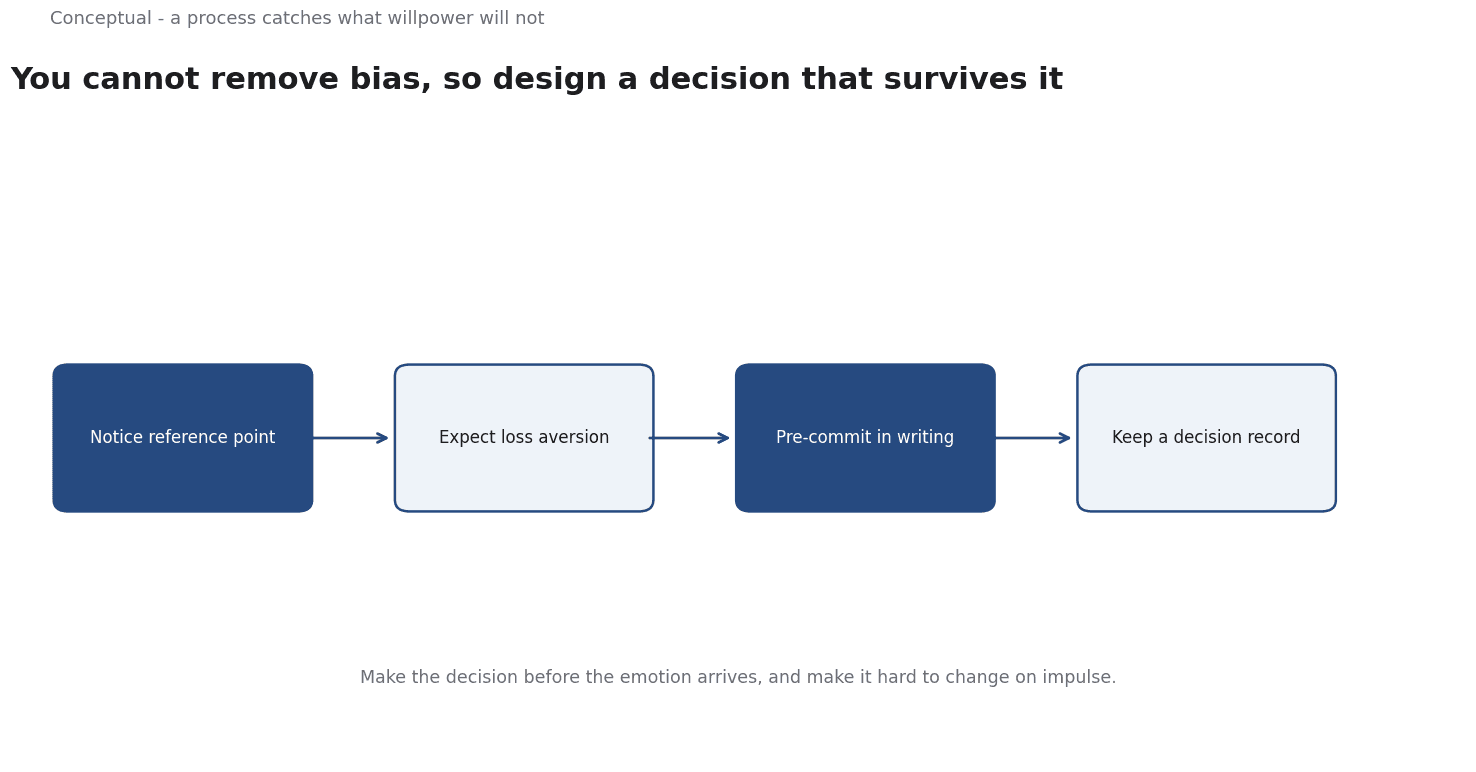
The defensible approach is to make the decision before the emotion arrives, and to make it hard to change on impulse.
- Write the investment thesis before buying, including the conditions under which it would be wrong. A thesis written after the purchase is a justification.
- Decide the rebalancing rule in advance. Rebalancing forces you to sell what has risen and buy what has fallen, which is psychologically uncomfortable and mechanically sensible.
- Separate the decision from the outcome. A good process can produce a bad result; a bad process can produce a good one. Judging the process by the outcome teaches the wrong lesson.
- Limit the number of decisions. The more often you decide, the more chances for a bias to act, and the more noise you will mistake for information.
- Delay consequential decisions. A rule that requires a night between intention and action removes the most reactive mistakes.
- Use a pre-mortem. Before committing, ask what would have to be true for this to be a mistake, and check whether those conditions already hold.
The broader implication
The reason behavioural finance belongs in a business publication is that the same mechanisms operate in pricing, in planning, in hiring, and in how organisations interpret data. An anchor in a negotiation, a sunk-cost commitment to a failing project, and a herd response to a competitor's move are the same patterns in different costumes.
The practical response at an organisational level is the same as at an individual one: write the rule before the decision, keep the record, and review the process separately from the outcome. For the research method behind survey-based claims, see Market Research; for the valuation context, see Corporate Finance Essentials.
A worked example
The following is hypothetical and illustrative. A hypothetical investor holds a position that has fallen 20 percent from its purchase price and feels the urge to buy more to lower the average cost. Three structural checks replace an argument with willpower. First, is the reference point chosen deliberately? The purchase price is an arbitrary number that became salient; Kahneman's lecture describes how outcomes are judged relative to a reference point rather than a final state, so the investor restates the decision against the asset's current prospects instead. Second, was the decision made before the emotion arrived? A written thesis records the conditions under which the position would be wrong, and a pre-mortem asks what would have to be true for adding to be a mistake; if those conditions already hold, no trade is placed. Third, is the outcome separated from the process? The decision is judged by whether the written rule was followed, not by the next quarter's return. The outcome is bounded: with the rebalancing rule fixed in advance and a night between intention and action, the reactive trade is deferred, and the record shows why.
A counterargument
A fair critic could push back that the "design a process that survives your own judgment" prescription is itself an article of faith drawn from one primary source - Kahneman's Nobel lecture - which reports laboratory findings on judgment under uncertainty, not evidence that written rules and pre-mortems improve invested outcomes. The article rightly says a bias label is not an explanation and that much popular literature lacks controlled experiments, yet the stepwise process it recommends is offered without that same standard. Damodaran's datasets and CORE's textbook are listed as further reading but do not support the claim that structural rules beat judgment in live markets.
There is also a tension between "separate the decision from the outcome" and judging whether the process worked: without outcome data, the process can never be validated.
References & Further Reading
- Daniel Kahneman, 2002. Daniel Kahneman Prize Lecture - NobelPrize.org — The primary source for the bias taxonomy used in behavioural finance.
- Aswath Damodaran, 2026. Damodaran Online: Home Page for Aswath Damodaran — Publicly maintained datasets for industry averages, WACC, and valuation.
- Econlib, 2026. Core Econ: The Economy — A complete free economics textbook covering supply, demand, and elasticity.