Competitive Intelligence: Win/Loss Analysis, Battlecards, and Tracking
Competitive intelligence is a decision process, not a collection of decks. Read what to gather, what to ignore, and how to test it.
Competitive intelligence is one of those functions whose name promises more rigour than its practice usually delivers. The output is typically a slide deck full of feature comparisons, pricing tables, and press coverage — a description of competitors that nobody uses to make a decision. The useful version is much smaller and much more specific: it is the evidence a seller needs to win a particular deal, and the evidence a leadership team needs to decide whether a position still holds.
Direct answer: Competitive intelligence has two distinct jobs — helping a seller in a live opportunity, and informing a strategic choice about where to compete — and the artefacts for them are different. A battlecard supports the first; a win/loss analysis supports the second. Both fail in the same way when they record what competitors say rather than what customers did, and when nobody owns the decision the intelligence is supposed to change.
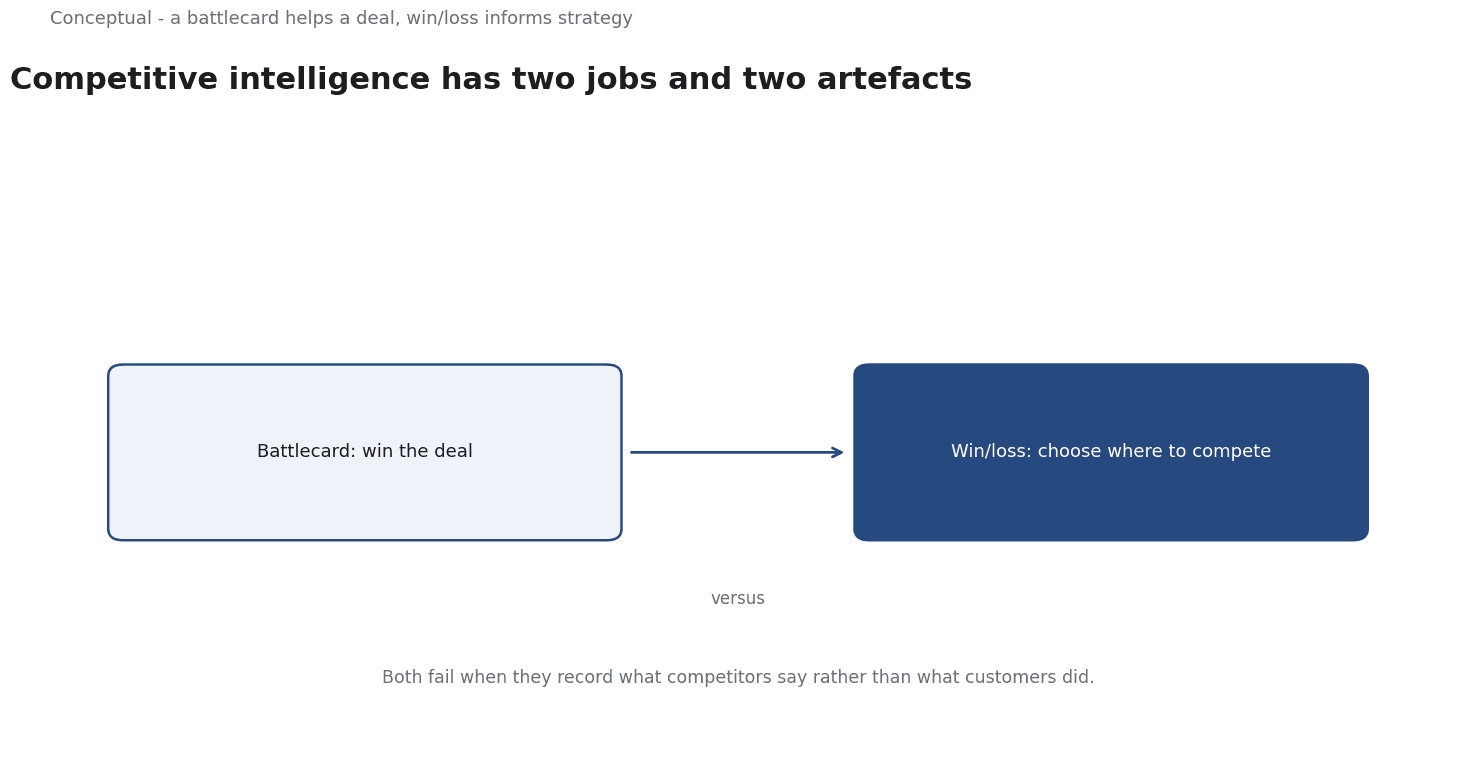
Two jobs, two artefacts
Battlecards are decision aids for a specific selling moment. Their job is to help a rep answer "why us rather than them, for this buyer, in this situation?" A good battlecard is short, names the situations in which the competitor genuinely wins, and states what to do in each — including when to walk away.
The test of a battlecard is whether it survives contact with a real objection. If it does not tell the rep what to say when the buyer says "their implementation is faster and cheaper", it is not a decision aid, it is a brochure.
Win/loss analysis is a strategic instrument. It asks why deals were won or lost, and the evidence comes from the parties who decided — including the ones who chose a competitor or chose to do nothing. The "no decision" category is usually the largest and the least examined, because no competitor exists to blame.
The two artefacts are often confused, and mixing them causes a specific failure: strategic discussions get flooded with anecdotes from individual deals, while sellers get strategic positioning instead of help with the objection in front of them.
Why most competitive decks are not intelligence
Porter's argument in "What Is Strategy?" is useful as a filter. A position is defensible because of trade-offs — "a strategic position is not sustainable unless there are trade-offs with other positions" — and trade-offs mean that a competitor's strength in one area is usually a weakness in another. A competitive deck that lists strengths and weaknesses without describing the configuration behind them misses the point: a competitor's apparent weakness may be the cost of the position that makes them strong where they win.
This is why feature-by-feature comparisons are so often misleading. A product built for high-volume self-serve will have fewer enterprise features, and that is not a gap to be closed; it is the other side of a cost structure. Treating it as a gap leads to a roadmap that dilutes your own position and imitates theirs badly.
The other reason decks fail is a source problem. Most of what circulates as competitive information is self-reported by the competitor — marketing copy, press releases, conference talks. It is a statement about what they want buyers to believe, which is useful information but not the same as what buyers believe or what the product does. Porter's distinction between what a company says and what its activities are is the right filter: value the job posting, the pricing page, the partner list, and the customer case study more than the vision deck.
A repeatable method
- Start with the decision. Who will use this, and what will they do differently? A battlecard without a seller and an owner is a document, not an instrument.
- Interview the decision-maker, not only your own sales team. Internal accounts of losses are systematically flattering. Ask the buyer what alternatives they considered, what they chose, and what would have changed the answer.
- Include the "no decision" cases. They are often the majority, and they reveal whether the problem was the product, the price, the timing, or the fact that nobody owned the decision on the customer side.
- Record the trigger situation, not just the feature. The situation in which a competitor wins is a strategic fact; the feature they were praised for is usually a symptom.
- Write the battlecard for the objection, including the case where you should not compete. "They genuinely win here" is the most valuable line in the document.
- Review on a fixed cadence, and remove what has not changed. A deck that only grows becomes noise.
What to track, and what not to
Track the things that constrain a decision: pricing changes, packaging changes, channel moves, hiring in roles that indicate a new segment, partnership announcements, and the terms customers actually report. Track wins and losses against a fixed set of reasons so the categories stay comparable across quarters.
Ignore most of the feed. Product launches, executive quotes, and analyst commentary are useful context but rarely change what a rep says in a live opportunity or what a leadership team decides about position.
A monitoring system that reports everything is indistinguishable from no system.
A caution about method
A customer research process has standards. The American Association for Public Opinion Research publishes standards and ethics for survey work, and the principle transfers: be clear about who was asked, how they were selected, what the question was, and what the sample can support. A win/loss programme based on four conversations with friendly customers is not a finding; it is an anecdote with a spreadsheet.
The practical minimum is a consistent set of questions, a record of who answered, and a note about which cases could not be reached. That is enough to make the difference between an instrumental and a plausible story.
For the strategic frame this intelligence feeds, see How Companies Build Competitive Advantages and Brand Positioning.
A worked example
The following is hypothetical and illustrative. A sales team keeps losing deals to a rival it describes as faster and cheaper, and proposes a longer feature matrix for the battlecard. Three checks come from the method. First, start with the decision: a seller and an owner are named for the artefact, so it is a decision aid rather than a document, since a battlecard with no owner is not an instrument. Second, interview the decision-makers, including losses and the no-decision cases, using the consistent questions and recorded sample that survey standards such as the American Association for Public Opinion Research's require; internal accounts of losses flatter the home team. Third, record the trigger situation rather than the feature, and read the rival's apparent weaknesses through Porter's trade-offs, since a weakness may be the cost of the position that makes them strong where they win. The bounded outcome is a short battlecard that names when the rival genuinely wins and when to walk away, plus a fixed review cadence; the feature matrix is dropped rather than expanded.
A counterargument
A reasonable critic would defend the artefacts this article dismisses. Its own methodological caution - that a win/loss programme built on a handful of friendly conversations is "an anecdote with a spreadsheet" - applies with equal force to the interviews it recommends: losses are self-selected and the buyers who answer are not representative. By contrast, the competitor material it treats as secondary - the pricing page, job postings, partner lists, the sell-in versus sell-out distinction for which NRF data is cited - is systematic, comparable across quarters, and available without a buyer's willingness to be interviewed. Porter's trade-offs argument also cuts both ways: if a rival's weakness is the cost of its position, a feature comparison may be the evidence that reveals the configuration rather than a misleading distraction.
References & Further Reading
- Michael E. Porter, 1996. What Is Strategy? — The differentiation-versus-cost argument behind competitive-advantage analysis.
- National Retail Federation, 2026. NRF Press Releases | Latest Statements & Announcements | NRF — Primary retail-sales and channel data for sell-in versus sell-out definitions.
- Colin Bryar and Bill Carr, 2019. Amazon Company News — Primary company material on how the working-backwards method is applied.